.png)
 1 hour ago
17
1 hour ago
17

 BBC
BBC
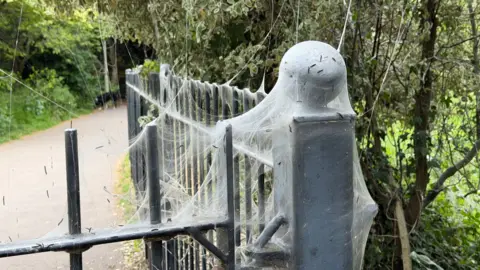
Butterfly Conservation says this is most likely caused by Ermine moth caterpillars
Thick white caterpillar webs have been spotted covering fences and trees in a city park.
The local authority advised people not to be concerned about the "harmless" white webbing seen in trees in Belle Isle Park, Exeter, caused by an infestation of caterpillars.
Butterfly Conservation said was most likely caused by ermine moth caterpillars, which feed inside the webs and "are the definition of a hungry caterpillar".
"They can sometimes completely strip the bush or tree of its leaves but it's nothing to worry about," a spokesperson added. "While it can look alarming, the plant usually suffers no permanent damage. The webs are there to protect the caterpillars from predators."
The spokesperson explained that while it was not unusual to see this sort of thing at this time of year, it was quite unusual to see the webs over metal gates.
Exeter City Council said: "The webbing and the caterpillars are harmless and pose no risk to the public.
"Whilst visually striking, most healthy trees typically recover from the infestation and the caterpillars are controlled naturally, many eaten by predators such as birds."
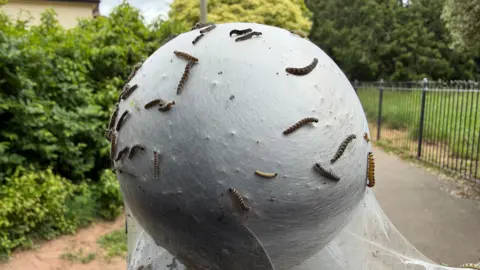
Butterfly Conservation says it is unusual to see the webs over metal gates
Ellie Knot, of Devon Biodiversity Records Centre, said there were eight species of ermine moth, so it was hard to tell if these were spindle ermine.
She said orchard ermine and bird-cherry ermine caterpillars also made webs.
"It's quite common to see them at this time of year. They're harmless, though the webs can get quite extensive and even cover nearby objects such as fences or benches."
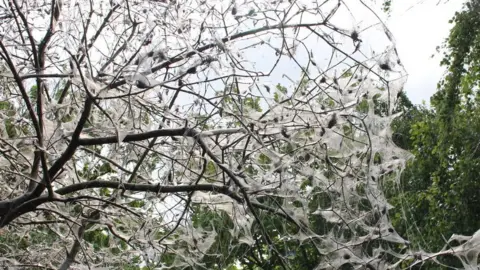
She added: "These caterpillars create webs as a defence strategy, they live in large groups, so they have safety in numbers.
"But large numbers are hard to hide, which is why they produce the silken webbing."
 Derek Duff
Devon Biodiversity Records Centre says the webs are created as a defence strategy







 English (US) ·