.png)
 2 hours ago
20
2 hours ago
20
Four decades ago, a film arrived in Telugu cinema that broke away from commercial tropes, no larger-than-life hero, no action set pieces, and no formulaic romance. What it had instead was a grown man played by Kamal Haasan with the mind of a child, a widow carrying the weight of societal judgment, and a story so quietly constructed that audiences almost did not know what had hit them.
Swathi Muthyam, which translates to “white pearl,” is a 1986 Telugu romantic drama written and directed by K. Viswanath and produced by Edida Nageswara Rao. It starred Kamal Haasan and Radikaa Sarathkumar in lead roles. Forty years later, it remains one of the more honest films Indian cinema has produced.
A simple premise, a complicated world
Swathi Muthyam follows Sivayya (Kamal Haasan), a man with a cognitive disability who has never shed the innocence of childhood. Sivayya encounters a young widow named Lalitha, played by Radhika, during a village festival and decides to marry her because it simply seems like the right thing to do. Lalitha already has a five-year-old son. The village is not pleased.
What follows is not a conventional love story. It is a study of how two deeply vulnerable people try to build a life together in a society that has no place for either of them. Sivayya’s moral compass is guided entirely by the instructions of his grandmother, and it is this uncomplicated goodness, not intelligence or ambition, that becomes the film’s entire argument. If you live without guile and work without wanting anything in return, the world will, eventually, make room for you.
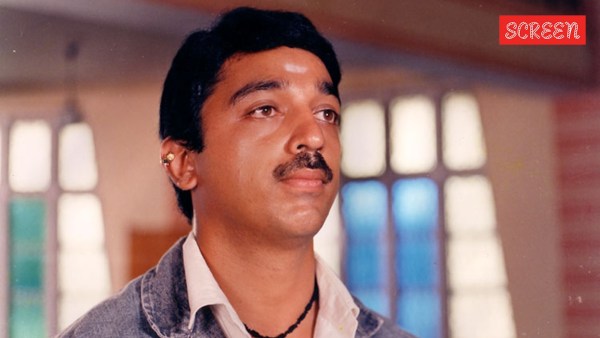 A still of Kamal Haasan in Swathi Muthyam.
That argument connected. Swathi Muthyam completed 100 days in over 25 centres.
The budget was Rs 45 lakhs, with Kamal Haasan’s remuneration accounting for roughly one-fifth of that figure. During production, director Viswanath proposed two changes: that Sivayya be written as more mature by the climax, and that Lalitha survive to the end. However, producer Edida Nageswara Rao declined both. He believed the story’s emotional weight depended on neither change being made. The ending, in which Sivayya outlives Lalitha and continues on, still pure and unaffected, surrounded by the family that grew from their union, became one of the most remembered conclusions in Telugu cinema.
The title was also debated. Kamal Haasan wanted the film to be called Sivayya, after the protagonist. Viswanath pushed for Swathi Mutyam, the image of the oyster and its pearl, which he felt captured the character’s essence more completely than a name could.
Story continues below this ad
Kamal Haasan’s performance
Very little that has been written about this role over the past four decades reads like exaggeration today. Kamal Haasan did not rely on studied mannerisms. He recalibrated the way he carried himself physically, the way he responded to situations, and the way he communicated feeling without any of the conventional tools actors usually reach for. The performance earned Kamal Hasaan his second Nandi Award for Best Actor and the Asia-Pacific Film Festival Award for Best Actor.
Also Read: Not a co-star, not a director: Vijay’s strictest critic was always his wife Sangeetha
In later interviews, Kamal addressed comparisons between Sivayya and the title character of the 1994 Hollywood film Forrest Gump. He noted that given the eight-year gap and the uniqueness of the story, the influence may have run in the other direction. The claim is disputed, but the timeline is not: Sivayya came first.
Ilaiyaraaja’s score and India’s Oscar entry
The soundtrack, composed by Ilaiyaraaja, drew from Carnatic ragas and Telugu folk rhythms while incorporating restrained Western string arrangements. It stayed well clear of the era’s commercial sound. The lullaby “Laali Laali” became the piece most associated with the film. Ilaiyaraaja has spoken publicly about breaking down while composing the background score for the climactic scene in which Sivayya sits beside a dying Radhika.
Story continues below this ad
Swathi Muthyam was selected as India’s official entry for the Academy Award for Best Foreign Language Film at the 59th Academy Awards, making it the first Telugu-language film to receive this distinction and only the second South Indian film to be selected after Nenjil Or Aalayam in 1965. It won the National Film Award for Best Feature Film in Telugu, three Nandi Awards, and the Filmfare Award for Best Director (Telugu). The film was screened at the Moscow Film Festival and the Asian and African Film Festival in Tashkent.
The film was dubbed into Tamil as Sippikul Muthu and remade in Hindi as Eeshwar in 1989. It now streams on digital platforms, where it continues to find viewers who were not born when it first released.



 English (US) ·