.png)
.png) 2 hours ago
19
2 hours ago
19
The first thing you notice about Blessing Muzarabani, 29, is the height. Six foot eight. The second thing, if you’re paying attention, is what Tatenda Taibu saw when he first met the kid at Takashinga Cricket Club in Harare’s Highfield suburb: hunger.
Not the physical kind, though that was there too. The kid was malnourished, like so many from the poorest neighborhoods in Harare. His hunger though was the kind food can’t satisfy. The kind that got satiated on Saturday in Sri Lanka when the 29-year old seamer hassled the Australians with his skiddy pace and bounce to grab a four-for. The short ball into the ribcage took out Josh Inglis and Tim David with the new ball. And he returned at the end to slip in a lovely slower ball to knock down Australia’s highest scorer Matt Renshaw, before taking out the leg stump of Adam Zampa. Game over.
He was seven years old when he bowled his first ball. Tagged along with his cousin Taurai to Takashinga. Something clicked. He didn’t have cricket shoes that day. Didn’t have them cleats the next day either. Or the day after that. What’s it like to show up at Harare Sports Club—concrete hot under your bare feet—and watch the other boys arrive with their parents dropping them off in cars?
“It was really tough because sometimes you mingle with the rich kids and poor kids together,” Muzarabani once told the Cricket Monthly. “As a kid, that affects you a huge deal. You see the kind of shoes they wear, and you want them too, but there’s no way I could afford them.” He could have walked away, but he didn’t. ”I didn’t care about whether I had shoes, or whether I had a bat. I just focused on going out there and bowling and doing what I loved.
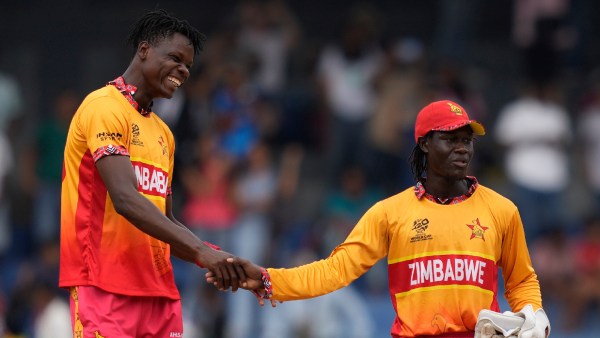 Zimbabwe’s players celebrates after won the T20 World Cup cricket match against Australia in Colombo, Sri Lanka, Friday, Feb. 13, 2026. (AP Photo/Eranga Jayawardena)
Love. Not privilege. Not opportunity. Just love for a game. For Muzarabani, it had to be enough. Taibu, the diminutive former Zimbabwe wicketkeeper who was convener of selectors, almost dismissed him at first. Too quiet. Too shy, maybe. But for a month, Taibu watched.
“Whatever he has gone through in life, he doesn’t want to experience that again,” Taibu once told Cricbuzz. That hunger—there’s that word again—to change his life situation.
By 15, he had shot up. Six foot eight out of nowhere. With the height came genuine, frightening pace. The gangly kid from Highfield—the suburb that had already given Zimbabwe Wellington Masakadza, Taibu, Elton Chigumbura.
Story continues below this ad
Then came March 2018. The ODI World Cup Qualifiers. Free entry flooded the grounds in Harare. Green, gold, black, and white everywhere. For two weeks, the nation allowed itself to dream. Muzarabani was magnificent. Four wickets against Afghanistan. The final wicket in a tie against Scotland. Zimbabwe just needed to beat UAE but they fell three runs short that meant the difference between a world cup and going home. “The World Cup qualifiers changed people’s lives,” Muzarabani had said then. “We wanted to, really, but sometimes you don’t get over the line.”
He would cross the line soon, but in an unexpected manner. Zimbabwe Cricket’s finances were in tatters. Salaries unpaid. In August 2018, Muzarabani signed a Kolpak deal with Northamptonshire. The backlash came swift. How could he leave? But what’s loyalty when you grew up without shoes?
“The fact that I’m from a financial background that is maybe not typical of many in Zimbabwe gives me a lot of perspective,” he explained to Cricket Monthly. “I knew if I didn’t do well, I was throwing away a chance at an opportunity that was really helping me in my life.” And so he chose the safety of the Kolpak. Cricket had been his escape from poverty. His wasn’t betrayal, but survival.
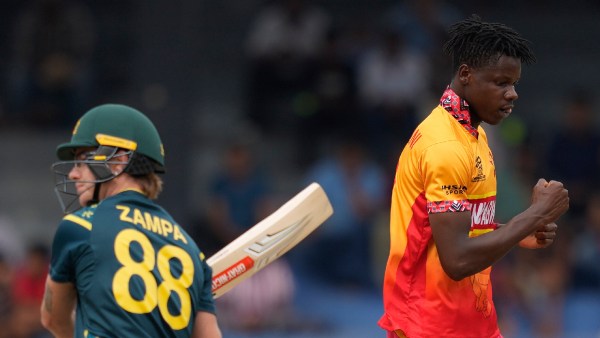 Zimbabwe’s Blessing Muzarabani, right, celebrates the wicket of Australia’s Adam Zampa, left, during the T20 World Cup cricket match between Australia and Zimbabwe in Colombo, Sri Lanka, Friday, Feb. 13, 2026. (AP Photo/Eranga Jayawardena)
England was grim at first. A back injury wiped out most of his first season. But at Northampton, West Indian player Jason Holder arrived. Holder saw a kid desperate to improve. They talked. Went for food. Holder taught him about being tall—the advantages, the curses, the physics of extracting pace from that frame.
Story continues below this ad
When Brexit ended Kolpak contracts in 2020, Muzarabani came home. Different now. Sharper. He had learnt the art of bowling. “Playing in England really helped me use my variations,” he told in the interview. “You pick up the moments where you need to throw in a yorker or a slower ball. If it works, it works, and if it doesn’t, too bad. It’s just a mentality.” Just a mentality. Maybe when you’ve learned to bowl without shoes, the pressure of bowling against Australia in a World Cup doesn’t register the same way.
On a humid afternoon in Sri Lanka, that hunger rose again — pounding in from six-foot-eight, skidding, lifting, refusing to be ignored. Australia’s batting order learned what Taibu had seen all those years ago at Takashinga.


 English (US) ·