.png)
 2 hours ago
27
2 hours ago
27
There seems to be a dearth of love stories in cinema and television all over the world so whenever there is a new show or film that promises to satiate that thirst of the viewers, they start queuing up from the get-go. The recently concluded season of Bridgerton – which seems to be a polite nod to the story of Cinderella – was one of the most beautiful love stories that the show has presented so far, only to prove that the most acceptable conflict in love stories for today’s audience, isn’t existential, but the one that is dictated by the society. In India, we know this as the age old ‘log kya kahenge’ (people will say something or the other) syndrome but that’s not to say that the rest of the world doesn’t have various versions of this.
This season of Bridgerton focused on the story of Benedict and showed him falling in love with Sophie, who works as a maid. In the world of this show, this isn’t just a profession, but defines her social standing, making this a conflict between classes. It takes a few episodes for Benedict to get over that hump, and eventually, his mother Violet too gives her approval. While the story is set in 19th century, it is being watched in 2026, so it would be foolish of the makers to not examine the social rules of the time, and criticise them; but whilst watching all of this, it is simply impossible to not think how much of our society is still jailed by rules of similar nature.
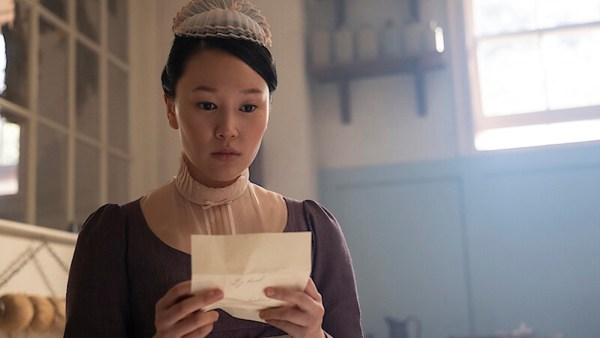 Sophie Baek is put in a precarious position by Benedict when he asks her to be his ‘mistress’.
Are 19th century Britain and 21st century India the same?
Indian society, like a few others in the world, follows some strict rules, and those who don’t follow those rules are always made to stand in a corner and answer for their ‘crimes’, so to speak. In a recent interview with Jay Shetty, Priyanka Chopra was, once again, asked about how the world perceives her relationship with her husband Nick Jonas (the couple has been married for 7 years). She just responded by quoting a popular song, “Kuch toh log kahenge (People are going to say something).” When Anand Bakshi wrote these lines in 1972, he must have known that this inherent nature of society, where it examines your actions and passes judgement, wouldn’t change for decades. And this makes you wonder – are 19th century Britain and 21st century India the same worlds?
Benedict, for a large part of the season, does not question the society’s rules and assumes that he ‘can’t marry a maid’. This, coming from a Bridgerton who has no regard for society otherwise, shows the deep seeded classism of his character, where he finds infidelity and polyamory acceptable, but being with someone he actually loves is forbidden. Benedict behaves like doesn’t care for society, but the thought that he would be boycotted, is a little more than he can accept.
Until Sophie points it out to Benedict that his proposal to make her his ‘mistress’ is deeply offensive, he can’t even figure out the error of his ways. Even Sophie’s friends can’t seem to understand why she wouldn’t agree to such an ‘arrangement’. Violet, his mother, keeps looking for a ‘noble connection’ so she can accept Sophie socially. It is only after a tragedy in the family that they re-examine their priorities and realise that they can’t function within the given boundaries. But, despite all of this realisation, they put up a silly skit in front of the Queen just so they are not ostracised by the same society that just put Francesca through one of the most gruelling moments of her life. There is a hint of rebellion, but no revolt.
Bridgerton sticks to its lane
Much like in the world of Bridgerton, unions, in a large part of India, are still arranged by parents on the basis of the families’ economic standing, caste and factors that instantly make it sound like a business proposition. In Greta Gerwig’s Little Women, Florence Pugh’s Amy, living in the 19th century, put it succinctly, “Marriage is an economic proposition,” and for most marriage alliances in India, it continues to hold true. When Celine Song made Dakota Johnson’s Lucy say the same thing, albeit in different words, in last year’s Materialists, it reflected on the fact that the traditional idea of marriage and partnerships continues to hold true for many.
Story continues below this ad
In India, much like Bridgerton, one’s surname makes them gain/lose points in the ‘marriage mart’. Most women don’t have enough power to make unilateral decisions, and are often found looking at their father or brother or husband for approval. And be it a man or a woman, in the end, they always need the approval of the ‘elders’ to be together.
Bridgerton has had four successful seasons so far and in all of them, one cannot help but think that more than a love story, this show is about falling in love only when it is convenient for everyone. This time around, however, the show went into unknown territory and though it didn’t march with pitchforks against the class system, even though it had the opportunity to do so, it did what it does best – present a fantastical love story that makes its audience swoon.








 English (US) ·