.png)
Just now
Anbarasan Ethirajan,Global Affairs Correspondentand Kelly Ng

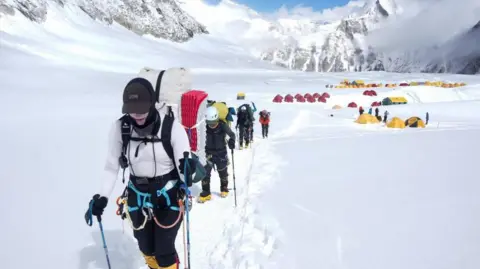 Reuters
The climbing window for Mount Everest has narrowed this year because of a glacial blockage
An elite team of Nepali climbers have managed to clear a way to the summit of Mount Everest, as experts warn of overcrowding this climbing season.
Hundreds of mountaineers and their guides have been stranded for the past few weeks at the Everest Base Camp in Nepal after a huge chunk of ice blocked their only viable route.
The Nepali climbers managed to fix ropes and ladders as they found a way past the obstacle on Wednesday morning. Other climbers can now start climbing up using these ropes.
But some experts are worried about "traffic jams" and safety at the world's highest peak, especially in a year when a record number of permits have been issued to Everest aspirants.
Almost 500 foreign climbers have been granted permits to scale the 8,849m (29,032ft) peak this year. Most attempt the ascent with at least one Nepali guide, who do not require permits.
This means that some 1,000 climbers will be climbing toward the summit in the next two weeks or so.
Climbers who were acclimatising on the mountain had earlier raised safety concerns as a result of the delay in the route's opening.
"Lots of climbers [are] having to make their attempts in a short period of time," prominent climber Purnima Shrestha, who is attempting to summit Everest for the sixth time, told the BBC late last month.
"Delays in the opening of the route have added concerns of possible 'traffic jams' to the peak this year," she said.
Peak climbing season on Everest usually runs from late April until the end of May.
But this year, climbers were hindered by a huge, unstable chunk of dangerous ice, known as a serac, which had been blocking the route from Everest Base Camp up to the peak.
"If the [next] window is limited, the traffic will be intense... Many of [the climbers] could get into trouble," Mingma G Sherpa, who is on the mountain, told ExplorersWeb, a digital publication on mountaineering.
A team of elite mountain guides managed to clear a route past the serac to go up to camps high in the mountain, but their attempt to fix ropes from Camp Four to the summit was again disrupted by bad weather earlier this week.
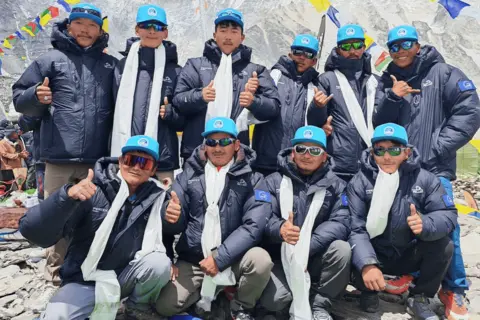 Expedition Operators Association of Nepal
An elite team of Nepali climbers managed to fix ropes and ladders up the world's highest peak on Wednesday
Mountaineers usually climb back and forth between four main camps above Base Camp as part of the acclimatisation process, but they had to complete fewer of these treks this year because the ropes could not be fixed earlier.
China also has closed the northern route up Everest, on the Tibetan side, to foreign climbers this season, which is likely to lead to an increase in the crowd taking the southern route.
With the push to the summit well underway, authorities and expedition operators have told the BBC they will space out the ascents to manage overcrowding.
"We are coordinating with various expedition teams to avoid more climbers trying to scale the summit at the same time," said Rishi Ram Bhandari, Secretary-General of the Expedition Operators Association of Nepal.
Khim Lal Gautam, a tourism department official at Base Camp, said his department has deployed a team of five officials to "coordinate with various commercial expedition teams to make a plan" to avoid queues near the summit.
He estimates that there are nearly 2,000 people at the Everest Base Camp right now, including climbers who are heading for other mountains in the region.
Three people have died on the mountain over the last two weeks while preparing for the climbing season.
The casualties include Bijay Ghimere, the first mountaineer from Nepal's underprivileged Hindu Dalit community to scale Mount Everest. The 35-year-old had suffered from altitude sickness, reports say.
Phura Gyaljen Sherpa, 21, died after slipping on the snow and fell into a crevasse near Camp 3 on Monday, while another guide, 51-year-old Lakpa Dendi Sherpa died on his way to Base Camp on 3 May.
Tourism to the world's tallest mountain has continued to surge despite a mark-up in permit fees.
Since September, climbers have had to pay $15,000 (£12,180) for a permit, up from the longstanding fee of $11,000, in the first fee increase in nearly a decade.








 English (US) ·