.png)
Yolande KnellMiddle East correspondent, Jerusalem

 BBC
BBC
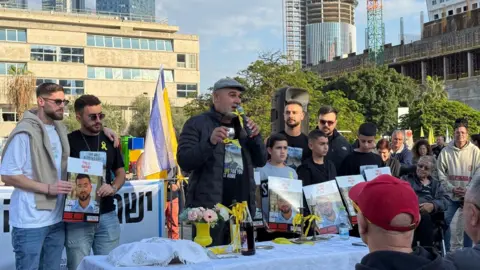
Itzik Gvili demands the return of his son Ran, the last dead hostage in Gaza, in Tel Aviv's Hostages Square
In central Tel Aviv, the main stage has now been dismantled in Hostages Square, the focal point for the campaign over the past two years to bring back Israelis held in Gaza.
Nearby, signs and posters have been taken down, and the Hostages and Missing Families Forum has vacated the offices that served as its nerve centre. Of the 251 hostages seized by Hamas and other Palestinian armed groups in the 7 October 2023 attacks, 168 have been brought back alive from Gaza, eight have been rescued. Only one deceased hostage, Ran Gvili, remains.
With songs and prayers instead of mass rallies, the Gvili family and a small crowd of supporters assemble in Hostages Square each Friday to mark the start of the Jewish Sabbath; this week, a candle for the Hanukkah holiday was also lit.
They are determined to bring back the young police officer who was killed by Hamas fighters after he rushed to help people being attacked in Kibbutz Alumim in southern Israel in October 2023.
"I feel every day is still the 7 October. We didn't pass the 7 October, but we are strong, and we're waiting for him. We do whatever we need," says Itzik Gvili, Ran's father. "This gives us hope: the support of the people."
 Reuters
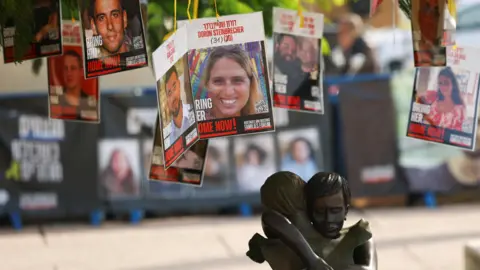
The Hostages and Missing Families Forum's slogan is: "Bring them home now"
From the start, people power has been key to the hostage families. As its operations wind down, members of the Hostages Families Forum have been reflecting on its extraordinary evolution which turned the grassroots group into a powerful international lobbying force.
In the terrible aftermath of the 2023 Hamas-led assault on southern Israel, which also killed some 1,200 people, a huge group of distraught relatives gathered for the first time in Tel Aviv desperately seeking answers about their missing loved ones. Because of the incoming rocket fire from Gaza, they met in an underground car park.
"We were together, shocked, and it fell on me that this is actually real, that now we are going to face this unbelievable challenge of understanding where all these people are, getting them home," recalls Gil Dickmann, whose cousin Carmel Gat had been snatched from Kibbutz Be'eri.
"And the second thing is that we're going to do this together. I'm not going to stand alone."
 Reuters
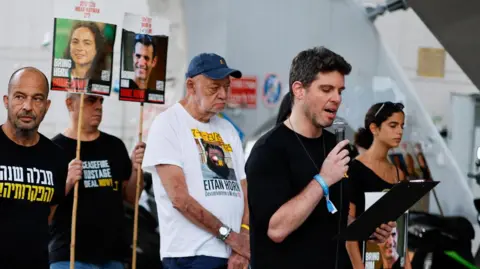
Gil Dickmann (2nd R) said the public support gave him hope after kidnapping of his cousin, Carmel Gat
The formation of the new forum, with its slogan: "Bring them home now", gave the hostages' families a much-needed sense of regaining control.
"It was very, very powerful to feel that when the government and Israeli state, in a way collapsed in those very first few days after 7 October, it felt like nothing was working, what was working was Israeli society," Mr Dickmann says. "So many wonderful people came to help. That brought me a lot of hope."
Dividing its efforts between supporting the families - many of whom were bereaved and displaced from their homes following the attacks - and campaigning in Israel and around the world, the Hostages Families Forum worked with more than 10,000 volunteers. They included former Israeli diplomats, lawyers and security officials.
Funded entirely by donations, it began to pay some staff, and a high-tech company loaned its central Tel Aviv office space.
 Reuters
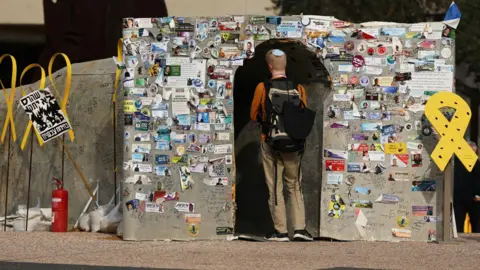
A makeshift tunnel symbolizing Hamas's tunnel network in Gaza was constructed at Hostages Square
In November 2023 - more than six weeks into the brutal war in Gaza, which had by then killed more than 14,000 Palestinians according to the Hamas-run health ministry - Israel and Hamas agreed to a Qatar-mediated truce.
This saw most women and children hostages returned in exchange for Israel releasing more than 240 Palestinian prisoners, all women and children. Hamas also freed some foreign nationals.
But after a week, the fighting resumed with ferocity. About half of the hostages were left in Gaza. In December, three Israeli hostages were killed by Israeli soldiers in Gaza despite the fact they were shirtless, waving a makeshift white flag, and calling out in Hebrew.
 Israeli Prime Minister's Office/handout via Reuters
Itay Regev and his sister Maya were released during the November 2023 ceasefire
Those were difficult days for the Hostages Families Forum and in early 2024, with polls suggesting more Israelis prioritised eliminating Hamas over the return of those still held captive, it brought in political strategist, Lior Chorev, as campaign manager.
"We were in deep war in Gaza, deep war in Lebanon, there was the Iranian threat, and it appeared that everything was stuck, and public opinion was against us," Mr Chorev explains.
"As a civil society organisation, we could not impact whether or not there's going to be a deal, but we could work hard on the Israeli public opinion to ensure that if a deal came into place, it would have a sound civilian majority within the country."
 Reuters
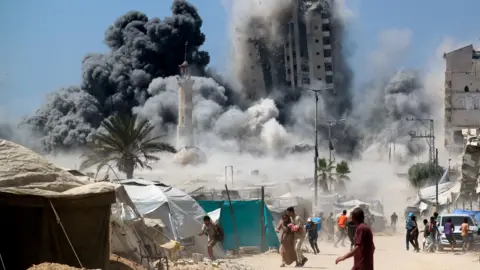
Gaza has been devastated by the two-year war sparked by 7 October 2023 Hamas-led attacks on Israel
As well as Saturday evening demonstrations in the plaza in front of the Tel Aviv Museum of Art, now renamed Hostages Square, there were near-daily actions by the Hostages Families Forum ranging from concerts and art installations to civil disruption. Media and diplomatic teams helped keep the hostages at the centre of attention.
"They kept going 24/7 for two years," comments Times of Israel political correspondent Tal Schneider who, like visiting foreign officials, often went to the forum's HQ.
"This place became like a foreign ministry for the country, for the families of 250 people."
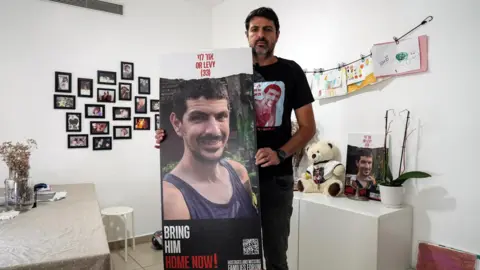
Looking back, Michael Levy says his intensive campaigning helped him deal with the "emotional rollercoaster" after his sister-in-law, Einav, was killed at the Nova Festival and his younger brother, Or, was taken hostage alive.
"The only thing that helped me was becoming active. I was interviewed all the time. I went with 15 different delegations to over 12 countries. I spoke to whoever was willing to listen and didn't want to stop and think," Mr Levy says.
"You need to stay optimistic all the time. You need to tell yourself every morning that today is going to be the day that he's going to be released, even though you know you are lying to yourself."
 Reuters
Michael Levy's brother, Or, was released during the ceasefire that lasted from January to March 2025
Although a hostage-prisoner exchange deal to end the war laid out in mid-2024 was described by then-US President Joe Biden as an Israeli proposal, Israel's Prime Minister Benjamin Netanyahu was widely seen as dragging out hostilities to aid his own political survival – a claim he rejected.
Tensions rose between the Hostages Families Forum and Israel's government; there was open animosity from some government supporters.
The situation worsened after a Netanyahu aide was accused of deliberately acquiring and illegally leaking a top-secret document to a German newspaper to influence how Israel's public viewed negotiations on a ceasefire and hostage deal.
The document was misleadingly cast as suggesting that pressure on the prime minister played into the hands of Hamas.
 Reuters
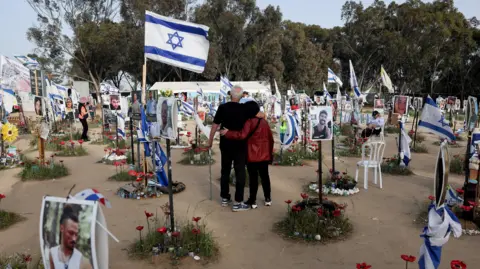
Hundreds of people were killed or taken hostage at the Nova music festival during the 7 October 2023 attacks
For Mr Dickmann and Mr Levy, there was a low point when they headed to Washington for Netanyahu's address to a joint meeting of US Congress in July 2024 with other forum members.
They showed off T-shirts saying "Seal the deal" during an ovation for the Israeli leader and were arrested for an unlawful demonstration. "That was one of the moments in which I felt most alone," Mr Dickmann says. "It was one of the most frightening things and it was while Carmel was still alive in captivity."
The worst news came a month later when Carmel and five other hostages were killed by their Hamas captors, as the Israeli military closed in nearby.
Mr Dickmann says it was only an "unbelievable support group" of younger forum members that helped him get through the ordeal.
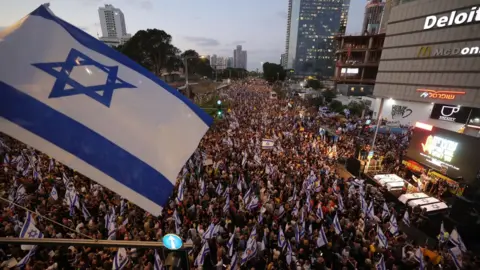
After the Israeli deaths were confirmed, angry protesters flooded the streets of Israeli cities. The forum puts the total number at 600,000.
In Tel Aviv, a crowd of hostage families and their supporters marched with six prop coffins. A crowd gathered outside Israel's military headquarters and clashed with police on a major road.
 EPA
EPA
The killing of Carmel Gat and five other hostages by their Hamas captors sparked a huge protest in Tel Aviv
By the start of 2025, international opposition to the devastating Gaza war had reached new heights as the number of Palestinians killed approached 48,000, according to Gaza's health ministry.
In Israel, polls indicated a clear shift in Israeli public opinion, with a growing majority backing a hostage deal to end the war. With the election of a new US president, the Hostages Families Forum was increasingly directing its efforts stateside.
"They needed to bypass their own government," comments Ms Schneider. "The most important person for the job was obviously [US] President [Donald] Trump. There were signs written in English carried by the people and they would pack all their messages into a one-minute video, and they'd send it to him."
Working with regional mediators, the US secured a new Gaza deal between Israel and Hamas in January 2025, just as Trump took office. The first stage brought back 33 hostages – eight of whom were dead – in exchange for nearly 2,000 Palestinian prisoners and detainees. Five Thai hostages were also released.
But in mid-March, Israel ended the ceasefire, resuming its heavy bombing of Gaza, without starting talks on the deal's second stage, which involved a full end to fighting and the return of the remaining hostages.
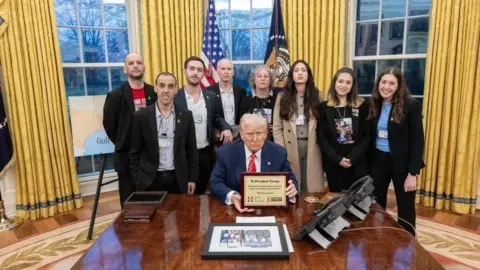 The White House
Released hostages travelled to Washington to ask President Donald Trump to ensure the return of those left behind in Gaza
Frail and emaciated following his release in February under the ceasefire deal, Or Levy was emotionally reunited with his three-year-old son, his parents and brother Michael. However, Michael's joy was short-lived. He quickly resumed his campaigning with others in the Hostages Families Forum.
"I got what I wanted, I got my brother back, but I couldn't just stop," he says, "I couldn't be happy because in those 491 days, they became my family. I almost felt I knew all the other hostages, that every hostage still there was part of my family."
Newly freed hostages gave TV interviews saying they had been starved and beaten in captivity, sometimes in response to the ill-treatment of Palestinian prisoners held by Israel.
Despite their trauma and fragile health, a few of the former hostages travelled to the White House urging President Trump to use his influence to bring back all the living and dead Israelis they had left behind in Gaza.
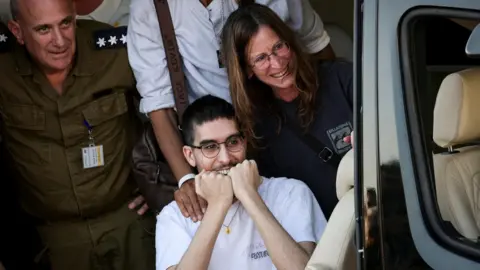 Reuters
Evyatar David was among the last 20 living hostages freed shortly after the current ceasefire began in October
There were more dramatic moments.
In September, an Israeli air strike unsuccessfully targeted the exiled Hamas leadership as it met in Qatar, a regional mediator, to discuss a new ceasefire proposal presented by the US.
However, the ultimate effect was to push the Trump administration - backed up by its Arab allies – towards a new plan to end the war, which had by then killed more than 67,000 people in Gaza, according to the territory's health ministry.
Israel and Hamas agreed a ceasefire deal, under which all 20 living and 28 dead hostages still in Gaza would be handed over in return for almost 2,000 Palestinian detainees and prisoners in Israeli jails, as well as a surge in humanitarian aid and a partial Israeli withdrawal.
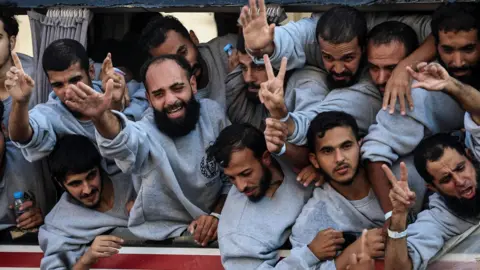 Reuters
Israel released about 250 Palestinian prisoners and 1,700 detainees from Gaza in exchange for the living hostages
When Trump's Middle East envoy, Steve Witkoff, and the president's son-in-law, Jared Kushner, arrived in Israel just after the latest ceasefire started on 10 October, they were greeted by rapturous applause on stage in Hostages Square.
On 13 October, the remaining living hostages came back.
"I'll never have a happier day in my life," says Mr Dickmann, remembering seeing his best friends reunited with their loved ones.
Mr Chorev, the Hostage Families Forum's chief strategist, considers that long-held Jewish and Israeli traditions won through.
"This basic value of the Israeli theme that you don't leave anyone behind, that you're responsible for each and every Israeli held by the enemy, this was something that was unclear to certain elements in the Israeli government," he says. "But it was very clear to the Israeli public."
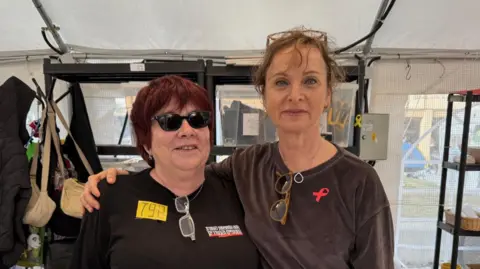
Tali (L) has been helping out hostages' families since the beginning of the war
Slowly, 27 of the dead hostages' bodies have been returned to Israel over the past two months.
Amid the ruins of Gaza, where health ministry officials say the number of Palestinians killed has risen to more than 70,000, Hamas operatives and the Red Cross have been searching for Ran Gvili's body east of Gaza City.
Now, the last funds of the Hostages Families Forum are being used to support the Gvilis and a few dozen volunteers continue to head to Hostages Square on Fridays.
"We have been here in the rain and in nearly 50-degree [Celsius] heat, from winter to summer," says Tali, from Tel Aviv. "Now that this is nearly over, I have mixed emotions. There is still one hostage who hasn't come back. I told myself I would stay until the last one."
A symbolic tunnel, a large "Hope" sign and a piano put in the square in honour of now released hostage, Alon Ohel - a musician - have not yet been removed, nor has the giant countdown board which marks the days since 7 October 2023. A final mass rally is promised for when Ran Gvili's body is returned for burial.
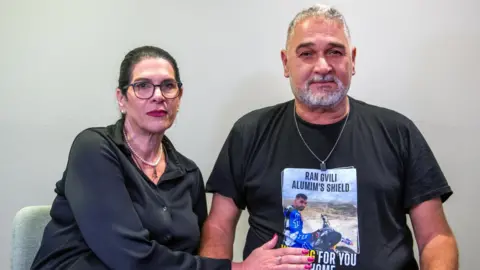
Itzik and Talik Gvili are determined to bring their son Ran home for a proper burial
Israel's prime minister has never appeared in Hostages Square, but he has met with released hostages and hostage families, including those from a small, alternative group to the Hostages Families Forum, the Tikva Forum. The Gvilis belong to both.
The family joined a candle-lighting ceremony on the first night of Hanukkah with Netanyahu.
"We will bring Ran back, just as we brought back 254 out of our 255 abductees," the prime minister said. "Some did not believe. I believe. My friends in the government believed. They said: 'It will be a miracle.' I said: 'This nation performs miracles.'"
But in Israel, painful questions linger over why more hostages' lives were not saved.
The Hostages Families Forum recently released harrowing Hamas videos recovered in Gaza which show the six hostages who were later murdered, including Carmel Gat, celebrating Hanukkah in a tunnel in 2023.
The hostage crisis continues to cast a long shadow over Israeli society; even as many take heart from the families' message of endurance and solidarity.
Additional reporting by Davide Ghiglione and Gidi Kleiman





 English (US) ·