.png)
OTTAWA, ONTARIO — On their record-setting journey around the moon and back, the Artemis II astronauts experienced awe that remains hard to put into words, the team said at a recent public appearance in Canada.
One of the crew’s most memorable mission moments was watching the sun disappear behind the moon for 53 minutes on April 6, marking a unique solar eclipse visible only from space. NASA’s Reid Wiseman, however, wasn't initially focused on the celestial sight. He had his responsibilities on his mind.
But the commander of the moon mission noticed his crew was distracted. "Very quickly, I heard gasps. I heard, 'Oh my God.' I heard, 'I can't believe this.'"
Wiseman diligently kept working behind the camera, but once he finished, NASA pilot Victor Glover invited him to the docking tunnel. Wiseman floated there and looked through the window. The sight, captured in photography, is spectacular — the three-dimensional moon curving like a ghost ship, backdropped by a gorgeous solar corona. On top of that, Earthshine — the reflected light of our home planet — makes the moon glow eerily in the dark.
But seeing it in person was something else. "I don't think the human mind has evolved to the point of being able to understand what we're looking at," Wiseman recalled saying to Glover. (Glover's laconic response, broadcast to the world: "We just went sci-fi.")
Braids and maple cookies
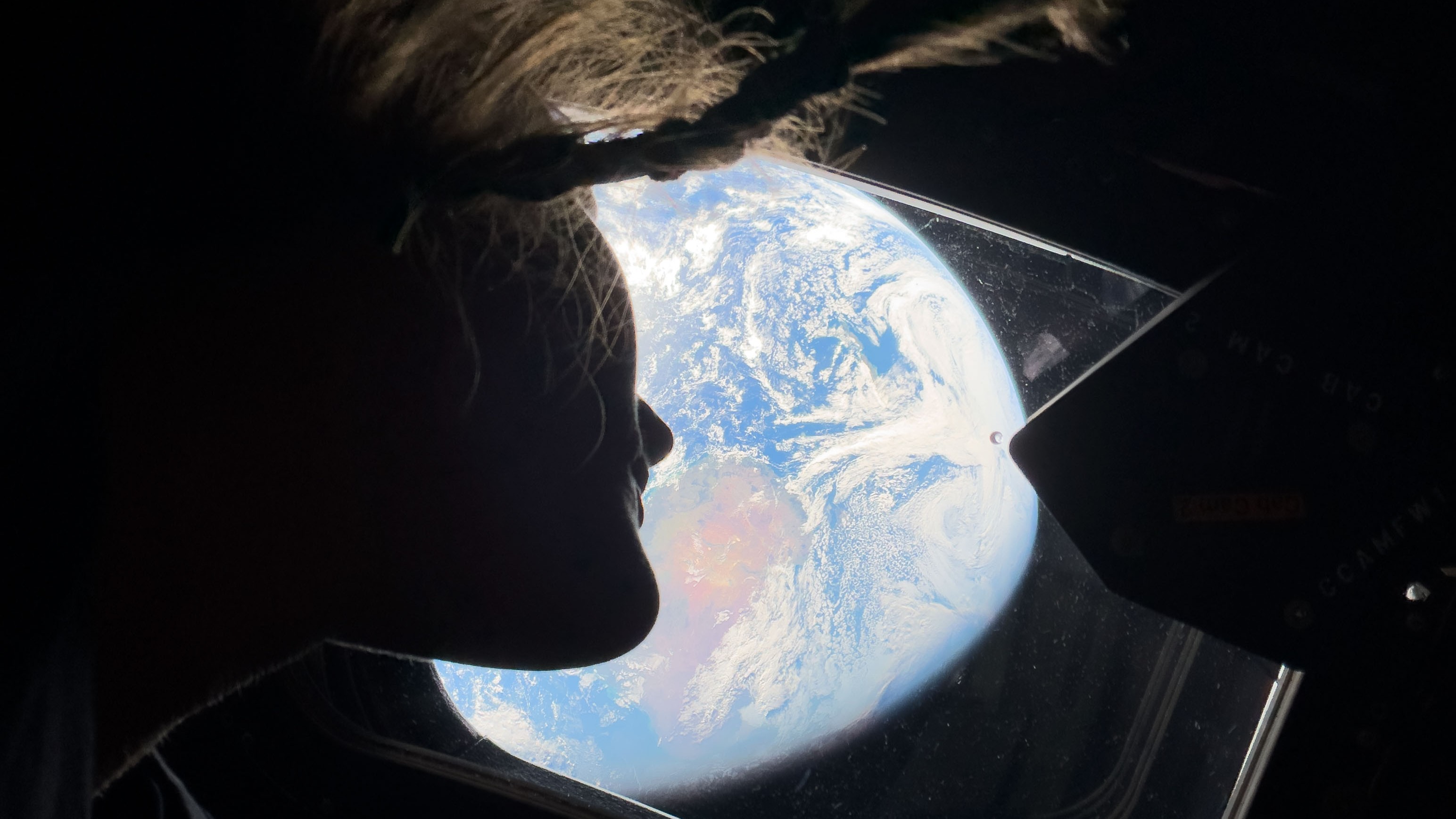
Artemis II astronaut Christina Koch looks down at Earth from space.
(Image credit: NASA via Getty Images)
Wiseman, Glover and the other two Artemis II astronauts — mission specialists Christina Koch of NASA and Jeremy Hansen of the Canadian Space Agency (CSA) — shared their lunar experiences during the crew's first visit to Canada since the mission's conclusion on April 10.
The National Arts Centre's outdoor screen in downtown Ottawa, within a short walk of the Parliament of Canada, included giant avatars of the astronauts and a welcome message to the crew. Space-themed banners lined nearby streets, while temporary image displays showcased Canada's 40-plus years of astronaut missions. Boxes of tulips, as a part of the city's annual Tulip Festival that runs in mid-May, adorned the space display.
Accompanied by the CSA's Jenni Gibbons, one of the mission backup crewmembers who served as capsule communicator for Artemis II, the moon astronauts focused on international collaboration — even in food choices. According to the team, a sweet snack from the CSA played a key role during the crew's time on the far side of the moon, while the crew was out of communication with Earth.
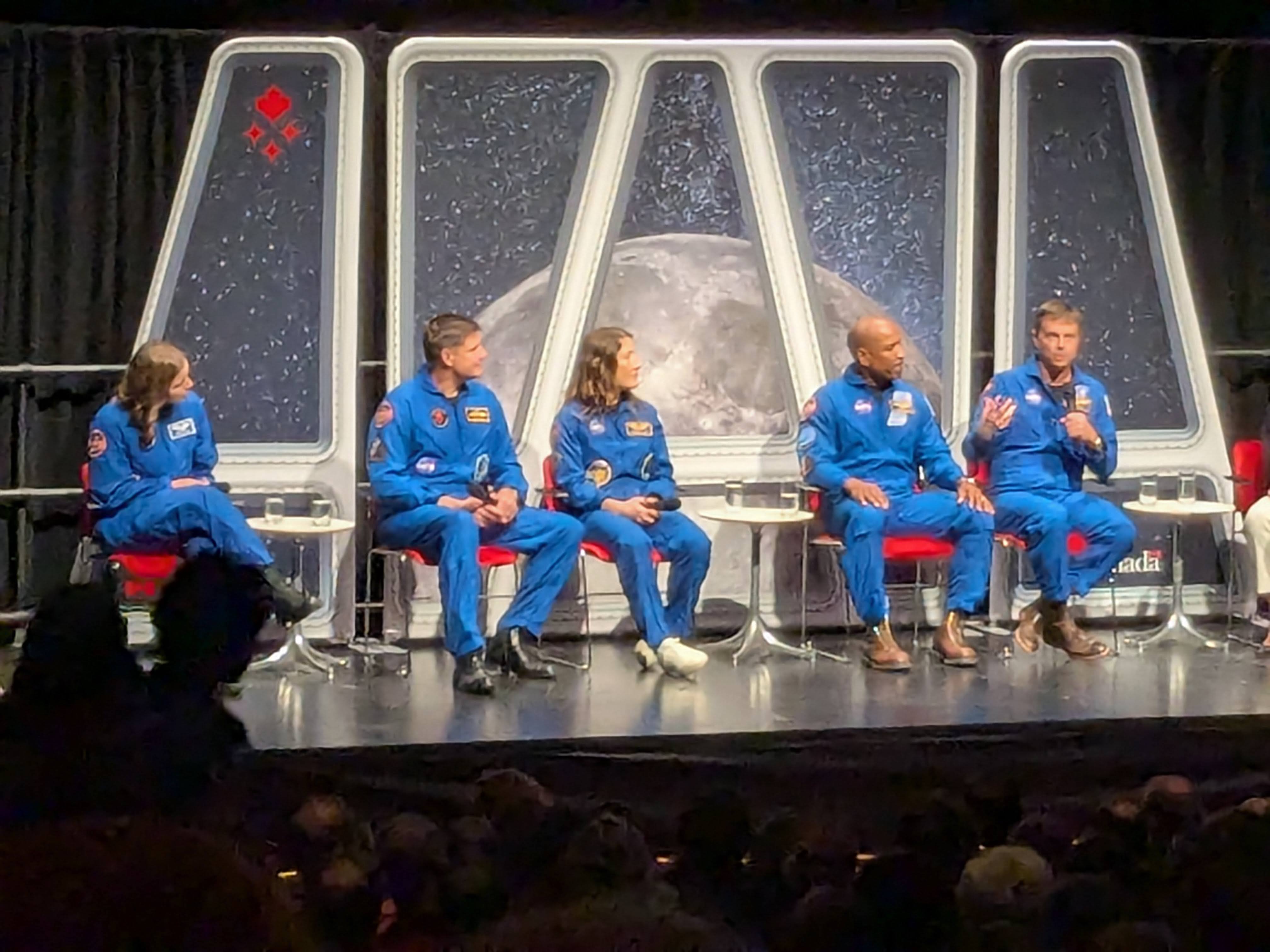
The Artemis II crew spoke in Ottawa, Ontario, on May 13, 2026, to discuss the mission with local space fans. From left to right: Backup astronaut Jenni Gibbons and mission specialist Jeremy Hansen of the Canadian Space Agency, and mission specialist Christina Koch, pilot Victor Glover and commander Reid Wiseman of NASA.
(Image credit: Elizabeth Howell)
"One of the things that we decided to do was to have a maple cookie," Glover said, then paused. "I don't know if I can give maple cookies a better endorsement."
The crowd roared with laughter. Minutes later, a lucky few people got to ask the famous astronauts a question. One woman thanked Koch for the astronaut's iconic Earth selfie showing Koch's braid floating in the window.
"When I originally took the braid selfie, I saw the braid and I was, like, 'Oh, it's kind of in the way," Koch answered. But Koch — who holds the record for the longest consecutive spaceflight by a woman, at 328 days — realized "what it meant" and sent the picture down as is.
That said, Koch had no idea that people around the world were commenting on the braid, or really following the mission at all, until a late-mission video call with her husband. Koch's husband shared that "this mission is having an incredible impact down here,” she said. "It's moving people across lines. Everyone is paying attention."
'I started to cry'
Koch said that, until that point in the mission, including their historic flight around the moon, she thought only a few people in mission control and the tight-knit space community were watching the broadcasts.
"We just thought we were on a screen for our best friends," Koch said. "We knew that our audio was going out publicly, but I didn't realize that impact. I just stared back at him on the screen and started crying."
The reason she was in tears, she continued, was that the crew had a special message to share and were grateful so many people were witnessing their care for each other.
"All we ever wanted was to be able to move the needle, to hopefully tell people that our shared humanity is the most important thing we have," Koch said. "That we live on a precious lifeboat, that we are a crew, And the fact that that was resonating down here was the gift that you all gave us. And thank you for that."
Hansen, the first non-American to leave low Earth orbit, emphasized why that message crosses borders. He used an expression, "the joy train," which harks back to what he said is the point of everyone's life on Earth: to experience joy.
When things get difficult among the crew, "We have gotten adept at getting back on the joy train, because we make the assumption of a good intention," he said, and the same attitude can also hold true of Canada's relationships around the world.
The Artemis II crew had just met with Canadian Prime Minister Mark Carney hours before the public event, following a meeting with U.S. President Donald Trump in late April. Hansen appeared to reflect on those experiences in his remarks.
"The one we talk a lot about right now in the news is Canada-U.S," he said, alluding to recent tensions between the two countries. "But we know overall, the intentions are good," he continued. "That love, that interdependence, is real. And that's what we have in this crew."






 English (US) ·