.png)
 2 hours ago
18
2 hours ago
18
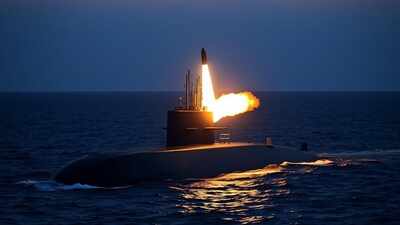
NEW DELHI: India tested an intermediate-range ballistic missile called K-4, which is designed to hit targets 3,500-km away, from the nuclear-powered submarine INS Arighaat in the Bay of Bengal on Tuesday.There was no official word from the defence ministry on the missile test conducted off the coast of Visakhapatnam from the 6,000-tonne INS Arighaat, which is operated by the tri-service strategic forces command.Sources, however, confirmed the missile was the solid-fuelled K-4, which can carry a two-tonne nuclear payload and is critical for India to strengthen the sea leg of its nuclear weapons triad."A comprehensive analysis will determine whether Tuesday's test actually met all laid down technical parameters and mission objectives or revealed some shortcomings.
It usually takes several tests for ballistic missiles, especially those launched from submarines, to achieve full operational status," a source said.After multiple trials from undersea platforms in the shape of submersible pontoons over the last several years, the two-stage K-4 missile was tested for the first time from INS Arighaat in Nov last year.INS Arighaat, the country's second nuclear-powered submarine with nuclear-tipped ballistic missiles (called SSBN in naval parlance), was commissioned on Aug 29 last year.
Her forerunner INS Arihant, which became fully operational in 2018, can carry only the 750-km range K-15 missiles.India will commission its third SSBN as INS Aridhaman in the first quarter of 2026 and the fourth in 2027-28 under the secretive over Rs 90,000 crore ATV (advanced technology vessel) programme launched decades ago. These two SSBNs are slightly larger, with a displacement of 7,000 tonnes each, than the first two 6,000-tonne ones.There is also the plan to eventually build 13,500-tonne SSBNs, with much more powerful 190 MW pressurised light-water reactors instead of the existing 83 MW ones on the first four submarines.India's existing SSBNs, of course, are less than half the size of the ones with the US, China and Russia. The operational deployment of K-4 missiles, which will be followed by the K-5 and K-6 missiles in the 5,000 to 6,000-km range class, will somewhat help India narrow the huge gap with countries like the US, Russia and China, which have a range of intercontinental ballistic missiles (ICBMs).The first two legs of India's nuclear triad are much more robust, with the land-based ballistic missiles led by the Agni-5 with a strike range of over 5,000 km and fighters like Rafales, Sukhoi-30MKIs and Mirage-2000s capable of delivering nuclear gravity bombs.The SSBNs, however, impart India's deterrence posture with much more credibility because they are considered the most secure, survivable and potent platforms for retaliatory strikes in line with the country's "no first-use" policy.








 English (US) ·