.png)
 2 hours ago
18
2 hours ago
18
Across the United States, citizens say they have started carrying their passports with them through their daily activities as widespread immigration raids create a pervasive climate of fear, and reports of citizens being detained circulate in the media.
The Guardian talked to people living this reality.
Munira Maalimisaq, Minneapolis
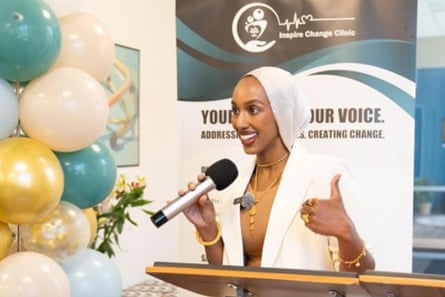
Munira Maalimisaq, a family nurse practitioner who runs a clinic in Minneapolis, started carrying her passport with her daily on 2 December, as federal agents surged in the city after Trump repeatedly targeted Somalis.
Maalimisaq has been a naturalized US citizen for more than two decades; she came to the US as a child from Somalia. She previously only carried her passport when traveling in other countries.
Her clinic, Inspire Change Clinic, with a mission to serve marginalized communities, is located in an area where ICE agents have been targeting the local residents. Her patients have expressed fear about coming to the clinic, leading her to start a rapid response effort to provide more telehealth appointments and safe rides if needed. When patients check in at the clinic, more and more have presented their passports rather than a drivers license, something she hadn’t seen previously.
“We have a lot of patients that may be targeted,” she said. “And because of that, I know that I may come in contact with (federal agents). And for that, I want to make sure that I go home safely to my kids and simply for my own safety, I feel like, if I have my passport and I have my ID with me, I can show it, and hopefully that itself will be sufficient.”
She knows some people may be pulled over because they look like immigrants. In the Minneapolis area, and nationwide, people who are US citizens have been detained. She notes that she wears a headscarf: “I do look like an immigrant. It’s not something that I can hide who I am.”
“For me, it didn’t stop me from working and doing everything that needs to be done, but just taking extra precautions, and the passport was my safety net,” she said.
“No one should have to carry a passport just to exist safely in their own city.”
– Rachel Leingang
Walter Cruz Perez, Kenner, Louisiana
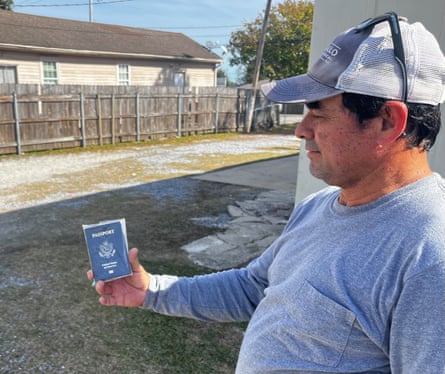
Walter Cruz Perez has been a US citizen since 2022, six years after immigrating to the US from his native Guatemala with legal permanent residency. He used to never think twice about only carrying his driver’s license while going about his life in Kenner, Louisiana, running his successful landscaping and gardening business.
But then the second Trump administration embarked on its campaign to deport as many immigrants as possible. Kenner, with a relatively large Hispanic population, became a focus of that effort when federal agents descended on the New Orleans suburb in early December. Cruz, 58, began seeing stories in the media of Latino US citizens without their American passports readily on hand being at least temporarily detained by immigration agents.
Cruz said none of those agents seen scouring Kenner’s streets had approached him. But if they did, he surmised his accent would betray that he is a native Spanish speaker as well as an immigrant. He also joked that his short height and belly could make him seem like a particularly soft target.
So now Cruz said he is in the habit of putting his passport in his cellphone case while he tends to his landscaping in case any of the agents seen scouring the streets of his city in recent days eventually approach him. He always makes sure to put it in a ziplock bag to protect it from inclement weather and keep it in the best shape possible – out of fear an agent may doubt the document’s authenticity if it gets too worn down.
“It’s stressful,” said Cruz. “But you see on the news that people don’t have the chance to identify themselves … so you do what you have to do to avoid problems.”
– Ramon Vargas
Carola Lopez, outside New Orleans
Carola Lopez, an educator who lives outside New Orleans, grew up in the Latino US territory of Puerto Rico. And despite the fact that Puerto Ricans are US citizens, she became accustomed to being asked by other Americans why she and her people spoke Spanish, and even if she paid taxes.
She said she has been carrying her US passport with her in her car since the time in 2015 when authorities stopped her for no apparent reason near Houston while traveling there to watch star singer Ricky Martin – her fellow Puerto Rican – perform in a concert. And she said she is making sure to stick to that practice given the ongoing immigration crackdown as well as the stories in the media of US citizens being detained temporarily by agents in some instances.
Lopez said she would never understand “why we have to carry our passports and be afraid of being detained despite having US citizenship”.
“I bring it around to avoid getting into uncomfortable situations with the authorities,” Lopez said.
She added: “It’s really sad that we have to do this and that Americans are living in these times. I never thought I’d feel like I have to prove where I’m from, … and that we are from the United States.”
– Ramon Vargas
Miguel Rios, Los Angeles
Miguel Rios, a 49-year-old born and raised in Los Angeles, and his family started carrying copies of their passports once the immigration raids began in the region earlier this year. He cancelled planned road trips to Utah and northern California, and discouraged his parents from going to large family functions where they might be more vulnerable.
Even as a US citizen, Rios, who works in aquarium and pond maintenance, was concerned when the Trump administration began mass sweeps across Los Angeles. But the turning point came when he heard from an associate at work that their relative, a US citizen, had been erroneously detained and taken to an Immigration and Customs Enforcement (ICE) processing facility in the southern California desert. Around the same time, ICE agents used a moving truck for an operation at a Home Depot near his house. That was when he decided to carry additional identification.
But Rios said he feels there is little he can do to protect himself. “My sister taught me how to go Instagram live, that’s all I got going on … I have a dash cam on my truck. That’s kind of it.”
The supreme court ruling that federal agents can stop people in Los Angeles for speaking Spanish or appearing Latino was particularly upsetting, he said, and it’s been difficult to see the widespread impacts of the administration’s deportations.
“It’s really scary for the elders,” Rios said. “You’re tearing families apart. The numbers have come out, it’s not like they’re catching criminals. You’re going to workplaces – that’s not where the criminals hang out.”
– Dani Anguiano
Ana, southern California
For Ana*, a middle-aged educator based in southern California, the danger came into focus with the detainment of Andrea Velez. The US citizen was on her way to work in downtown Los Angeles when masked men suddenly picked her up and dragged her into a vehicle parked nearby. The men were US immigration officials. Velez was charged with assaulting an officer, but the charge was later dismissed. During the incident, her mother and sister watched nearby but were afraid to intervene.
Ana, a US citizen and the daughter of Mexican immigrants, watched the news coverage, horrified by what Velez experienced.
“I thought if that happened to her that could happen to me. That could happen to anybody who looks like me or sounds like me,” she said. “If I’m just buying a taco at a taco truck, speaking spanish. You never know. It’s just a reminder you are not what they consider fully American.
“I know I am. [But] this is an administration that says ‘you don’t belong’.”
Now, she carries her passport and ID at all times: “I’m a citizen but nonetheless I feel the need to carry my damn passport.” She’s gone to marches and talked to city council and tried to ensure her students, who have family members who have been deported, know their rights. But she fears the erosion of basic human rights and due process in the US.
“This is a very dangerous moment,” she said.
– Dani Anguiano
*Ana asked for her last name not to be used because she’s afraid for her safety and fears she will be targeted for speaking out




 English (US) ·