.png)
 1 hour ago
5
1 hour ago
5
Closing summary

Jakub Krupa
And, on that note, we will be closing the blog for today.
-
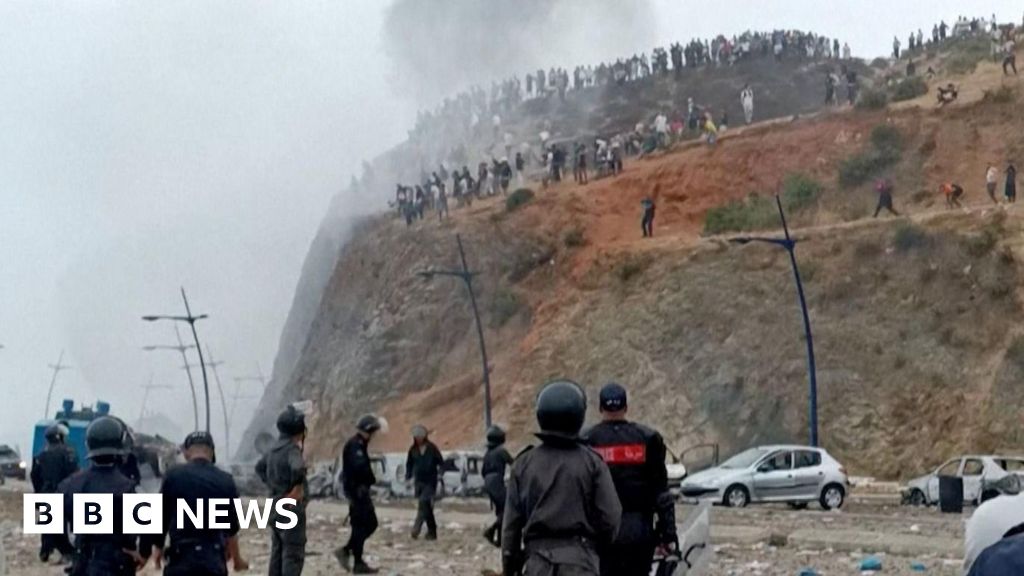
At least 57 people have died trying to reach the Spanish enclave of Ceuta after as many as 60,000 migrants entered the tiny territory from Morocco (17:33).
-
Spain’s prime minister, Pedro Sánchez, called it a “a violation of Spain’s territorial integrity” (12:51) and blamed on misleading narratives spread by human traffickers (12:54, 13:17).
-
In response, Italy has moved to suspend its free-travel Schengen arrangements with Spain by sea and air (18:26), claiming it was necessary to safeguard the security of its citizens (19:02, 19:07). It is understood it will amount to “targeted, selective checks” on third-country nationals arriving from Spain (19:19).
-
But by Friday afternoon, the Spanish authorities claimed that a vast majority of the migrants have voluntarily returned to Morocco (16:41, 18:20), with hundreds more going back by the hour as there was no onwards migration route to mainland Spain or the EU (14:02, 15:04).
-
The huge influx, which took place over the course of just 24 hours, overwhelmed the city of 85,000 people, triggered a political crisis for Madrid and led to a barrage of criticism from the US (15:25, 15:29, 18:02) and other EU countries, including broader calls to suspend Spain’s membership of the Schengen area (9:42, 10:21, 12:10, 13:52, 14:52, 16:59, 17:38).
If you have any tips, comments or suggestions, email me at jakub.krupa@theguardian.com.
I am also on Bluesky at @jakubkrupa.bsky.social and on X at @jakubkrupa.
Key events 17h ago Meloni confirms 'extraordinary' measure to reinstate border controls with Spain 17h ago Closing summary 17h ago Slovakia's Fico opposes suspending Spain's Schengen status, offers help with border controls 18h ago Italy to carry out 'targeted, selective' checks on non-EU nationals from Spain 18h ago Temporary suspension of Schengen with Spain 'a necessary choice,' Italian foreign minister says 18h ago Italy expected to use rules on temporary reintroduction of internal border checks 18h ago France's Macron expresses solidarity with Spain after border crisis in Ceuta 18h ago Italy says it's suspending EU Schengen arrangements with Spain 18h ago Nearly 50,000 migrants have returned to Morocco, Spain says 19h ago Trump condemns 'invasion' in Ceuta, criticises 'bad management' and 'weak laws' of Spain 19h ago EU's Costa expresses solidarity with Spain, praises 'firm response' and stresses migrants have no onward routes to EU 19h ago 'Solidarity and empathy are optional. Respect for EU treaties is not,' Sánchez hits back at critics 19h ago Spain needs to tighten asylum laws, border protections if Schengen is to survive, Poland's Tusk says 19h ago Death toll from Ceuta crossings has risen to 57 20h ago Ukraine warns against Russian disinformation seeking to exploit migration crisis in Ceuta 20h ago Czechia's Babiš joins calls to suspend Spain's Schengen membership 20h ago Most migrants returned to Morocco, Spain says 20h ago Situation in Ceuta - in pictures 21h ago At least 43 people died during Ceuta crossings 21h ago 'That's going to be us in three years if the wrong side gets in,' Trump responds to Ceuta crisis 21h ago Ceuta 'an unfortunate reminder of the consequences of mass migration,' JD Vance says 22h ago 'Unacceptable' situation in Ceuta, but 'no onward movements' to Europe, EU commissioner says 22h ago Denmark's Frederiksen urges EU to 'consider all options' including Spain's Schengen suspension 22h ago What do we know so far on Ceuta migration crisis 23h ago Migration is where political narratives often clash with legal reality - snap analysis 23h ago Spain says 25,000 migrants returned from Ceuta to Morocco today 23h ago Former Spanish senior EU official dismisses Italy's call to suspend Spain's Schengen status 23h ago Where is Ceuta? - locator map 23h ago Estimated 60,000 migrants crossed into Spain's Ceuta, with at least 34 dead, local leader says 23h ago 'Protecting borders crucial for combating illegal migration,' Germany's Merz says 23h ago 'Images coming from Ceuta are unacceptable,' EU's von der Leyen says 23h ago Ceuta crisis may be linked to diplomatic issues between Spain and Morocco - snap analysis 24h ago Sánchez blames human trafficking gangs for 'violations' in Ceuta 24h ago Spain to set up temporary centre in Ceuta to send back migrants with no legal claim, says Sánchez 24h ago Migration crisis in Ceuta 'a violation of Spanish territorial sovereignty' 1d ago Spain's Sánchez address media on migration crisis in Ceuta 1d ago Spain needs to 'act swiftly to regain control of the situation,' Swedish PM says 1d ago France to strengthen controls at French-Spanish border in response to Ceuta crossings, minister says 1d ago Le Pen, Barnier call for France to strengthen border controls in response to Spain migration crisis 1d ago Spanish opposition calls on Sánchez to 'defend our national security' 1d ago 49,000 people believed to cross into Ceuta, more than half of its population 1d ago Morning opening: Spain faces migration crisis in north African enclave of Ceuta
Meloni confirms 'extraordinary' measure to reinstate border controls with Spain
Just as we closed the blog, Italian prime minister Giorgia Meloni has confirmed the move to suspend the free movement with on air and sea borders with Spain.
She said it was “an extraordinary measure, adopted to safeguard national security and prevent possible repercussions for our nation.”
In another sign that it may stop short of full border control for all arrivals from Spain (19:19), she said “the measure will be kept in force only for the time necessary, with particular attention to limiting any impact on summer tourist flows.”
She added that “Italy is ready to support every European initiative to assist Spanish institutions as needed to restore full control of the Union’s external borders and to address the ongoing situation with determination.”
“Defending borders means defending the safety of citizens, combating irregular immigration, and striking at the criminal networks that traffic human beings,” she said.
Closing summary
Jakub Krupa
And, on that note, we will be closing the blog for today.
-
At least 57 people have died trying to reach the Spanish enclave of Ceuta after as many as 60,000 migrants entered the tiny territory from Morocco (17:33).
-
Spain’s prime minister, Pedro Sánchez, called it a “a violation of Spain’s territorial integrity” (12:51) and blamed on misleading narratives spread by human traffickers (12:54, 13:17).
-
In response, Italy has moved to suspend its free-travel Schengen arrangements with Spain by sea and air (18:26), claiming it was necessary to safeguard the security of its citizens (19:02, 19:07). It is understood it will amount to “targeted, selective checks” on third-country nationals arriving from Spain (19:19).
-
But by Friday afternoon, the Spanish authorities claimed that a vast majority of the migrants have voluntarily returned to Morocco (16:41, 18:20), with hundreds more going back by the hour as there was no onwards migration route to mainland Spain or the EU (14:02, 15:04).
-
The huge influx, which took place over the course of just 24 hours, overwhelmed the city of 85,000 people, triggered a political crisis for Madrid and led to a barrage of criticism from the US (15:25, 15:29, 18:02) and other EU countries, including broader calls to suspend Spain’s membership of the Schengen area (9:42, 10:21, 12:10, 13:52, 14:52, 16:59, 17:38).
If you have any tips, comments or suggestions, email me at jakub.krupa@theguardian.com.
I am also on Bluesky at @jakubkrupa.bsky.social and on X at @jakubkrupa.
Slovakia's Fico opposes suspending Spain's Schengen status, offers help with border controls
Spain found an unexpected ally in Slovakia’s Robert Fico, who said that he did not believe that “excluding Spain from the Schengen Area would be the right solution” as he offered help to the government in Madrid.
In a lengthy post in English, he said:
“I am closely monitoring developments in the migration crisis in the Spanish enclave in Africa on an hourly basis. Today, I also joined the initiative of Italian prime minister Giorgia Meloni calling for a strong response from the EU institutions.
The Government of the Slovak Republic has long maintained that the most effective way to prevent illegal migration is the rigorous protection of the Schengen external borders. In other words, everything possible – and even what may seem impossible – must be done to prevent illegal migrants from entering the territory of EU Member States without authorisation. It is striking to observe the hypocrisy of many EU Member States, as well as EU representatives, who only a few years ago, through their lax approach, allowed illegal migrants to enter EU countries in massive numbers, causing serious crises.
Today, everyone presents themselves as a determined opponent of illegal migration, having seen how voters across individual Member States politically removed several governments because of their inability to deal with the migration crisis. I would like to recall that, several years ago, when I exercised my right of veto and prevented the adoption of mandatory migrant quotas at the European Council, I had to endure considerable political hostility and criticism.
Radical, even extreme, proposals will also emerge in connection with the current crisis in Africa. As prime minister of the Slovak Republic, I do not believe that excluding Spain from the Schengen Area would be the right solution. Just as we were prepared to assist France in combating wildfires, Slovakia should also adhere to its proven strategy of protecting the Schengen external borders at all costs. Any country requiring assistance in safeguarding those borders should receive the maximum possible support through the deployment of police officers and the technical equipment necessary for border protection.
Slovakia is ready to offer such assistance to Spain.”
It looks like not everyone is Italy sees the need to adopt these measures.
As Reuters noted, Meloni’s coalition, which came to power in 2022 promising to reduce illegal immigration, has faced strong pressure from a new far-right party led by former army general Roberto Vannacci, whose anti-migrant rhetoric has resonated with some voters.
“The problem is that this is a purely demagogic proposal, as usual designed for domestic consumption and to compete with Vannacci, without solving anything at all,” said Piero De Luca, a senior lawmaker with the centre-left Democratic Party.
Italy to carry out 'targeted, selective' checks on non-EU nationals from Spain
We are getting a bit more detail on what the Italian decision will mean in practice.
The Italian interior ministry said border police would carry out “targeted, selective checks” on third-country nationals arriving from Spain to verify that they had the documents needed for travel within the European Union, Reuters reported.
Remember that it’s all a bit symbolic – or political – as all people leaving Ceuta still have to go through a Spanish border control anyway, and do not have free access to the EU or the Schengen zone, as per the EU’s rules (14:02),
Jakub Krupa
As mentioned earlier, the issue of migration has become heavily toxic in domestic politics of many countries (14:02), so it may or may not be relevant to just mention in passing that Italy is expected to go to the polls at some point next year – with some media reports suggesting that it could happen as early as April 2027.
Temporary suspension of Schengen with Spain 'a necessary choice,' Italian foreign minister says
Italian foreign minister Antonio Tajani has just confirmed the decision to close Italy’s air and sea borders with Spain.
In a post on X, he said the temporary suspension of Schengen with Spain “is a necessary choice to safeguard the security of our citizens and defend the European borders.”
He stressed that it was “a measure provided for by the treaties and made unavoidable today.”
“The migrant crisis in Ceuta reminds us that the management of the Union’s borders is a shared responsibility among our countries, one toward the other.
We must work together to prevent uncontrolled migrant flows from entering EU territory, with all the consequent risks and the threat of terrorism, which must be confronted without hesitation.”
For what it’s worth, Italy’s reported decision to close borders with Spain follows a specific and direct suggestion they could do just that.
As reported this morning (9:42), prime minister Giorgia Meloni said last night that “Italy will not stand by and watch,” and suggested it was “prepared to intervene with extraordinary measures to defend the borders and the safety of citizens, including the suspension of the Schengen Area with Spain.”
Italy expected to use rules on temporary reintroduction of internal border checks
Jakub Krupa
In the absence of a detailed breakdown of the proposed measures from the Italian government, I managed to get a bit more from the European Commission on what are the legal options available to Rome.
A commission spokesperson crucially insisted that “there are today no onward movements from Cueta,” with the focus on “getting the situation under control and making sure people are returning to Morocco.”
But they added that:
“For the general legal framework, the rules provide that Member States may exceptionally and temporarily reintroduce internal border control as a matter of last resort, to address serious threats to public order or national security (Article 25(1)(c))
As regards maritime travel: What is possible is a reintroduction of internal border control at the internal sea borders. However Article 41 of the Schengen Borders Code provides that the special rules applicable to Ceuta and Melilla remain in place, meaning there is border control between Ceuta and Melilla and the rest of the Schengen area.”
Where such threat is unforeseeable and requires immediate action, the Member State may, on an exceptional basis, immediately reintroduce border control at internal borders.
The Member State in question would need to notify the Commission, Council, Parliament and other Member States thereof and explain how the situation in Ceuta constitutes a serious threat to their public policy or internal security.
The Guardian understands that Italy has not yet formally notified any of the partners of its decision, which may explain why we don’t know the details of the proposed measures yet.
There are some precedents: for example, Germany has reinstated some border controls with its neighbours in 2024 as a measure against irregular migration. The latest set of measures is due to expire in September, but German ministers suggested today it would be extended once again.
Just like Reuters (18:26), the Italian news agency Ansa says the Italian ministry of interior “has ordered the closure of the sea and air borders with Spain.”
It adds that “the decision was made following the most recent information were analysed by the Committee on Immigration and Border Security,” chaired by the interior minister, Matteo Piantedosi.
But there are no further details available at this stage.
France's Macron expresses solidarity with Spain after border crisis in Ceuta
Meanwhile, ever a diplomat, France’s Emmanuel Macron said he had been in touch with the Spanish government to express his solidarity and offer assistance to Spain.
“I welcome the ongoing cooperation with Morocco, which has already enabled more than 40,000 returns from Ceuta to Morocco today. The interior ministers are in contact to ensure close monitoring of the situation,” he said.
As others, he also pointed out that “Ceuta does not benefit from freedom of movement to the rest of the Schengen Area.”
But, as a precautionary measure, Macron said he had asked the interior ministry to strengthen the French controls on its border with Spain with four mobile units and drones.
He ended with a call for “solidarity” and joint “responsibility” in “enforcing rules of firmness on returns and the protection of the Union’s external borders.”
Jakub Krupa
It’s not exactly clear what the Italian decision covers in detail.
We are trying to find out.
Italy says it's suspending EU Schengen arrangements with Spain
Italy said it was suspending the EU’s border-free Schengen arrangements with Spain in response to a mass influx of migrants into the Spanish enclave of Ceuta from neighbouring Morocco, Reuters reported.
Italy does not have a land border with Spain but the measure will impact people travelling by plane or boat between the two countries, the agency noted.
Italy’s interior ministry said it had also agreed with Paris to strengthen controls along the Franco-Italian land border.
Nearly 50,000 migrants have returned to Morocco, Spain says
The latest estimates by the Spanish government say that 48,300 people have returned back to Morocco after crossing the border last night.
This means that only a fraction of the total – estimated to be between 50,000 (as per central government) and 60,000 (as per local government) – remain in Ceuta.
Trump condemns 'invasion' in Ceuta, criticises 'bad management' and 'weak laws' of Spain
In sharp contrast, the US president, Donald Trump, offered some critical commentary on Cueta, attacking Spain for “bad management” and “very liberal laws.”
It looks like he will want to draw comparisons with Spain to mobilise voters ahead of his upcoming midterms campaign in the US.
Here is what he said during a cabinet meeting. Note that some of his numbers – “hundreds of thousands of people” – are wildly off.
“I saw Spain yesterday, and I watched the catastrophe that took place. It was, it looks like an invasion of a country by hundreds of thousands of people. And that same thing is going to happen to us if the Republicans don’t get elected. Except worse, much bigger, much easier to get into.
Despite the fact that we have built thousands of miles of wall, which I said we were going to do, but we didn’t have that fear. Again, we [now] have the safest border in the world.
If we’re not in office, our country will be invaded at levels that made Spain look small, high.
And when I watched it, I said, boy, I said, … that’s going to be a talking point for the midterms, because when you look at what happened to Spain, they don’t know what to do. And it’s happening again today.
They’re coming in by the tens of thousands. It just is just invading the country. And what that is… weak law, bad management, but very liberal law. They passed a couple of laws and people read, you know, people are smart. They read from other countries and they swam that three mile swim or however they got in, but nobody’s seen it anything like it.
That will look good compared to what’s going to happen to the United States.”
EU's Costa expresses solidarity with Spain, praises 'firm response' and stresses migrants have no onward routes to EU
European Council president António Costa strikes a sympathetic tone in his response to the events of the last 24 hours.
In his statement, markedly different in tone to that of several other EU leaders, he expresses his “solidarity with Spain in the current situation of illegal migration in Ceuta.”
As migration commissioner Brunner earlier (15:04), he also specifically makes the point that “third-country nationals in Ceuta do not enjoy free movement to mainland Spain or the rest of the Schengen area” (14:02).
He also says that “Spain’s firm response, including ongoing accelerated returns, demonstrates our determination to protect our external borders, combat illegal migration, and dismantle criminal smuggling networks.”
“I welcome Spain’s close cooperation with Morocco in addressing this shared challenge and ensuring swift returns. We will remain in close contact with the Spanish authorities in the coming days.”
'Solidarity and empathy are optional. Respect for EU treaties is not,' Sánchez hits back at critics
Meanwhile, Spain’s Pedro Sánchez has taken to social media to hit back at a group of countries calling for Spain to be suspended from the Schengen agreement, led by Italy.
“Solidarity and empathy are optional. Respect for European treaties and data is not,” he said.
Referencing the latest data on irregular entries into the bloc collected by the EU’s border agency Frontex, he pointed out that more people crossed into the EU from Italy, the western Balkans, and Greece than from Spain.
“This is not the time to divide. It is the time to continue building a strong and united EU,” he said.
Spain needs to tighten asylum laws, border protections if Schengen is to survive, Poland's Tusk says
Poland’s Donald Tusk urged Spain to tighten its asylum laws, border procedures and build “effective” barriers “if Schengen is to survive.”
In a rare post in English on X, he said:
“Poland has tightened asylum laws, border procedures, and has built effective barriers on its border with Belarus, which is the eastern border of the EU. We have invested billions of euros and engaged thousands of soldiers, police officers and border guards. Spain must follow our example if Schengen is to survive.”




 English (US) ·