.png)
.png) 1 hour ago
11
1 hour ago
11
Deep in her heart, Narengbam Lakshmi Devi carries the pain of missing out on the 2012 London Olympics. By an agonisingly slim margin.
Competing in the Asian Continental Olympic qualification regatta in South Korea’s Chungju, Lakshmi had finished fourth in the single sculls semi-final. Had she finished just one better, she would have been on the flight to the British capital, a historic first for an Indian female rower.
Fourteen years from that near-miss, India has still not had a female rower making the cut for the Olympics. Lakshmi, now working as an assistant coach with the women’s team under national coach Ratheesh DB, is trying her best to change that.
As she stands at a vantage point overlooking the 18 girls testing their will and endurance against the serene blue waters of the RWP-3 water body at Bellary, she can see them going where she couldn’t.
“When our female rowers qualify for the 2028 or 2032 Olympics, only then will our goal be achieved,” she says with a smile.
The sport in India has forever been the preserve of male rowers, all of them polished at the Army Rowing Node. Female rowers, meanwhile, trained at centres like Aleppey or Hyderabad and came together only during national camps for a few months before dispersing to the training centres of their home states. That made finalising a team combination in boats and getting the camaraderie right tough.
But a couple of months back, the Inspire Institute of Sport (IIS) joined hands with the Rowing Federation of India to train the national group at Bellary all year round with the goal of breaking into the Olympics.
Story continues below this ad
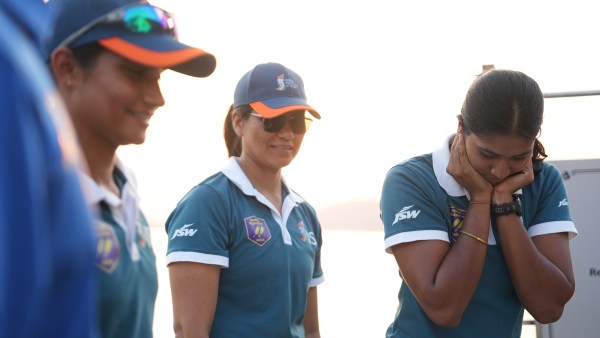 Lakshmi Devi overseeing a session in the gym at the IIS Vijaynagar Centre. (Photo: IIS)
Big things are already expected of the women’s group at this year’s Asian Games, especially after they won two medals last year at the Asian Rowing Championship after 12 years – a silver in the lightweight women’s pair and a bronze in the women’s eight. Currently, two women’s boats have already made the cut for the Aichi-Nagoya Games, with the coach confident that one more will make it.
Lakshmi, the daughter of a fisherman, sheepishly admits that when she started rowing in 2009, it was only to get a government job. But soon, she found herself breaking into the national camp.
“I didn’t have a coach back in Manipur even when I broke into the national set-up. Instead, I had a physical education teacher who taught me,” she says.
Starting trouble
The early days in the national camp was a steep learning curve: she learnt about all the rookie errors she was making, including the fact that she was gripping her oars wrong.
Story continues below this ad
Soon after her near-miss at making it to the Olympics, Lakshmi pivoted to coaching, getting a diploma from the National Institute of Sports. She was determined that the next- gen’s rookie mistakes should be fixed a lot earlier than hers were. At the Loktak Lake, a freshwater body in Moirang in Manipur, she started shaping the next generation of female rowers in her home state with a tiny club.
Those early days, when she would try to scout girls to get them into rowing, Lakshmi would face some hard practical questions from parents: ‘What will you give them? Will they get hostels to stay in? Will they be given a stipend to train and compete?’
“I didn’t have the courage after a while (to approach parents)! They would ask about facilities. We didn’t have any,” she recalls.
Despite that, at the tiny club she ran on Loktak Lake, over 40 girls have trained under Lakshmi over the years. She also unearthed talents like Priya Devi, Tendenthoi and Bharati Oinam Devi, who are all national campers today. In fact, the trio is among the four Manipuri girls in the 18-strong female rowing programme at IIS’s Bellary facility.
Story continues below this ad
Manipur isn’t the first place that comes to mind when one thinks of rowing. But over the last few years, the tiny northeastern state is quietly becoming a force. The early indicator of this came at the National Games in Gujarat four years ago when rowers from Manipur ended with a surprise haul of a gold and a bronze. It was surprising because rowers from the state had just one boat available per category to train on, and those were at least 15 years old. Moreover, the state’s rowers had just six pairs of oars available in total.
Despite that Priya and Tendenthoi won gold in the double sculls.
Lakshmi and the other female rowers are now counting the days for the Asian Games. If medals come there, she is certain that the scenario for women’s rowers will change. And maybe when she goes scouting for the next generation of rowers, the questions she gets from parents will change too. Instead of ‘kya facilities hain?’ they will probably ask ‘Olympics ja sakti hain kya?’
(The writer is in Bellary on the invitation of Inspire Institute of Sport)




 English (US) ·