.png)
 2 hours ago
23
2 hours ago
23
“I shudder at the thought of what she would have experienced today,” said screenwriter and director Saeed Mirza at the panel titled The Life and Times of Saeed Mirza held at the India Habitat Centre on Tuesday. Mirza, who won a National Film Award for Best Direction for the 1995 film Naseem, was speaking of the freedom his mother once had, small decencies he thinks she might not have received in today’s times. But he is optimistic. “You do see signs of people standing up and sticking their legs out here and there, once in a while. But it takes a little time. The only consideration is how long can the hate last? Love has to follow,” he said, as the audience broke into applause.
Organised by Tuli Research Centre for India Studies as part of the 7th Self-Discovery Via Rediscovering India Festival, Mirza was joined by film makers Dibakar Banerjee and Gurvinder Singh. Moderated by Aakash Joshi, Deputy Associate Editor at the Indian Express, the discussion flowed from the craft and politics of filmmaking to funding and freedom.
Mirza, whose films include Albert Pinto Ko Gussa Kyoon Aata Hai (1980), Mohan Joshi Hazir Ho! (1986) Salim Langde Pe Mat Ro (1989), traced his journey from a “very strong left position” in his early years to a more introspective phase later on. He recalled making his first documentary just before the Emergency was declared. “I thought I was doing something,” he said. Over the years, that certainty changed. After the Babri Masjid demolition, he felt both he and the country were at a “critical juncture” in defining identity. “How does a nation gain its identity, through the destruction of a masjid or the building of a temple? I don’t understand,” he said.
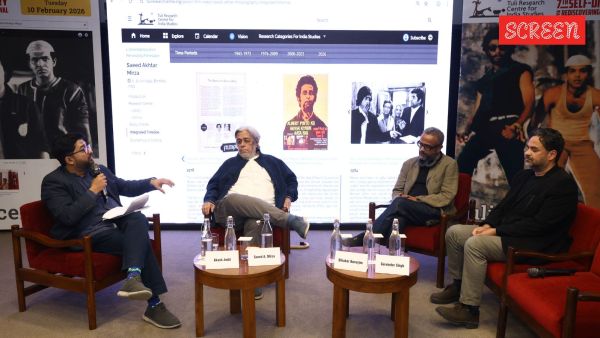 Moderated by Aakash Joshi, Deputy Associate Editor at the Indian Express, the panel titled The Life and Times of Saeed Mirza featuring screenwriter and director Saeed Mirza along with film makers Dibakar Banerjee and Gurvinder Singh. (Photo Credits & Courtesy: Tuli Research Centre for India Studies )
Known for films like Khosla Ka Ghosla (2006), Oye Lucky! Lucky Oye! (2008), Love Sex Aur Dhokha (2010) and Shanghai (2012), for Banerjee, the question of whether a filmmaker responds to the times is almost irrelevant. “I don’t know how one can make anything without responding to the times that one is a prisoner of,” he said. He described the current moment as one shaped by what he called “stage four capitalism,” where profit enters every space, even the air one breathes. The problem, he argued, is not that popular cinema exists, but that the space for films that “provoke and question and engage rather than entertain” is shrinking. “That is missing. That, I think, is the main differentiator,” he said, comparing the present to the early 2000s when smaller, riskier films still found backing.
Singh, whose works include Punjabi movies like Anhey Ghore Da Daan (2011) and Chauthi Koot (2015), spoke of revisiting Mirza’s films from the 1980s before the panel. Watching them back-to-back, he said, felt like witnessing “one long film” that captured a decade of Bombay’s history. “Filmmakers are not just storytellers, they are historians,” he said. Whether or not such films feel immediately relevant, he believes they will endure. “One day the films will resurface… they will be documents of this time.”
The discussion also turned to institutions. Singh recalled how film education was once more democratic, drawing students from different classes and regions. While technology has made filmmaking equipment cheaper and more accessible, funding and state support have thinned out. “There is no state support today,” he said, pointing to the absence of meaningful backing for independent films.
Mirza agreed that while there was state control earlier, it was “incredibly minimal,” and there was at least a sense of cultural responsibility. Today, he argued, freedom is selective. “You can have as much violence as possible. But if you think of an alternative view of the world that is going to be questioned, that’s the problem,” he said.
Story continues below this ad
Yet the conversation was not without hope. Banerjee said optimism lies in younger filmmakers who refuse to seek permission and continue to push boundaries. Singh spoke of building small communities of collaborators outside the industry’s centre, while Mirza returned to the idea that hope comes from people themselves.




 English (US) ·