.png)
 2 hours ago
19
2 hours ago
19
On a bracingly cold February night in Levenshulme, a black Volkswagen people-carrier draws up outside a little parish church, around which a small crowd has begun to gather. From behind the car’s darkened windows steps the Reform candidate for the Gorton and Denton byelection, dressed in the trademark gilet that makes him look less like a politician and more like a man who has come straight from a grouse shoot. As he enters the church where the electoral hustings will take place, a leaflet is thrust into his hand, which as he will later discover with a horrified grimace, is a flyer for the local branch of the Communist League, bearing policies such as “amnesty for all immigrants” and “defend Cuba’s socialist revolution”.
But then, when you are trying to attract the attention of someone as elusive as Prof Matt Goodwin, you have to seize your opportunities whenever they arise. Over recent weeks the former academic and rightwing firebrand has been a curiously intangible presence in the constituency whose representation he is seeking: perpetually detectable but not remotely approachable, always visible without ever really being seen.
None of the dozens of voters I spoke to across the area over the course of two weeks in February had actually glimpsed him in the flesh, much less seen him on their street or doorstep. “He’s probably chilling in St Albans,” jokes one young man crossing the Stockport Road in Denton, a pointed reference to Goodwin’s southern upbringing and unmistakable home counties vowels.
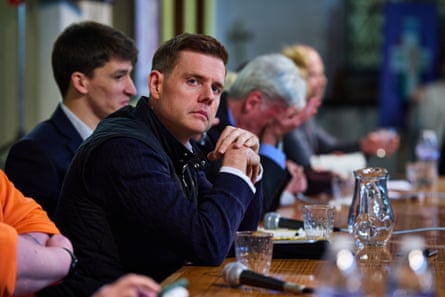
This is not quite true. By his own account, Goodwin has been out campaigning every single day since his candidacy was announced in late January, although this in itself is a term freighted with ambiguity. To a large extent, this is a campaign conducted for the benefit of the internet: consisting of a handful of carefully curated media appearances, arranged meetings and brief photo opportunities. A black car rolls up alongside a pub or a row of terrace houses; its cargo emerges; photographs are taken; content is captured. By the time it is posted, the candidate has long since been ferried away in his transport, presumably back to the safety of Reform’s headquarters, a corrugated iron hulk on an industrial estate just off the M67.
Then again, given the toxic fallout on both sides of the political divide that Goodwin’s campaign has engendered, perhaps a certain caution is only to be expected. Even by the melodramatic standards of the classic British byelection, this has been an unusually feverish month, beset by controversy and fury. There have been accusations on all sides of phantom polls and pretend numbers, dirty tricks and disinformation. A member of Goodwin’s team, Adam Mitula, has reportedly been suspended for racist social media posts in which he claimed he “wouldn’t touch a Jewish woman” and disputed the true death toll of the Holocaust. There were accusations made on social media – comprehensively debunked by FullFact – that Reform had doctored photos to add posters in house windows. The far-right activist Tommy Robinson has given Goodwin his personal endorsement.
And so who can blame Reform’s buoyant and ever-alert operation from wanting to put as much distance between their candidate and any potentially awkward questions as humanly possible? Requests to interview him, or simply accompany him while he goes out canvassing, have been flatly denied. A terse security guard shoos us away from campaign HQ, reminding us that “everything to the end of the car park is private land”. Earlier this month Goodwin was withdrawn from a hustings in Gorton on the basis that it would not have provided an impartial environment. Other candidates have said that it was because the venue was unable to provide him with a private green room.
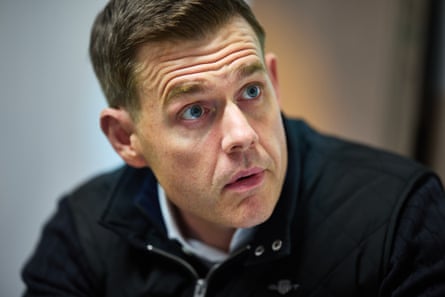
For a supposedly proud free-speech warrior, a man who has always readily embraced the adversarial side of politics, who says what he says and seems singularly unbothered by who he offends in the process, it all feels a touch incongruous. Goodwin has a huge Substack following, a significant media imprint and enough money not to need an MP’s salary. Why is a man with his own GB News show and a huge public platform concerning himself with bin collections and bus provisions in a place he had barely visited before January? What exactly are the voters of Gorton and Denton preparing to unleash on this country? In short: what’s the long game here?
Gorton and Denton is really about seven places in one: a jagged dinosaur’s tooth of a constituency, inelegantly redrawn in 2023, stretching from the slowly gentrifying south Manchester suburbs to the post-industrial villages and small towns of Tameside to the east. Some of it is lovely and some of it is grim. No single message, no single campaign can ever hope to appeal to the whole. In a way it is a perfect microcosm of modern Britain, fractured and dislocated from itself, separated by motorways and algorithms.

I sit in pubs and cafes and libraries and supermarkets and have countless conversations. There is no great enthusiasm for Reform in these parts, and even less for Goodwin himself. Nigel Farage is variously described as “a chancer”, “a smooth talker”, “a snake-oil salesman”, “full of shit”. But people intend to vote for his candidate nonetheless because – and this is something that also comes up again and again – they need to be “given a go”. Everyone else has fucked-up, and now it’s their turn.
There’s a bit of the basic, ill-informed racism that sounds parodic until you actually hear it come out of a real person’s mouth. We work hard; they come over here to take because of the benefits. My son can’t buy a house; they get houses for free. And by the way, if you’re hungry later there’s a cracking Chinese restaurant up the road. (This was a real conversation, and the guy was genuinely lovely. He bought me two pints of Cruzcampo, showed me his holiday photos and asked whether I was any good at paper folding.)
Insofar as anyone has heard of Goodwin, it’s because of his GB News show, which often plays in pubs with the sound down. Nobody can recall anything he’s actually said, whether it’s about fines for wearing the burqa in public places or penalising childless women through the tax system. Which, evidently enough, is a problem for anyone attempting to campaign against him. How do you counter a narrative that people can’t remember? How do you rebut a vibe?
“When I hear something racist or xenophobic, I will challenge it,” says Hannah Spencer, the Green party candidate. “But there’s a huge group of people considering Reform who aren’t racist, who often don’t fully understand what Reform are like. They don’t know what Matt Goodwin has been saying. When I’ve told people what he says about Muslims, what he says about women, people are really shocked. So maybe what we know about him, people don’t yet know about him.”
When asked previously about his past comments on Islam, Goodwin said: “What you’ll find in places like Longsight and Burnage is Muslim voters who are often quite socially and culturally conservative and agree with us on issues like open borders, legalisation of drugs, men going into women’s spaces, antisocial behaviour.”

One of the Greens’ main attack lines on the doorstep is that Goodwin isn’t really from Manchester. How does this square with the idea that this is a city for everyone, enriched for centuries by outsiders making it their home? “You don’t have to be from here to be one of us,” Spencer replies. “I really wholeheartedly believe that. However, I don’t believe he’s interested in wanting to make this area better. I think he’s just doing it because it’s a step on his career ladder. He wants the status and the attention and the ego.”
Goodwin is bristling. “I’m sorry, why would I want you to leave the country?” he asks, unhappy with the direction the conversation has taken. “When has anybody ever said anything like that?”
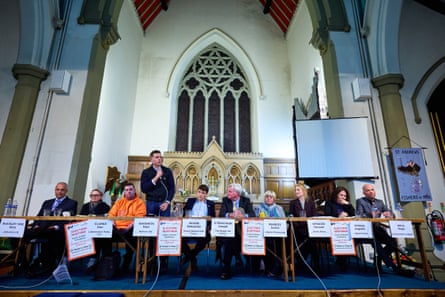
We’re back in Levenshulme, a few minutes before the start of the hustings, and there is precious little time for small talk. Goodwin has said in the past that Englishness is an “ethnicity deeply rooted in people that can trace their roots back over generations”. He has said that people from minority ethnic backgrounds, even if they were born here, are not necessarily British. Farage has already unveiled plans to deport up to 600,000 migrants in the first term of a Reform government. “Remigration” – a fancy term for the “send them back” motif that has defined far-right rhetoric for decades – is back on the political agenda. Do they mean me? Who is them? Where is back?
“I’m not sure you’ve looked at Reform policy in detail,” Goodwin says. “What I’ve said with regards to things like 7/7 and the Manchester bombings, is that if you come to Britain and you decide to blow up our children, you are rejecting membership of our community. Now, based on knowing you for one minute, you seem to be somebody who’s not … running around blowing up your fellow citizens.”
“Wouldn’t dream of it,” I respond.
“You seem to be working hard, probably paying taxes and probably following the rules. So I have nothing but support for people who do that. If you’re here illegally, you will be deported.”
The problem is that “legal” and “illegal” are extremely malleable terms, defined above all by the government and the polity of the day. My parents came here perfectly legally in the 1970s, but what if a future regime fixated on the evils of multiculturalism, determined to roll back mass immigration, decides that it wasn’t actually legal at all? “What I don’t understand,” I say, “is that you roll it back and roll it back. At what point do you say: OK, we’ve got our culture back? At what point is it enough?”
“Personally, I think we should do what America did after the 1920s and Ellis Island,” he replies. “America paused all immigration for 40 years. I think we should pause migration with the exception of a very small amount that is essential for some public services. And then we need to bring back a very limited amount of migration, something comparable to what we had in the 1980s, 1990s, before Tony Blair.”
But of course we had social unrest and racial tension in the 1920s, in the 1950s, in the 1960s, in the 1980s. Does he really think this was a better, more harmonious country in the 1980s?
“There’s been some disturbances,” Goodwin says disdainfully. “But nothing compared to what we’ve had over the last 25 years. 7/7, Manchester Arena, British Jews being murdered on the streets of Manchester. I mean, how much of this are you willing to tolerate? This is the problem with the left. The endless catastrophising. At no point did I say I wanted to return to the 1980s and 1990s. At no point did I talk about throwing communities out. And I’d appreciate a very fair write-up of this interview, otherwise Reform’s press officer will be in touch.”
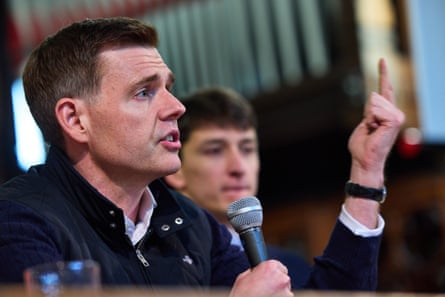
As he leaves, doubtless elated at having owned another lib, I finally realise why Goodwin has entered the rat race. Over the course of the subsequent two hours at the hustings, his eyes will frequently glaze and droop as a succession of parishioners raise their concerns over air quality, fly-tipping, traffic gridlock. What really appears to animate him is the cut and thrust of the culture wars, the end-of-civilisations stuff, politics as a vessel for race debate, the parliamentary byelection reimagined along the lines of the YouTube comments thread.
In essence this is the very substance of the rightwing strategy: politicians feign enough of an interest in what voters care about so they can get on with what they care about. Gorton and Denton goes to the polls on Thursday. What does Matt Goodwin really think? By the time we find out, it may be too late.



 English (US) ·