.png)
 1 hour ago
16
1 hour ago
16
UN chief warns situation in Middle East ‘getting out of control’

Peter Beaumont
The UN secretary general, António Guterres, has told the security council that the Middle East is being pushed to the “edge of the unimaginable” amid mounting fears over the trajectory of the conflict.
“The situation is getting out of control. It is teetering on the edge of the unimaginable. The region is being pulled into an ever-widening circle of confrontation. One crisis feeds another. One escalation triggers the next,” Guterres told a security council meeting.
“As this dynamic spreads, the political objectives are becoming increasingly obscured by the confrontation itself,” he said.
It comes after Donald Trump said he was close to deciding whether to launch “a massive attack” against Iran, on a scale larger than strikes already witnessed during the months-long conflict with Tehran as the US president flounders in his attempts to get a grip on the spiralling crisis in the region.
Amid growing evidence that a major escalation may be imminent, the UK announced that it was temporarily withdrawing diplomatic staff from Iran on Wednesday, and the German military announced on Thursday that it would withdraw two vessels from the Red Sea.
And as Israeli cities opened bomb shelters, the US state department warned Americans living in the region of the risk that flights may be cancelled.
With Trump’s poll ratings in freefall, and his war against Iran deeply unpopular at home, the US president and his administration are running short of time before the midterm elections in the autumn to force a resolution to the conflict on Washington’s terms.
Key events
Despite the success of the two Chinese supertankers bypassing the Houthi blockade of the Bab el-Mandeb strait, at least two other vessels chartered by the same company and scheduled to pick up Saudi crude at the Yanbu port later this month have slowed their advance.
Data shows the vessels are due to enter the Res Sea, but are making small circles in the Gulf of Aden.
The delays are a sign of the effect the Houthi threats could have on the market. Full avoidance of the Red Sea, through which a quarter of global container trade passes on its way to and from the Suez canal, requires rerouting around Africa via the Cape of Good Hope. That journey roughly doubles the voyage length and adds an estimated $2m-$2.5m in cost for each transit.
Two Chinese supertankers carrying a combined 4m barrels of Saudi Arabian oil exited the Red Sea via the Bab el-Mandeb strait on Thursday, apparently escaping the blockade on shipments of Saudi oil by the Houthis.
Their transit came as other Saudi vessels came under attack.
The Singaporean-flagged VLCC Xin Long Yang, which made a U-turn and paused in the middle of the Red Sea on Tuesday, resumed its journey southward late on Wednesday, shipping data showed. The Chinese-flagged VLCC Cosnew Lake followed and both tankers exited the Red Sea later on Thursday, the data showed.
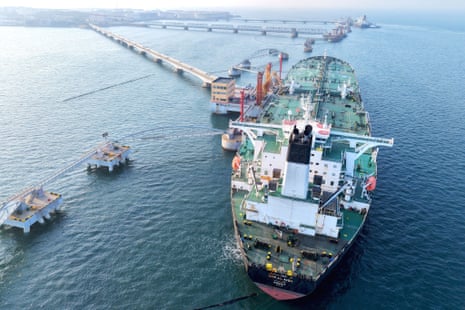
The Xin Long Yang was heading to the port of Qinzhou in southern Guangxi province, while Cosnew Lake is expected to discharge its cargo at the port of Huizhou, in the southern Chinese province of Guangdong, the data showed.
Both vessels indicated through their automatic identification system transmitters that there were Chinese crew onboard.
Experts say the transit of the Chinese tanker suggest the Houthis are being selective in the vessels they target – and that the blockade is being enforced differently depending on the flag or destination.
Donald Trump’s suggestion that the US could use Iranian frozen assets to pay for war damage comes as his administration threatened to step up attacks, and Yemen’s Houthis struck Saudi shipping and sent oil prices soaring.
Trump said the US would hold Iran responsible for the Houthis’ actions and warned both would soon receive a “major military punishment”.
On Thursday Brent crude surged past $100 a barrel for the first time since May, up 7%.
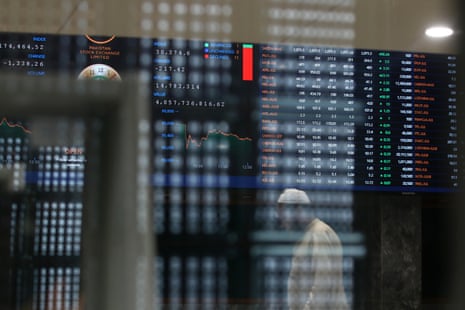
European Central Bank president Christine Lagarde warned “the energy shock could intensify further” and push up inflation, feeding speculation about a September eurozone interest rate hike.
German defence minister Boris Pistorius, meanwhile, warned of “dire consequences” for oil-importing economies and said “nothing – absolutely nothing – suggests that a ceasefire, let alone peace, could be reached”.
Donald Trump has suggested that damage caused to shipping by Iranian attacks could be paid for using Tehran’s assets frozen overseas.
Please let this statement serve to represent, until further notice, that from this point forth, any and all damages done to Ships, Cargo, or anything related thereto, will be paid for by Iranian Money that the United States has in its possession, and controls.”
It’s unclear whether the US would be able to use frozen assets in such a way; any move would probably be challenged.
Europe has faced an array of issues in its attempts to use Russian frozen assets to fund Ukraine.
The day so far
-
The UN secretary general, António Guterres, warned that the Middle East is being pushed to the “edge of the unimaginable” amid mounting fears over the trajectory of the conflict. “The situation is getting out of control. It is teetering on the edge of the unimaginable. The region is being pulled into an ever-widening circle of confrontation. One crisis feeds another. One escalation triggers the next,” Guterres told a security council meeting. “As this dynamic spreads, the political objectives are becoming increasingly obscured by the confrontation itself.”
-
It comes after Donald Trump said he was close to deciding whether to launch “a massive attack” against Iran, on a scale larger than strikes already witnessed during the months-long conflict with Tehran as the US president flounders in his attempts to get a grip on the spiralling crisis in the region. Speaking to Axios, the US president said: “I am considering a massive attack. Bigger than ever before. I am close to making a decision. We are all set for it.” He acknowledged that such a decision would have consequences but said he had not yet made a final determination. Israel “would join in two minutes if I ask them to”, he added, before saying: “We don’t need anybody.”
-
Trump’s comments followed the earlier threat of “major military punishment” against Iran and the Houthis, after the Iran-backed Yemeni militia’s attacks on two Saudi Arabian oil tankers in the Red Sea. The Houthi attacks threatened the safety of a second major maritime route connecting the Suez canal to the Red Sea and Gulf of Aden. They also came amid reports that Iran had sent military advisers and drone parts to the Houthis 10 days ago. Trump wrote on social media: “If [the Houthis] do this again, the US will hold Iran responsible, in that the Houthis are a Surrogate and/or Proxy of Iran, and major military punishment will be inflicted upon Iran and, of course, the Houthis, themselves.”
-
In a separate development, Trump clarified that an announced agreement that the US would help Saudi Arabia with its civilian nuclear programme would require the kingdom to normalise relations with Israel through the Abraham Accords, a move Saudi Arabia has long resisted until there is demonstrable movement on Palestinian rights and statehood. During Thursday’s press briefing, Karoline Leavitt, the White House press secretary, reiterated that the Saudi Arabia nuclear deal is “contingent” on the kingdom on joining the Abraham Accords. “The president is always the final dealmaker, as you know... He has said, if they don’t join the Abraham accords, the deal is off,” she said. It emerged later that Trump had not spoken to Saudi Arabia about the new condition.
-
Oil prices once again surged past the symbolic $100 for a barrel of Brent crude, the international benchmark, and amid indications the price could go higher still.

Haroon Janjua
“Whenever Trump starts taking about massive military action on Iran, everything changes in Iran overnight. Parents begin to stock up on food, groceries, and medicine; school administration fears opening the school, and children ask questions that no parent should have to answer. My biggest fear tonight is not anything but to watch another generation of Iranian children grow up believing that war is normal for us. We have already lived very difficultly through sanctions, inflation, and uncertainty. Another escalation and broader war would only deepen the anxiety that families carry with them every single day,” Sahar, a 38-year-old teacher from Tehran who uses only a single name, told the Guardian.
“In hospitals and medical facilities, we prepare for emergencies whenever there is a political statement of potential attacks. Even if there are no attacks taking place, the psychological impact is immediate about such ultimatums. Normal patients and families become more anxious, healthcare workers and medics worry about shortages, and people delay treatment because they fear what may happen next. The human cost of these threats on Iranians begins long before any attacks actually start,” Neda, a 31-year-old doctor from Tabriz, told the Guardian.
Iran’s top negotiator and parliamentary speaker, Mohammad Bagher Ghalibaf, has mocked the US military’s strategy aimed at degrading Tehran’s ability to control the strait of Hormuz, and suggested it has backfired.
“They wanted to punish Iran. Punished themselves with triple-digit oil instead. 10/10 strategy,” Ghalibaf said on X.
Oil prices rose above $100 a barrel for the first time in two months earlier on Thursday after the Houthis attacked two Saudi oil tankers, as a fresh escalation of the conflict threatens to compound disruption to global oil supplies.
Kuwait intercepting 'hostile' missile and drone threats, army says
Sirens are sounding in Kuwait, the state news agency reports, as the Kuwaiti army says its air defences are currently intercepting hostile missile and drone attacks from Iran.
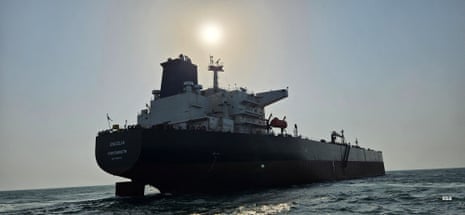
The Gulf Cooperation Council, led by secretary general Jasem Mohamed Albudaiwi, has condemned the Houthi targeting of Encelia, a Saudi-owned tanker in the Red Sea.
On Thursday, Albudaiwi said the attack “represents an extension of the hostile behavior pursued by the militia and a flagrant violation of international law.”
He added that the Houthi’s “continued threats to target commercial vessels and jeopardise international navigation lanes constitute a danerous escalation” in the region.
The attack marks a significant escalation in Middle East tensions and comes after Donald Trump vowed to destroy a bridge or power plant in Iran every time the country attacks a ship in the Hormuz Strait.
Oman’s foreign minister Badr Albusaidi has met with his UK counterpart, Ed Miliband, on Thursday amid growing tensions across the Middle East as Donald Trump deliberates on further strikes against Iran.
In a statement on X, Albusaidi said that the two “discussed the Strait of Hormuz and the urgent need for stakeholders to cooperate on UNCLOS obligations,” referring to the United Nations Convention on the Law of the Sea.
The meeting follows the UK’s decision to temporarily withdraw its diplomatic staff from Iran, citing “regional tensions" and “due to the security situation” in the Midle East which “remains unpredictable,” the UK government said on its website.
UN chief warns situation in Middle East ‘getting out of control’
Peter Beaumont
The UN secretary general, António Guterres, has told the security council that the Middle East is being pushed to the “edge of the unimaginable” amid mounting fears over the trajectory of the conflict.
“The situation is getting out of control. It is teetering on the edge of the unimaginable. The region is being pulled into an ever-widening circle of confrontation. One crisis feeds another. One escalation triggers the next,” Guterres told a security council meeting.
“As this dynamic spreads, the political objectives are becoming increasingly obscured by the confrontation itself,” he said.
It comes after Donald Trump said he was close to deciding whether to launch “a massive attack” against Iran, on a scale larger than strikes already witnessed during the months-long conflict with Tehran as the US president flounders in his attempts to get a grip on the spiralling crisis in the region.
Amid growing evidence that a major escalation may be imminent, the UK announced that it was temporarily withdrawing diplomatic staff from Iran on Wednesday, and the German military announced on Thursday that it would withdraw two vessels from the Red Sea.
And as Israeli cities opened bomb shelters, the US state department warned Americans living in the region of the risk that flights may be cancelled.
With Trump’s poll ratings in freefall, and his war against Iran deeply unpopular at home, the US president and his administration are running short of time before the midterm elections in the autumn to force a resolution to the conflict on Washington’s terms.
Today so far
-
Donald Trump posted on Truth Social that he will hold Iran responsible for attacked launched by the Houthi militia. This came after the Yemen-based, Iran-backed militia said it attacked two Saudi Arabian oil tankers in the Red Sea, with a Saudi news agency later confirming one of the vessels was ablaze on Thursday. The Houthis have declared a maritime blockade of Saudia Arabia, a move that current and former US officials said could significantly widen the US-Iran war and strain the American military.
-
Reuters reported that Iran flew Islamic Revolutionary Guard Corps (IRGC) commanders, military advisers and missile- and drone-related equipment into Yemen this month, which suggests that Tehran is seeking to strengthen its Houthi allies as US attacks on Iran continue.
-
Later, Trump told Axios that he was considering restarting major combat operations on Iran. “I am considering a massive attack. Bigger than ever before. I am close to making a decision. We are all set for it,” the president said.
-
The US launched its 12th successive night of strikes against Iran, saying military targets were hit to degrade Tehran’s ability to attack commercial vessels. Iranian state TV said two people were killed and 11 wounded in what a Khuzestan provincial official described as a US missile attack on the Shalamcheh border crossing with Iraq.
-
Iran’s Shalamcheh border crossing with Iraq was crowded with “hundreds of pilgrims” when it was reportedly targeted in a deadly US strike, according to an expert. The border is used by Iranian pilgrims going toward Najaf and Karbala in Iraq to commemorate the annual Arbaeen gatherings, which can involve more than 20 million pilgrims each year.
-
Trump said on Thursday that the US-Saudi nuclear deal is subject to the kingdom joining the Abraham Accords, which normalises ties with Israel. Karoline Leavitt, the White House press secretary, reiterated his comments later at the press briefing: “The president is always the final dealmaker, as you know... He has said, if they don’t join the Abraham accords, the deal is off.” Saudia Arabia has yet to comment on this, but Benjamin Netanyahu, the Israeli prime minister, said that Saudia Arabia joining the Abraham Accords “would be an historic leap forward for peace in the Middle East”.
-
Global oil prices have risen to more than $100 per barrel for the first time since May as violence escalates in the Middle East. Brent crude, the global benchmark, increased by more than 6% after Iran’s Houthi allies attacked shipping in the Red Sea.
-
Israel’s far-right national security minister Itamar Ben Gvir led hundreds of Israelis, including settlers, into the al-Aqsa compound in Jerusalem, a breach of a decades-old status quo. In a statement, the Palestinian Ministry of Religious Endowments and Affairs said: “These provocative practices, emanating from the highest political levels of the occupying government, seek to ignite a religious war throughout the entire region.”
-
The US House of Representatives on Thursday for the second time passed a war powers resolution directing Trump to withdraw the US military from the conflict with Iran. Its passage comes after the House last month approved a similar resolution, which the Senate later approved in a significant bipartisan rebuke of the president’s decision to join Israel in attacking Iran in February. The resolutions are nonetheless largely symbolic, as the Trump administration has argued such measures are unconstitutional.
-
The IRGC said on Thursday it stopped three oil tankers from passing through the strait of Hormuz. It said in a statement quoted by Iranian state media on Thursday that the three oil tankers “provoked” by the US military were trying to pass through a mine-laden route south of the strait “but after one of them exploded and caught fire, the other two quickly turned around and turned back”.
-
Earlier, Donald Trump warned on Truth Social that from now any time Iran shot at a ship in the Hormuz strait, the US “will bomb and destroy ONE BRIDGE OR POWER PLANT, including those located next to, or in, the Capital City of Tehran””.
-
The IRGC said its navy “emphasises that the strait of Hormuz is under our control”. US Central Command posted on X: “Iran does not control the Strait of Hormuz. The international waterway remains open for transit regardless of IRGC threats and attacks.”
Dubai offers £600 rewards to residents who lure friends to visit as tourist numbers plummet

Natasha May
Dubai is offering to pay residents who attract family and friends to visit the emirate in an effort to revive tourist numbers that have plummeted since the city was drawn into the US-Israel war on Iran.
The Dubai Invite scheme, an initiative of the department of economy and tourism, allows residents of the United Arab Emirates to nominate friends and relatives and then to receive benefits worth more than 3,000 UAE dirham (about £610) if they visit.
Visit Dubai’s website says residents will receive a “benefits package” including hotel stays, dining deals and attraction tickets.
Report: Trump is considering restarting major combat operations in Iran
Donald Trump gave an interview to Axios on Thursday in which he said he was “considering a massive attack” on Iran.
“I am considering a massive attack. Bigger than ever before. I am close to making a decision. We are all set for it,” the president said.
Trump told Axios that Israel “would join in two minutes if I ask them to,” but added that “we don’t need anybody” to launch a new operation against Iran.
“They haven’t received enough pain yet,” he said of Iran.
What are the Abraham accords?
The Abraham accords established formal relations between Israel and several Arab countries, ending a decades-old taboo in Arab diplomacy and signalling a power and priorities shift in the Middle East.
Signed in 2020 by Israel, Bahrain and the United Arab Emirates – three countries that already maintained significant informal ties – the accords established open business, direct flights and diplomatic relations. However, they fell short of full peace deals as the three countries have not been at war.
The agreements also had little to say about the Israeli-Palestinian conflict, which had been the obstacle to diplomatic progress until now – the signatories only had to commit to “continuing the efforts to achieve a just, comprehensive, and enduring resolution”.
More here:
White House: 'Deal is off' if Saudia Arabia does not join Abraham accords
During today’s press briefing, Karoline Leavitt, the White House press secretary, said that the Saudi Arabia nuclear deal is “contingent” on the kingdom on joining the Abraham Accords.
“This is a condition that the president has spoken about many times with our Gulf and Arab allies,” she said. “He wants to see these countries sign the Abraham Accords. It was one of the most historic acomplishments of his first term and it continues to be a longterm goal of his to expand those accords to ultimately come to a place where the Middle East can be a peaceful and stable region.”
When asked why the administration didn’t mention this as a condition when the deal was announced on Wednesday, Leavitt said that it is “something that he has mentioned on numerous occasions going back”.
“The president is always the final dealmaker, as you know... He has said, if they don’t join the Abraham accords, the deal is off,” Leavitt said.
US House passes war powers resolution directing Trump to withdraw US military from Iran

Chris Stein
The US House of Representatives on Thursday for the second time passed a war powers resolution directing Donald Trump to withdraw the US military from the conflict with Iran, amid renewed fighting in the Middle East that has driven oil prices to their highest levels in weeks.
The resolution proposed by Democrat Pramila Jayapal passed by a 214-208 vote, with four Republicans joining all Democrats in attendance to vote in favor.
Its passage comes after the House last month approved a similar resolution, which the Senate later approved in a significant bipartisan rebuke of the president’s decision to join Israel in attacking Iran in February.
The resolutions are nonetheless largely symbolic, as the Trump administration has argued such measures are unconstitutional. In debate ahead of the vote, the top Democrat on the House foreign affairs committee, Greg Meeks, accused the president of violating the law.





 English (US) ·