.png)
 1 hour ago
20
1 hour ago
20
Key events Show key events only Please turn on JavaScript to use this feature
Failure to adopt sanctions would make Russia 'happy,' Estonian foreign minister says
Germany’s foreign minister Johann Wadephul also said he was “astonished” by the Hungarian position on sanctions, and hoped to discuss this during today’s meeting of EU foreign ministers.
But Estonia’s foreign minister Margus Tsahkna was more blunt saying that the failure to adopt the new sanctions would only benefit Russia.
“If we are not able to put the sanctions on Russia, then Russia will be happy,” he said.
Hungarian government seeks to create, exploit anti-Ukrainian hostility in election campaign, Poland's Sikorski says
Poland’s foreign minister Radosław Sikorski has sharply criticised Hungary for blocking the 20th package of sanctions, saying it was “shocking” that with their history of fighting against Soviet aggression in the 20th century, the leaders in Budapest choose to attack Ukraine for domestic gains.
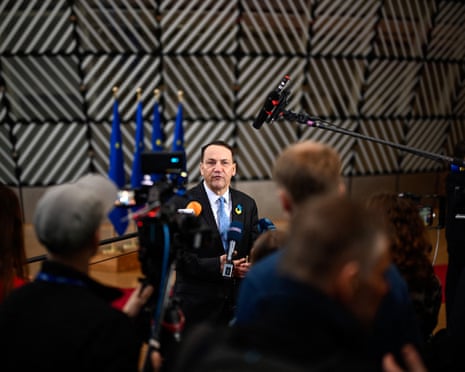
“I would have expected a much greater feeling of solidarity from Hungary for Ukraine. Instead, with the help of state propaganda and private but controlled by the government media, the ruling party managed to create a climate of hostility towards the victim of aggression, and … now is trying to exploit that in the general election,” he said.
Morning opening: New Russia sanctions on hold

Jakub Krupa
The European Union is increasingly unlikely to reach an agreement on the new, 20th package of sanctions against Russia ahead of tomorrow’s fourth anniversary of the full-scale invasion of Ukraine, as Hungary continues to block the package.
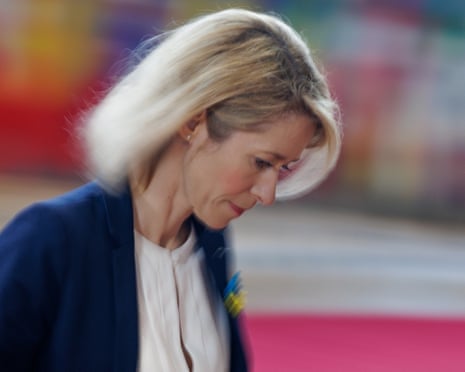
EU foreign policy chief Kaja Kallas admitted this morning that "there is not going to be progress” on this issue today, as Budapest continues to block the adoption of the sanctions.
“We are doing our utmost to have the sanctions package … through … and we are looking for ways how we can do it. But as we have heard some very strong statements from Hungary, … I don’t really … see they are going to change this unfortunately today,” she said.
Hungary opposes the proposed measures – as well as the payment of the €90bn loan for Ukraine – as part of its escalating dispute with Ukraine about oil transit using the Druzhba pipeline.
Hungarian foreign minister Péter Szijjártó said on Sunday that “until Ukraine resumes oil transit to Hungary and Slovakia via the Druzhba pipeline, we will not allow decisions important to Kyiv to move forward.”
It also comes just six weeks before the key parliamentary election in the country, which could see its pro-Russian prime minister Viktor Orbán ousted after 16 years in power.
The embattled leader – currently trailing 10 points behind the opposition leader, Tisza’s Péter Magyar – increasingly turns to anti-Ukrainian rhetoric to falsely allege a conspiracy between Kyiv and Brussels to remove him from office and talk about the risk of war expanding to Hungary.
The failure to agree on the new package of sanctions would be politically embarrasing for the bloc as its leaders, including the commission president Ursula von der Leyen, plan to travel to Kyiv on Tuesday to mark the anniversary.
I will bring you all the key lines from Brussels here, as well as other stories from across Europe, as we expect Rob Jetten to be sworn in as the new Dutch prime minister, Finland’s Alexander Stubb to meet France’s Emmanuel Macron in Paris, and hear from the European Parliament on the future of the EU-US trade deal.
It’s Monday, 23 February 2026, it’s Jakub Krupa here, and this is Europe Live.
Good morning.







 English (US) ·