.png)
 2 hours ago
22
2 hours ago
22
In a growing number of workplaces, the soundtrack of the lunch break is no longer the rustle of sandwiches at a desk, but the quiet hum of bees – housed just outside the office window.
Employers from Manchester to Milton Keynes are working with professional beekeepers to install hives on rooftops, in courtyards and car parks – positioning beekeeping not as a novelty but as a way to ease stress, build community and reconnect workers with nature in an era of hybrid work and burnout.
“There’s something very special – almost spiritual – about enabling your employees to take time away from work to see how nature has created the greatest example of how every business should run,” said Chris Payne, a co-founder of Green Folk Recruitment.
“If every organisation ran like a beehive – with shared, purpose-driven goals, decentralised decision-making where individuals act autonomously for the collective good, and honest communication – it would be a very successful business indeed,” he added.
Twice a year, Payne takes his employees on a four-hour round trip to Buckley’s Bees in Crewe, where they learn beekeeping and how to construct hives. “When we’re qualified, we’ll bring the hives we’ve built back to our offices,” he said. “It will be a magical moment.”
Emma Buckley, the chief executive of Buckley’s Bees, has about 24 UK clients and more than 10 international ones. Business has grown so quickly that she is now recruiting additional staff.
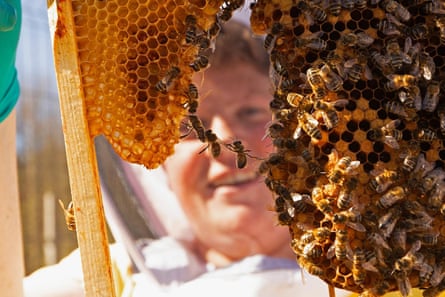
“Our motivation is improving people’s mental health, which employers increasingly understand is closely linked to nature,” she said. “It’s amazing to see the engagement on people’s faces as soon as we start talking about bees: they get completely lost in the world of bees and forget all about their troubles.”
Buckley runs lunchtime workshops for employees and installs cameras inside hives so they can observe the bees from their desks. “We even have one company that livestreams into their break room,” she said.
Mark Gale, the founder and managing director of BeesMax Ltd, said the experience was calming, educational and oddly bonding: a rare opportunity for employees to step away from screens and care collectively for something fragile and alive.
“It’s like nothing else you could possibly experience during a working day,” said Gale, who rents out and manages hives at sites including the QEII Centre in London, the video games developer Codemasters and the DoubleTree by Hilton hotel chain. “One minute employees are eating their sandwiches at their desk – and the next, they’re in full body suits with 10,000 bees flying around them.”
Gale said demand had increased so much that he was taking on new, full-time staff. “The increase is entirely organic,” he said. “It’s all word of mouth.”
Supporters of office apiaries say the appeal goes beyond novelty, pointing to workplace wellbeing, team building and tangible evidence of environmental commitment that companies can showcase to clients and staff alike.
Some teams report that the bees have become a source of camaraderie, and that in a workplace culture where perks often consist of gym subsidies or free snacks, nature-based experiences feel refreshingly purposeful and even quietly radical.
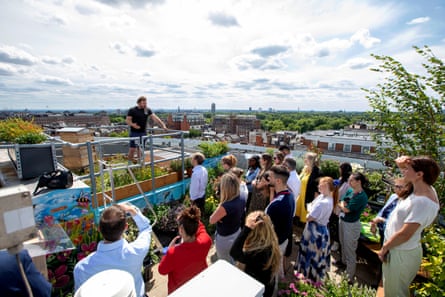
“A gym discount or fruit bowl is nice, but the bees create a shared story and a sense of stewardship,” said Phillip Potts, the general manager of Park House, on London’s Oxford Street, which has seven floors of office space.
“Our tenants say it is the most unusual and memorable workplace perk they have experienced – and our queen bee has developed something of a cult following in the building,” he added. “We call her Philippa.”
Damson Tregaskis, the founder of Hive5 Manchester, has also noticed an increase in demand. “Employers want to encourage workers to connect more with nature,” she said.
But as the trend spreads, so do questions about its environmental impact. Ecologists and conservation bodies warn that the rapid growth of managed honeybee colonies – particularly in towns and cities – may not be the unalloyed good it appears to be, when viewed through a biodiversity lens.
The concerns apply across the UK, from regional cities to market towns. Any place with limited green space risks putting additional pressure on already declining wild insect populations.
Tregaskis is conscious of this. “I know really big companies who have been interested but their motivation has been, for want of a better word, greenwashing,” she said.
“Even in these cases, though, you can connect with the people on the ground and make sure you make a real difference,” she added.
Buckley is also keenly aware of these issues, pointing to research suggesting that in areas with high density of hives, honeybees can compete with native bees, butterflies and hoverflies for limited nectar and pollen.
“We’re careful not to take on any business in locations that are densely populated or already have a lot of beekeepers,” she said.
Office apiaries stem from two modern anxieties: the scramble to improve workplace wellbeing, and the need to be seen acting as nature declines. In a single lunch break, the bees’ quiet hum can offer a moment of both.





 English (US) ·