.png)
 2 hours ago
21
2 hours ago
21
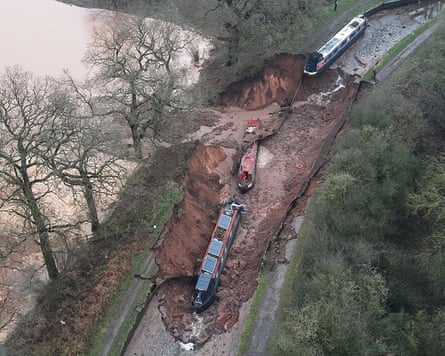
The dramatic breach of a canal in the early hours of Monday, which sent two narrowboats tumbling into a hole and left others stranded, was caused by the collapse of an artificial embankment that had stood for more than 200 years.
As emergency services declared the major incident phase over more than 24 hours after the embankment failure, work was beginning to isolate the damaged section of the canal and refloat boats still stranded either side of the emptied section of waterway.
Julie Sharman, the chief operating officer of the Canal and River Trust (CRT), which manages the Llangollen canal, was at the scene watching the remedial works under way. She said there was as yet no indication of what caused the embankment, which had been inspected last month, to collapse.
“At this point in time, we don’t have anything that is telling us, ‘Oh, it’s clearly was that’,” she said.
“Canals are old, you know, and they need a lot of care and maintenance. We inspect them regularly. We have some embankments that we are monitoring and more concerned about. And we inspect more frequently. This isn’t one of the ones that we were concerned about.
“Fortunately, it’s very rare. And obviously, you know, we do everything we can to make sure the network is stable and safe.”
The CRT’s on-site team were installing fabric dams either side of the breach and a pipe to carry water across on Tuesday, so that parts of the canal downstream could be refilled and about half a dozen stranded boats refloated.
The boats at the bottom of the hole are not on flat ground and were probably damaged, although they have not been closely inspected, Sharman said. The section of embankment that had collapsed had been between three and five metres high.
Scientists suggested the collapse could have been caused by high water levels and the ingress of water into the earth works holding the canal at its artificial elevation, destabilising them.
Dr Jamie Pringle, a reader in forensic geosciences at Keele University, pointed out that bedrock in the area contained large amounts of salt, “which of course is soluble”.
“That part of the Llangollen canal has Triassic Wilkesley halite and mudstone, so soluble rock, hence why they initially thought collapse was due to a sinkhole, I think,” he said.
The Llangollen canal was among those the Inland Waterways Association flagged this year as being an amber risk, but its director of campaigns, Charlie Norman, said the designation was the result of lack of funding rather than structural issues.
But she pointed out that the last major canal collapse in the UK happened at a similar time of year after a period of wet weather. The Bridgewater canal embankment at Dunham Massey collapsed on New Year’s Day. It was also said to have been well maintained and not thought to be at immediate risk.
“The year is ending as it began, with major incidents on our waterways, and without decisive action these breaches will keep repeating,” Norman said. “Maintenance alone isn’t enough. This canal is a vital piece of national water infrastructure. Every failure shuts down the connected system, disrupting water supplies and local economies and in some cases leaving people homeless.
“That’s why IWA has mapped the risks across our 5,000-mile network, and this year has shown those risks are growing. It’s fortunate no one was injured here, but a multi-agency investigation is essential.”
Sharman said she hoped the operation to refill the canal either side of the breach would begin soon. “I’m really hopeful that we’re going to get the boats floated tomorrow evening, if not maybe the day after, Christmas day,” she said.
But a full repair of the damaged section of canal would take most of next year. “It’ll probably take six to nine months and probably a couple of million pounds to get this embankment rebuilt and the canal reopened,” she said.
She also said the CRT was trying to support the boaters rendered suddenly homeless on the eve of Christmas. “Our hearts go out to those people and we’re trying to take care of them best they can,” she said.
“This is very rare. We don’t want people to worry, but it’s very difficult experience for those people who’ve been right in the middle of it.”
Peter Styles, a fomer president of the Geological Society of London, also visited the site and confirmed that the incident had been caused by the collapse of one section which was 200 year old. “It will take some fixing.”







 English (US) ·