.png)
.png) 2 hours ago
17
2 hours ago
17
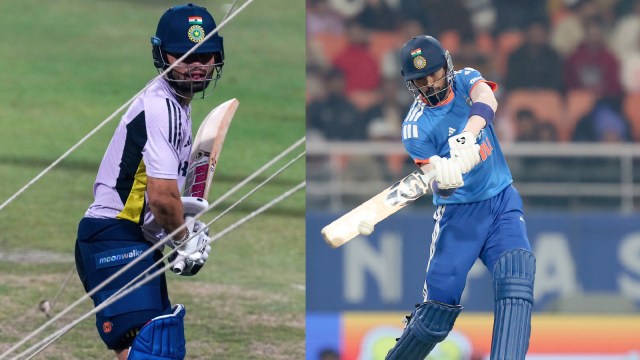 The batting profiles of Hardik and Rinku are similar yet dissimilar. Both are loosely classified as finishers. But they are primarily in the team to flick on the afterburners at the death overs, or to wrap up a chase. (AP and CREIMAS for BCCI)
Dropping Shubman Gill was the bravest move the selectors made when picking India’s squad for the T20 World Cup; the boldest, though, was recalling Rinku Singh. By installing another power-hitting, middle-order batsman in a line-up already rippling with muscle and power, India has emphasised their commitment to pure aggression in their title defence.
It would embolden an incendiary top eight, like one long stanza without a pause or punctuation, or a supercharged relay, where one batsman passes the belligerence baton to the other, an eleven without an accumulator, no classical batter whose default is to hold an innings together and build a crescendo. It blurs the boundaries of top, middle and lower-middle orders, but fuses them into one single slab of ball-strikers. Whichever batsman strides into the centre, starts spanking the ball from the get-go. It’s the cricketing equivalent of a midfield without a defensive midfielder.
It promises fireworks and fascinating associations. Like Hardik Pandya and Rinku, two unbridled hitters, unleashing mayhem on shivering bowlers. They offered a preview of their collective destruction last year when biffing 36 runs off 21 runs against Sri Lanka. But India’s fixation with stacking all-rounders, and there was little reason to revise the successful strategy, made Rinku an unfortunate casualty.
HARDIK PANDYA
186 Strike Rate (Last 3 Innings)
142 Runs in 3 Outings
1 in 8 Six Every 8th Ball
Hitting Style
- Flat, laser-like sixes
- Back-foot dominant
- Down-the-ground power
- Bottom-handed hitting
- Risk-averse approach
RINKU SINGH
161.76 Strike Rate (25 T20Is)
36 Runs in 21 Balls vs SL
1 in 11 Six Every 11th Ball
Hitting Style
- High-arc towering sixes
- Open stance, clears leg
- Extra cover specialist
- Less bottom-handed
- High-risk shot maker
Shared Finishing DNA
Approach
Controlled Power
Foundation
Technical Robust
Indian Express InfoGenIE
So much so he did not even get to bat in the last three games he played. Often, he warmed the benches, or ferried the drinks, the team management wondering how to unlock his precious gifts. But like in a crossword, one correct alphabet could complete the word. Pundits swoon on opening pairs, middle-order duets, seaming and spinning twins, Hardik and Rinku would be the axemen couple on whom super-modern T20 teams would draw templates.
The batting profiles of Hardik and Rinku are similar yet dissimilar. Both are loosely classified as finishers. But they are primarily in the team to flick on the afterburners at the death overs, or to wrap up a chase. Both have varied and deeper layers to the game, their batting grounded in technical robustness, both are capable of batting anywhere in the order, are versed in the art of accumulating if need be. But in this line-up, in a non-emergency situation, their function is to attack from the first ball. Besides, it could have a knock-on effect on batsmen batting ahead of them. They tend to play more aggressively when high-quality players exist down the order, thereby auguring resource maximisation.
Controlled hitting
The spirit that rages in them is the same, controlled power hitting.
Hardik, since his return from injury, has been a murderous knick. In three outings, he wafted 142 runs at a strike rate of 186. He smoked 10 sixes, that is a maximum every eighth ball. He heaved 11 fours, which is a boundary every seventh ball. Stunningly, he does so without courting risks. The bowler has to be pinpoint accurate to deny him a boundary-scoring opportunity. He punishes even the smallest of errors. In Ahmedabad, Corbin Borsch’s yorker had erred by a millimetre for Pandya to get underneath the ball and smear it down the ground.
Story continues below this ad
On the other hand, Rinku is more open to high-risk, non-percentage shots. He ramps and reverse sweeps. But like Hardik, in this format, Rinku sets his base on the back foot (though not as pronounced as Hardik), opens up his stance, sometimes clears his front leg. The first route Hardik’s eyes track is down the ground; Rinku’s hovers the extra cover region. The all-rounder from Baroda, who lived in shady rooms and survived on noodles, hits the ball flatly. The sixes of Rinku, who juggled odd jobs to realise his cricketing dream, traces a higher arc, the ball often vanishing in the night skies. He is less bottom-handed than Hardik. Rinku hits sixes fairly frequently too — one every eleventh ball, and a four every seventh ball, helping him command a strike rate of 161.76 in 25 T20I innings.
Two Caribbean finishers have helped nuance their art of finishing. Andre Russell of Kolkata Knight Riders praised Rinku thus: “As a batter, you have to have an open mind and be relaxed. You can’t expect just a full-pitched delivery. You have to expect the slower ball, the yorker, the short ball at the head, and Rinku has a shot for every delivery. He is always calm and relaxed.”
Russell’s West Indies colleague Kieron Pollard has uttered similar lines on Hardik, his Mumbai Indians ex-pal. “He has that confidence that he can hit any ball for a six, or win any game from anywhere. He is one of those guys who is free-spirited and will just go out and try to use his exuberance to have an impact on the game.”
They are men of different humours. Hardik walks with a swagger; Rinku with a mischief. Hardik wears a sombre face these days, his celebrations are understated; Rinku bats with a big broad smile and he could go overboard in moments of joy. He climbed on a tired Tilak Varma after hitting the winning runs against Pakistan in the Asia Cup final. Both quickly wipe the smile from the bowlers’ face too.






 English (US) ·