.png)
 2 hours ago
20
2 hours ago
20
When director Gautham Vasudev Menon was putting together his Telugu romantic drama Ye Maaya Chesave, the plan was always to cast a big name in the lead. Mahesh Babu was approached, the script was sent, and the answer came back: not the right fit, no available dates. A relatively unknown actor named Naga Chaitanya stepped in. And the woman cast opposite him, a complete newcomer who had appeared in three Tamil films that never released, was a 22-year-old named Samantha Ruth Prabhu.
On February 26, 2010, Ye Maaya Chesave opened in theatres. Sixteen years later, it remains one of the most talked-about Telugu romantic films ever made.
The film follows Karthik, a mechanical engineering graduate who wants to become a filmmaker. He lives with his family on the ground floor of a two-storey house in Hyderabad and falls for Jessie, his Christian Malayali neighbour. What follows is a slow, lived-in depiction of love across nearly three years, the push and pull of two people from different religious and cultural backgrounds, and what happens when a family’s disapproval becomes the wall between them.
The day Samantha Ruth Prabhu began
February 26, 2010 is, before anything else, marks Samantha Ruth Prabhu’s theatrical debut. She had acted in three unreleased Tamil films before this, but made her silver screen debut with Ye Maaya Chesave. In a later interview, Samantha recalled the experience with clarity: “The first scene I shot was the gate meeting with Karthik. I recall every little detail about that moment because working with Gautham Menon was a fantastic experience. He knew exactly what he wanted and how the character should come across.”
Her performance as Jessie earned her the Filmfare Award (South) for Best Female Debut, with the role highlighting her natural screen presence and emotional depth. It is virtually impossible to talk about Samantha’s filmography without highlighting her performance in Ye Maaya Chesave-it established her as a recognisable face and she was the undisputed choice of the younger generation.
How the casting came together
None of this was the original plan. After the announcement of Gautham Menon’s Tamil project, Manjula Ghattamaneni approached him to do a Telugu version, initially with Mahesh Babu in the lead. Menon forwarded the script but felt it was “not the Mahesh kind of film.” When Mahesh Babu could not allocate dates, he was replaced by Naga Chaitanya. For Chaitanya, the film became a career breakthrough, receiving cult status at the box office and earning him his first Filmfare Award for Best Actor nomination.
Story continues below this ad
The film was simultaneously shot in Tamil as Vinnaithaandi Varuvaayaa, starring Simbu and Trisha, with a different cast and ending. Gautham Menon ran both productions in parallel. The Hindi remake, Ekk Deewana Tha, followed in 2012, also directed by Menon, a rare case of the same director adapting his own film three times across three languages.
Take Ye Maaya Chesave away and the album still stands on its own. The album has seven tracks, with Telugu lyrics penned by Anantha Sreeram. Rahman’s compositions from the Tamil version were used without any changes in the Telugu version, and he won his first Filmfare Award in Telugu for this album. “Kundanapu Bomma”, “Ee Hridayam”, “Nuvvante”, sixteen years on, these songs still find their way onto playlists.
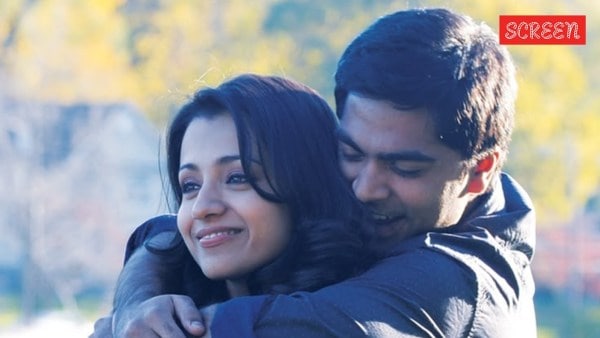 Trisha and Silambarasan TR in Vinnaithaandi Varuvaayaa
For Samantha Ruth Prabhu, the film was the starting point of one of Telugu cinema’s most decorated careers. Early successes followed with films like Brindavanam (2010) and Dookudu (2011), the latter becoming one of the highest-grossing Telugu films of its time, establishing her firmly as a leading actress. She went on to win four Filmfare Awards across Telugu and Tamil cinema, with recognition from multiple industry bodies along the way.
The film also changed how Telugu audiences responded to restrained, conversation-driven romance. Before Ye Maaya Chesave, the mainstream Telugu romantic film was built around songs, comic sequences, and a loud third-act resolution. This movie stripped most of that away and still worked, commercially and critically. Many filmmakers have since cited it as a reference point for grounded Telugu romance. Even the YMC abbreviation became shorthand, so attached to Samantha that she reportedly had it tattooed on her back during her marriage to Naga Chaitanya, and its removal after their divorce in 2021 became a news story of its own.
Story continues below this ad
Over time, Ye Maaya Chesave has come to occupy a quiet, enduring space in Telugu cinema. It introduced a new talent, brought AR Rahman’s sound closer to Telugu audiences, and showed that a simple, deeply felt love story could resonate widely. There was no spectacle, just two people, a sincere script, and music that stayed with you.





 English (US) ·