.png)
Katy WatsonAustralia correspondent

 BBC
BBC
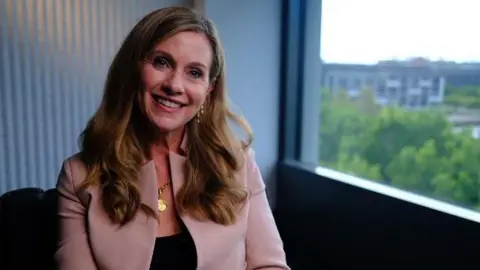
Julie Inman Grant has her work cut out as Australia's internet safety regulator
The interview with Julie Inman Grant is yet to start - she is not even in the room - when the conversation turns to the barrage of death and rape threats her office deals with on a weekly basis.
The job of heading up Australia's eSafety Commission has put her squarely on the frontlines of internet battles - over fake news, censorship, trolling and children's safety.
The online world can be a "cesspit", a colleague admits, noting the vast majority of abuse lobbed their way is targeted at Inman Grant personally.
"Unfortunately, I've been living that reality for the past several years," the 57-year-old tells me herself a few minutes later, in her office overlooking Sydney Harbour.
After decades spent working in the private tech industry, Inman Grant now finds herself on the other side: holding some of the world's most successful companies accountable as head of Australia's independent online safety regulator.
It has arguably made her the country's most famous bureaucrat. But it's also made her a target.
She was doxxed by neo-Nazi groups, has sparred publicly with Elon Musk and has even drawn the ire of some in the US Congress.
All that while being tasked with implementing the country's pioneering social media ban on teenagers - or, in simpler words, kicking every Australian under the age of 16 off social media.
Inman Grant's job has always been a high-stakes one but, with the world watching how Australia's social media experiment turns out, now more so than ever.
Ten platforms come under the legislation, which came into force on 10 December, including Meta's Facebook and Instagram, as well as Snapchat and YouTube.
Parents across Australia have widely supported the policy. For many, having the government on their side helps when they are at loggerheads with pre-teens desperate to get on to social media.
But there are plenty of critics. Technology experts and child wellbeing advocates have voiced concern, saying children need to be educated, not banned from platforms.
Many question the ban's enforceability and say it unfairly excludes minority groups such as rural kids, disabled teenagers and those who identify as LGBTQI+ - all of whom are more likely to find their communities online.
Watch: What do teenagers think about Australia's social media ban?
Unsurprisingly, none of the companies are hugely supportive either. Across the board, they have said they share the government's concerns about online safety and will comply with the law, but don't think a "ban" is the way to go.
Inman Grant argues anything that could help protect children online is worth trying.
"If we can delay [kids'] entry into social media for three years, and we can supplement that with digital action plans so that we're building their critical reasoning skills and resilience, then that's something that I think is worth exploring," she says.
It's at this point she often likes to compare the digital world with the open water - a clever tactic, perhaps, to draw in Australians proud of their relationship with the ocean and their beautiful beaches.
"Just like with water safety, we have to continue teaching our kids to swim until they're strong swimmers," she says. "We need to teach them about risks, like algorithmic rips. We need to teach them about predators in the water. It's sharks online, it's paedophiles and other scammers."
But she's also used the water analogy to argue against a ban in the past.
"We do not fence the ocean or keep children entirely out of the water but we do create protected swimming environments that provide safeguards and teach important lessons from a young age," she said in June 2024, while the government was still weighing up the ban.
"I actually had to come around to it," she admits now. After pushing to be given freedom in how it was rolled out, she was persuaded. And her role has been central in shaping which companies will be included and how they must comply.
She jokes her own home, which she shares with three children, including 13-year-old twins, has become a "laboratory". "I had one [child] that wasn't really fussed about the idea, but another who thought the sky was falling [in] that her Instagram and her Snapchat might be taken away."
She's not put off though. "They're in the midst of figuring out who they are, building their identities," she says.
"I was able to screw up as a teenager and not have it filmed and amplified all over the place."
 AFP via Getty Images
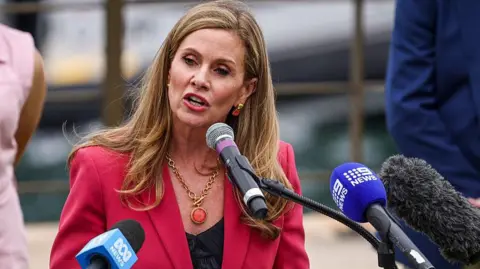
Inman Grant speaking at an event in Sydney on 10 December, the day the social media ban came into effect
Inman Grant's own formative years were spent in the orbit of the tech world. She grew up in the US state Seattle, the home of Microsoft and Amazon.
It's perhaps little surprise then that she fell into this line of work, after briefly flirting with the idea of working for the CIA.
She took a job at Capitol Hill, advising a US congressman on telecommunications and technology. From there, she did a masters in international communication before taking a job with Microsoft.
It was a posting at Microsoft that brought her to Australia in the early 2000s, just as the social media scene was starting to flourish. Here, she met her husband and has now become an Australian citizen.
As part of her work with Microsoft, Inman Grant looked for security vulnerabilities and safety breaches. After 17 years, she moved to Twitter's Australian operation and then briefly to Adobe.
While these tech companies were booming as the use of smartphones and apps proliferated, she felt there was an elephant in the room. Safety, she believed, wasn't being prioritised. This was an era without government regulators.
"[So] I tried to change things from the inside out."
After more than two decades, she decided to see whether change could happen from the outside instead.
When the job of eSafety Commissioner came up, she bashfully explains there was a small pool of candidates to choose from. The man who helped write the bill, Malcolm Turnbull, went on to become prime minister. He hired her and, she says, wanted a commissioner with a background in online safety, but also experience in the tech sector itself.
"[The government] didn't think you could be an effective regulator unless you knew the people and you knew the levers and you knew how they were thinking and you could anticipate their moves," she recalls.
"[You have] to understand that all of this is driven by revenue and growth and who has the power in the companies."
 Getty Images
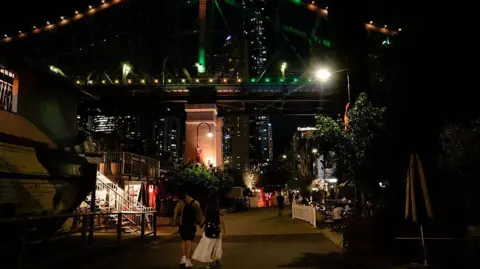
Brisbane's Story Bridge lot up in to mark the start of the social media ban
The role is one that has since been championed by politicians of all stripes, in what many see as a testament to how Inman Grant has managed the office. And especially so in a period that has seen scrutiny on the internet safety watchdog grow dramatically, its budget quadruple, and its remit and staff expand exponentially.
'[It's] frankly an extraordinary tenure in what is a fast-moving, pretty unforgiving type of space for a regulator," Inman Grant's predecessor Alastair MacGibbon says of her work. "The office has just become more relevant by the day."
Former Communications Minister Paul Fletcher, who helped appoint Inman Grant and worked with her closely for several years, said she has tackled the personally demanding role with vigour and courage.
"People take it for granted in a modern Western nation, that if you're assaulted or robbed or something else bad happens to you in the physical town square that you can get redress," he told the BBC.
"The rule of law needs to apply in the digital town square as well as in the physical town square, and the eSafety Commissioner is really a very clear manifestation of that."
While Australia sees itself as a world leader in the online safety space, some tech companies, headquartered in other parts of the world, have long accused the country of overreach.
"We've been regulating big tech for online safety for 10 years, and for the first seven years, we were the only ones," Inman Grant says.
As we speak, Inman Grant is resisting a request from the US Congress to testify about Australia's social media ban laws and has been referred to by the Republican House judiciary chair as a "noted zealot for global takedowns" who "threatens [the] speech of American citizens". Jim Jordan has even threatened her with contempt charges if she refuses to give evidence.
Inman Grant says she's not responsible for defending the policy, and can only really speak to its implementation: "Nothing that we do here affects the ability of American companies to show any content that they like to Americans."
She is also preparing to fight at least two High Court challenges against the ban - one from online forum Reddit and another from a pair of Australian teens - while also pursuing companies found in breach of the nation's array of online safety laws through the courts.
Watch: Annika Wells says big tech won't intimidate her over Australian social media ban
This, though, is far from her first rodeo.
In 2024, after a bishop was stabbed in Sydney during a service that was livestreamed, Inman Grant asked for the video to be taken down from X. The company's owner, Elon Musk, refused.
Instead, he called her a "censorship commissar" to his millions of followers and the abuse towards her reached a whole new level.
A report by Columbia University found Inman Grant was the target of tens of thousands of abusive posts, including death and rape threats. On 23 April 2024 alone, the report counted 73,694 mentions of Inman Grant or the eSafety Commissioner's office on X. Before then, the daily average was just 145.
While eventually the video was geo-blocked in Australia, it was still available around the world. The internet watchdog took X to court, but the case was ultimately dropped.
"[This kind of content] normalises, it desensitises, and it sometimes radicalises," she says. "At some point you have to take a stand."
But even as she and her office grapple with pulling off Australia's social media ban, Inman Grant is gearing up for new battles, now zeroing in on artificial intelligence (AI).
The world was "late to the game" with social media regulation, and it cannot afford to do that with AI, she explains.
"That's going to be the next and a much more pressing threat, to be honest."
But she may not be in the job long enough to see the fruits of that fight. She has been commissioner for nearly a decade now. Her second five-year term comes to an end next year.
"I think it will probably be time to hand over the reins to someone else. As I said, this takes a lot of resolve and a lot of resilience. It's been the privilege and the honour of a lifetime."
Before tech companies breathe a sigh of relief though, she hints she won't be swayed from her career-long mission of making the tech world safer.
"Maybe that means helping other governments establish online safety regulation and helping companies really embed safety by design."




 English (US) ·