.png)
 23 hours ago
24
23 hours ago
24
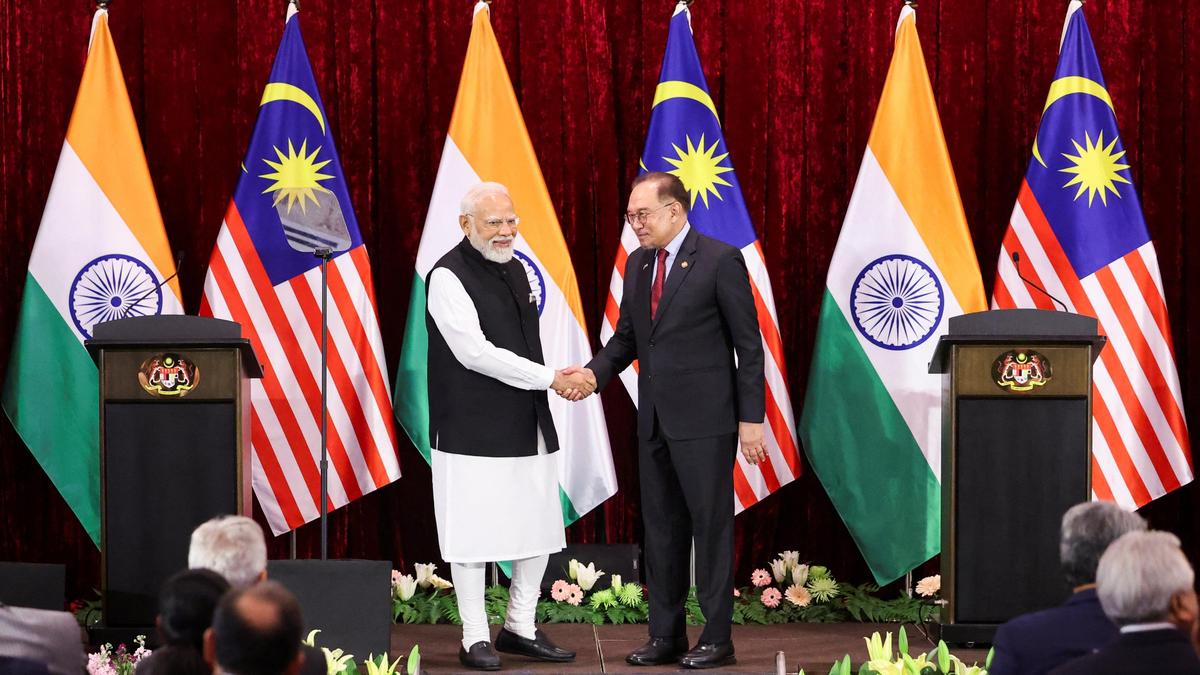
In a significant development, the US administration led by President Donald Trump said in an executive order waiving off the 25 per cent Russian penalty, that India has “committed to stop directly or indirectly importing Russian Federation oil”, has represented that “it will purchase United States energy products from the United States, and has recently committed to a framework with the United States to expand defense cooperation over the next 10 years”.
The tariffs have been withdrawn on or after 12:01 a.m. eastern standard time on February 7 (10.30 am IST).
These three elements — stopping Russian oil imports, buying energy from the US and boosting defence cooperation —are part of the larger strategic deal between India and the US, so that Delhi can get the waiver of punitive 25 pc tariffs.
There was no immediate response from Delhi, but on February 5, in the first remarks since US President Trump’s post on Truth Social that Prime Minister Narendra Modi “agreed to stop buying Russian oil” and “to buy much more from the US and, potentially, Venezuela”, and that “this will help end the war in Ukraine”, India had on Thursday said it was “diversifying energy sourcing” in keeping with “objective market conditions and evolving international dynamics”.
In the latest order titled, “Modifying duties to address threats to the US by the Russian government”, the US President Trump’s signed order said, “In Executive Order 14329 of August 6, 2025 (Addressing Threats to the United States by the Government of the Russian Federation), I found that the national emergency described in Executive Order 14066 has continued and that the actions and policies of the Government of the Russian Federation continue to pose an unusual and extraordinary threat to the national security and foreign policy of the United States. To deal with that threat, I determined that it was necessary and appropriate to impose an additional ad valorem rate of duty of 25 percent on imports of articles of India, which, at that time, was directly or indirectly importing Russian Federation oil.”
“I have received additional information and recommendations from senior officials regarding India’s efforts to address the national emergency described in Executive Order 14066. Specifically, India has committed to stop directly or indirectly importing Russian Federation oil, has represented that it will purchase United States energy products from the United States, and has recently committed to a framework with the United States to expand defense cooperation over the next 10 years.”
He further said, in the order, “After considering the information and recommendations these officials have provided to me, among other things, I have determined that India has taken significant steps to address the national emergency described in Executive Order 14066 and to align sufficiently with the United States on national security, foreign policy, and economic matters. Accordingly, I have determined to eliminate the additional ad valorem rate of duty imposed on imports of articles of India pursuant to Executive Order 14329. In my judgment, this modification is necessary and appropriate to deal with the national emergency declared in Executive Order 14066.”
Story continues below this ad
“Effective with respect to goods entered for consumption, or withdrawn from the warehouse for consumption, on or after 12:01 a.m. eastern standard time on February 7, 2026, products of India imported into the United States shall no longer be subject to the additional ad valorem rate of duty of 25 percent imposed pursuant to Executive Order 14329.”
This action puts India in a diplomatically difficult position vis-a-vis Russia, as it had increased its oil uptake since Moscow was giving discounted rates since February 2022.
Delhi’s rationale was that its decision was guided by commercial interests, since it wanted to cushion the inflationary impact of crude price hikes, and so was buying from the lowest rate-offering countries, and Russia was the most competitive in that area. Also, India said that the government was not involved in the process of buying oil, and it was the companies that made the decisions.
This worked well till US President Donald Trump assumed office last year, and grew frustrated with his attempt to broker peace between Russia and Ukraine over six months. So, he came up with the idea of squeezing the biggest buyers of Russian energy. India, as a result, faced the heat and the 25 pc punitive sanctions for buying Russian oil.
Story continues below this ad
Delhi was shocked to be singled out for this punitive measure by Washington, as China and Europe too were buying Russian energy. But the US had not put punitive tariffs on them.
Now, since August last year, when the 25 pc tariffs kicked in, the Indian goods were facing a total of 50 pc tariffs from the US — since there were 25 pc reciprocal tariffs and no trade deal had been concluded between India and the US.
India started to reduce its oil imports since September, and there was an unmistakable declining trend in the last five months.



 English (US) ·