.png)
 1 hour ago
26
1 hour ago
26
Where are the love stories? Hindi cinema, ever since the 1950s, has largely relied on love stories being its primary form factor. Every decade of Bollywood, since then, has had its fan-favourite on-screen couples. From the era of Dilip Kumar and Madhubala to Shah Rukh Khan and Kajol, Bollywood and its fans have loved love stories, but those seem to be a dying trend now. With Saiyaara in 2025, the conversation of a love stories for the younger crowd resurfaced but it would be safe to say that the Ahaan Panday and Aneet Padda film was an anomaly as the industry seems to be heavily dependent on its men playing the macho hero, no matter what the genre might be. It was amid this crowd of macho-ness that Kartik Aaryan and Ananya Panday starrer Tu Meri Main Tera Main Tera Tu Meri (TMMTMTTM) released in theatres, and the film expectedly died on arrival. The film is now streaming and one can now say that the problem with this Sameer Vidwans directorial wasn’t its genre, but the film itself.
The narcissistic hero makes it a one-man show
This was Kartik’s second collaboration with the director after 2023’s Satyaprem Ki Katha, which also starred Kiara Advani, and it is now evident that both these films have the same problem when it comes to its central love story – the narcissistic hero who can’t be bothered about what his love interest wants. Since both these films’ stories are told via the point of view of its male character, and the women appear only as an afterthought, you can safely draw the conclusion that a love story can’t be a one-man show.
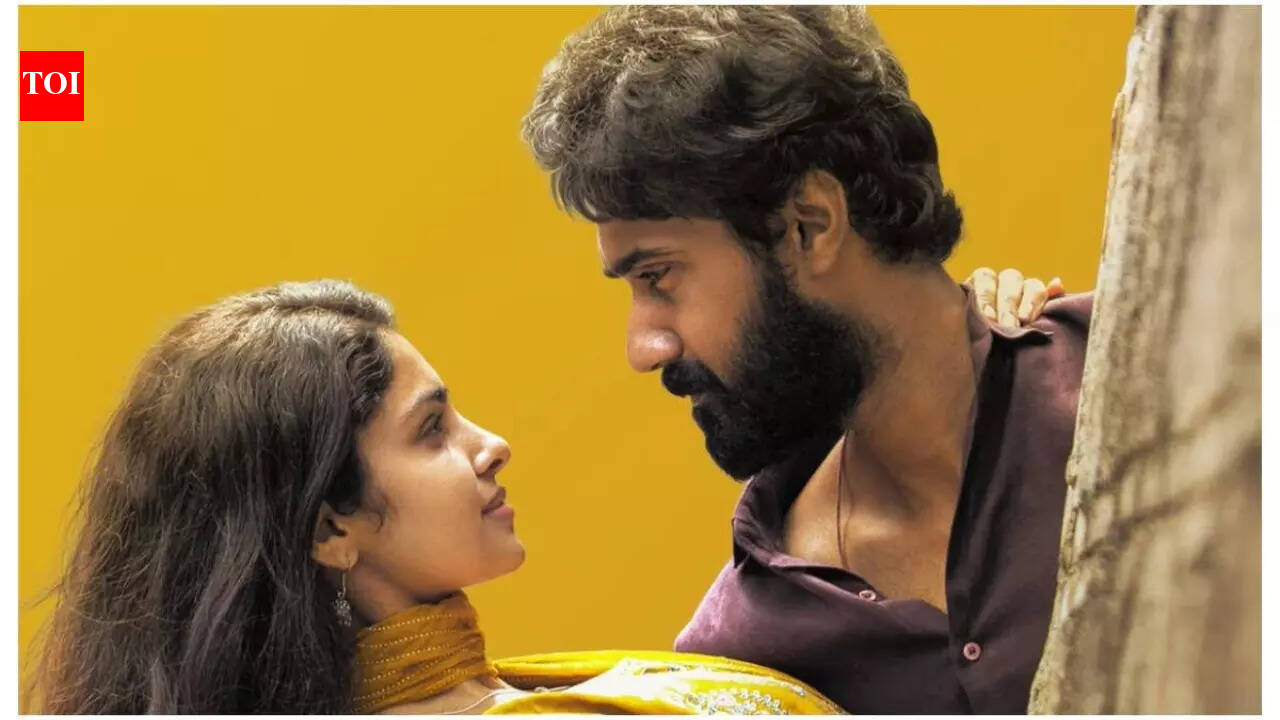
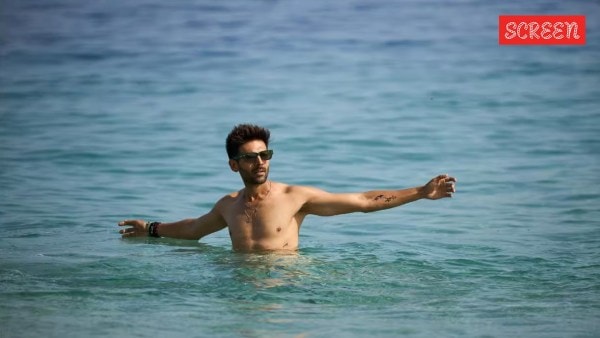 Kartik Aaryan in Tu Meri Main Tera.
TMMTMTTM has a plethora of flaws – with an excessively talkative protagonist who is a little too self obsessed to look beyond his own life, Kartik’s Ray comes across as a non affable, and a rather annoying version of Geet. The director believes him to be a reincarnation of DDLJ’s Raj, but completely discounts the fact that Raj had an inherent charm that made the audience fall in love with him, despite his flaws, and he could also earn their forgiveness (of course, a lot of that was thanks to Shah Rukh Khan’s charming screen persona). Raj’s much-visible transformation was triggered by him falling in love, but here, Ray continues to be pretty much the same guy, no matter what the crisis might be. Ananya’s Rumi, thus, gets the short end of the stick in this situation.
In worshipping the man, the woman is lost
Sameer doesn’t give her a chance to blossom (but he does give her some ghastly dialogues where she talks about her father’s eventual death in an unkind fashion). She is a writer whose first book fails, yet we are told that she has a “fat cheque” coming for the next one. (What era is this where young book writers are getting fat cheques?) We aren’t meant to ask questions here, and just accept whatever the film is throwing at us. A woman as tall as her asks for help getting something off a top shelf, and you wonder, why they wouldn’t change a meet-cute as lazy as this even while they were filming it. Did no one look beyond the page to see if it was even translating well on screen?
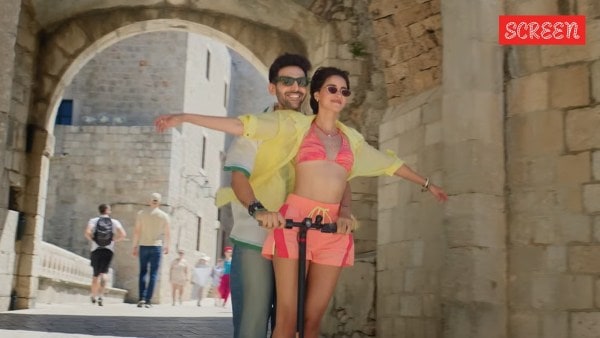 Kartik Aaryan and Ananya Panday in Tu Meri Main Tera.
The focus on the hero of the story is such that he is a main character even at someone else’s wedding, and Rumi, on the other hand, can’t even be consistently shown as a dedicated daughter (which is meant to be the big conflict of the film). Even the title chosen here is just about Ray, as he declares ‘Tu Meri Main Tera’. Ray’s narcissism doesn’t allow him to think beyond himself even when he is supposedly in love. Because anyone with two brain cells would come to the conclusion that if she can’t move countries to be with him, maybe he can? Or did they think the audience would be impressed by their token feminism after ignoring her character for over two hours?
But Sameer, and Kartik too, aren’t first time offenders. Satyaprem Ki Katha, which dealt with an issue as serious as sexual assault, had Sattu (Kartik), declaring himself as Katha’s (Kiara) saviour. The film showed him as an unemployed man who finds out about his wife’s trauma after they get married, and makes it his mission to get ‘justice’ for her, with no regard for how she would want to handle the situation. In the film’s climax, Sattu announces Katha’s trauma in a large family gathering and Sameer proceeds to present him as the hero who has saved the heroine, completely ignoring if Katha even wanted to share something as personal as this with the entire world. This film too, was all about the man falling in love with the woman, whilst it consciously ignored Katha’s wishes.
Story continues below this ad
In both TMMTMTTM and Satyaprem Ki Katha, love stories are a one-man show, and in both these stories, Kartik happens to be playing that man. A few weeks ago, Kunal Kohli (Hum Tum, director), shared with SCREEN that one of the fundamental reasons that love stories aren’t clicking with the audience now is because “the heroes want to be the be-all and end-all of the film.” He said, “Mughal-e-Azam can’t only be about Salim, there has to be an Anarkali. Kajol’s role in DDLJ is as important, if not a little more, than Shah Rukh’s. In Kuch Kuch Hota Hai, the narrative is from Kajol’s point of view.” And after two love stories featuring one of the most popular actors of the current generation, one can easily testify that love stories aren’t an obsolete genre, but they are just not being made well. The younger generation doesn’t diss everlasting love (as was obvious after Saiyaara), and they aren’t just about ‘benching’ and ‘situationships’; what they probably need is two individuals who have as much say in a relationship, even if it’s in a movie.




 English (US) ·