.png)
 1 hour ago
12
1 hour ago
12
The hantavirus outbreak, while unlikely to spark the next big pandemic, is shining a spotlight on the ways public health has deteriorated in the US: its ability to test for rare diseases, its expertise on outbreak prevention and response, its ability to battle misinformation and restore trust.
“Assuming everything goes well in containing this outbreak, which I hope it does, the takeaway from that should not be ‘we’re fine,’” said Stephanie Psaki, former White House global health security coordinator. “We’re not ready for this type of threat.”
Many of the people at health agencies who plan for a quick response to outbreaks, and the systems supporting them, are gone now, Psaki noted. Yet “this is just one of many, many pathogens. These types of things will continue happening.” And, she pointed out, there’s a 50/50 chance of another pandemic at least as bad as Covid in the next 25 years, according to scientific models.
Examining the mistakes – and the progress – made during the Covid pandemic can help us prepare for the next big one, Psaki and other former top US officials said at a recent event in Washington DC.
Misinformation is one of the greatest challenges facing public health. Conspiracy theories and rumors aren’t new; even the Milan plague around 1630 had its share.
But “the only difference between hundreds of years ago is social media”, said Anthony Fauci, former chief medical adviser to the president and former director of the National Institute of Allergy and Infectious Diseases. “We’re just being overwhelmed” with misinformation online, he said, calling it “a real problem which I don’t see any easy solution to”.
People don’t often relate to rigorous studies with methods sections, statistical analyses, and 17 supplementary figures in the New England Journal of Medicine, but they frequently relate to social media influencers pushing fake cures, Fauci said.
“It’s stunning. It’s painful, but it’s true that somebody on social media who’s a trusted influencer will outflank any scientist who’s trying to show you data, so you can’t fight misinformation with data,” Fauci said. “You have to fight misinformation with figuring out a better way to communicate to people on a level that they understand.”
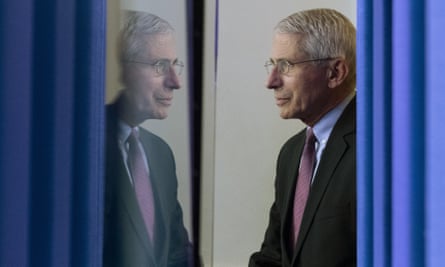
That means releasing accurate information quickly – and it should involve pre-bunking myths before they have a chance to spread, Fauci said. “Otherwise you’re always playing catch-up. And when you’re playing catch-up, you’re losing.”
Officials also need to get better at communicating uncertainty, said Nina Schwalbe, a senior scholar at Georgetown University’s Center for Global Health Policy and Politics and former director of Covid-19 Vaccine Access and Delivery Initiative at the US Agency for International Development (USAID).
“We say things too simply, and then people lose their trust.” But people can handle uncertainty “because the world is an uncertain place”, she said.
The very advances to come out of the pandemic – such as mRNA vaccines, widely viewed as one of the greatest technological advances of this generation – are now at risk, with slashed funding and growing misinformation.
The science conducted during the pandemic was “extraordinary”, but it frequently “gets lost in the somewhat muddled public health response”, said Fauci. Vaccine development began six days after publication of the Sars-CoV-2 genome, and a vaccine that was about 95% effective was going into arms 11 months later.
“That didn’t happen by accident – that happened because of the years of investment in basic and clinical research,” Fauci said. That work itself built on the response to a different epidemic, HIV. The Covid vaccine is “one of the best vaccines that was ever developed”, Fauci said, particularly because of its ability to be changed overnight as the virus evolves – and it can be produced quickly in enormous quantities.
“It saved us,” he said. “Could you imagine how many more people would have died?”
‘We have to invest in public health’
Yet now that work is being pulled back.
The US also failed to slow the pandemic in its flawed efforts to vaccinate the world, Fauci said, adding: “We got in our own way. We didn’t make equity our driving force.”
When the US later offered vaccines to other countries, a lack of planning – including basic supplies like having enough syringes – stymied the effort. “Tens of millions of doses of vaccine is meaningless if there’s no way of distributing them in the country that needs it,” Fauci said.
This delay in global access to Covid vaccines did “deep” and “long-lasting” damage to the alliances between the United States and other countries, Psaki said. “It’s being reinforced by the positions of this administration, but the damage was deep, and it’s very, very difficult to rebuild trust after that kind of betrayal.” The mpox outbreak response in 2024 was better, in part because there were already vaccines on hand – but “we were still not able to get those vaccines in arms”, Psaki said.
It’s also important to develop and distribute tests quickly, Fauci said. “The South Koreans were putting out 20,000 tests per day, and we were playing around with five tests that didn’t work.” But the “catastrophe” extended beyond bad tests to a “refusal to believe that there are other ways of doing it”, he said.
Pandemic preparedness is not just a domestic issue, Fauci said; it must involve working closely with international partners, and “that’s something that, unfortunately, we seem to be steering away from right now, which is very troublesome to me”.
Donald Trump has moved to leave the World Health Organization (WHO), which Psaki calls “an absolutely essential institution.” The US contribution to WHO is $130m – roughly equivalent to the Pentagon’s recent spending on lobster and steak, she noted.
In the absence of federal guidance, states are taking the lead by forming health alliances and working with WHO directly.
“From where I sit, the federal government is not going to play the role that is needed in the next pandemic, and so we are watching states step up,” said Matthew Kavanaugh, director of the Georgetown global health policy center.
The basics of outbreak response and pandemic preparation haven’t changed, Psaki said: “Stop a threat from emerging, identify the threat quickly, contain the threat, have a way to respond to the threat and keep people alive and keep hospitals from getting overwhelmed.”
Experts worry that the public, divided by politics and overwhelmed by misinformation, won’t have an appetite for public health measures. But it’s important to have “a little more space for hope and trust”, Psaki said. “Most families want to keep their family members safe” – which is different from the motivations of political leaders and others who may benefit from misinformation, she noted.
Schwalbe’s father was one of the first victims of Covid in New York. He got sick in March 2020 as the entire system was falling apart, Schwalbe said. “It was just me and my dad in his apartment on Lexington Avenue as he died.”
They didn’t have any oxygen or palliative care, but they did have refrigerator trucks for bodies and sirens wailing constantly in the street. She knew six people who died of Covid. The experience made her more determined to strengthen public health before the next crisis hits.
“We can’t just leave public health as the unseen thing that people complain about when it’s not working,” Schwalbe said. “We have to invest in it.”





 English (US) ·