.png)
 1 hour ago
17
1 hour ago
17
Stopping pollution leaking overseas
After sitting on it for a year, the government released the final report of a review into carbon leakage. The review considered the potential risks of companies moving industrial activity overseas due to Australia’s climate policies.
If this happened, emissions might be cut in Australia – but it would do nothing to help the world reach net zero emissions. That would be self-defeating, given the goal is to drive or encourage emissions cuts everywhere.
The review, headed by respected climate economist and Australian National University professor Frank Jotzo, found carbon leakage was not an imminent risk in Australia, but that was likely to change as major industries had to cut pollution or pay for contentious carbon offsets under a policy known as the safeguard mechanism.
It found the answer to this was a carbon border adjustment mechanism – or Cbam (pronunciation: see? bam!) – that would impose a charge on imports of some products so its users faced the same carbon cost as Australian-made products. A carbon tariff, in other words.
The Jotzo review recommended it initially be introduced for cement and clinker, which is used in making cement, arguing they were highly emissions-intensive products and domestic production would be easily replaced by imports. It recommended it be considered for lime, hydrogen, ammonia, glass, steel and iron.
A Cbam was already in place in the EU, with the UK planning to follow next year. Taiwan, Canada and South Korea were also considering them.
Taylor has been quick to criticise the idea, calling it a “carbon tax” and claiming it would increase cost-of-living pressures. This argument only holds if you plan to abolish policies to cut climate pollution – the Coalition’s position at the last election – and you reject the idea that industry needs to change to remain globally competitive.
Jotzo said a Cbam could be used to help build new industries by effectively introducing a “green premium” if local suppliers and importers faced the same carbon cost.
Labor’s response was muted. A spokesperson for the climate change and energy minister, Chris Bowen, said the government would “always back Australian industry to be competitive at home, and on the world stage”. Jotzo’s work would “inform discussions” during an upcoming review of the safeguard mechanism.
Why did the government sit on the review for a year?
The answer might have something to do with Donald Trump, who has threatened retaliatory tariffs in response to the EU Cbam.
Ruling that the Maugean skate is not critically endangered
The environment minister, Murray Watt, rejected calls by conservationists for the Maugean skate – an ancient ray-like species that is found only in Macquarie Harbour on Tasmania’s west coast – to be listed as critically endangered, which is one step away from extinction.
Instead, he kept its existing listing: endangered. It has had this listing since 2004.
This has been a contentious issue at the heart of debate over whether salmon farming in the harbour – the main threat to the skate’s survival – should continue.
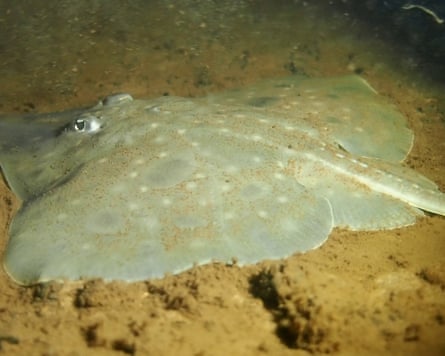
In 2024, Guardian Australia revealed the government’s threatened species scientific committee had advised the number of adult skates remaining in the wild was “extremely low”. It recommended salmon farms be either dramatically scaled back or removed, and the skate be “uplisted” to critically endangered.
The government has promised no new extinctions on its watch. It also strongly backs the salmon industry. Last year it changed national environment law to ward off a legal challenge that could have forced farming in the harbour to be paused.
It has relied in part on a report by Tasmania’s Institute of Marine and Antarctic Studies that said the latest assessment suggested the skate population was likely to have rebounded to 2014 levels. .
The government has described the report as saying “the population appears to be recovering”. The report itself said skate numbers were still low, could be badly affected by a major environmental event and stressed the need for continued monitoring.
Watt said the government was committed to ensure the skate did not “go extinct on its watch” and his decision did not change the need for “critical actions” to protect it. He said it was spending $37.5m on the issue. He noted the International Union for Conservation of Nature had also retained the species endangered listing.
But conservationists were critical, accusing the government of abandoning the precautionary principle and backing corporate interests over environmental wellbeing.
34 new threatened species listed
The Australian Conservation Foundation tallied up a long list of species newly added to the country’s threatened species register.
They included:
-
North Queensland’s lemuroid ringtail possum, which was being forced to higher elevations in the mountains of the wet tropics as the planet gets hotter due to greenhouse gas emissions.
-
The Mount Donna Buang wingless stonefly, which lives within one square kilometre on the mountain east of Melbourne, and is the only Australia stonefly that hatches in the snow.
-
The glossy grass skink, which has been hit by clearing and drainage of its habitat in Tasmania’s north-east for farming, housing and logging.
-
Four other reptiles, a fish, a mollusc and 25 plants.
Greenlight for another coal project
Watt approved an expansion of the Middlemount mine in Queensland’s Bowen Basin.
Conservationists say it could lead to about 236m tonnes of carbon dioxide being emitted in the coming decades after the coal is shipped overseas and burned to make steel or electricity. That’s a bit more than half what Australia emits each year.
The decision came with some unusual and controversial conditions promised to protect the threatened greater glider. You can read more about that here.
The government has approved 33 coal and gas developments or extensions since it was elected in 2022.







 English (US) ·