.png)
 2 hours ago
26
2 hours ago
26
If you take a closer look at the body of work of cinematographer KK Senthil Kumar, particularly his long-standing collaboration with SS Rajamouli across films such as Magadheera, Eega, the Baahubali franchise, and RRR, a recurring visual grammar begins to emerge. There is a consistent preference for soft lighting, a choice that seamlessly complements the larger-than-life storytelling of these tentpole mass entertainers.
“Everyone has a certain way of lighting and certain likes and dislikes. Personally, I like soft light because in soft light your skin starts looking good. And when you’re doing a commercial film, people come to watch the actors, so they have to look good in whatever situation it is. That’s one of the prime requirements when you’re doing popular cinema,” he tells SCREEN in an exclusive chat.
He tells that for him, soft lighting is not simply an aesthetic indulgence, it is very much functional, purposeful, and rooted in storytelling logic. Perhaps it is this quality that makes his lighting feel invisible; you rarely find yourself questioning its source. He elaborates on the philosophy that guides his approach: “I always make sure that whichever source light I put in is location-driven, not something I’ve planned at home and went with it even if it doesn’t suit the location. The location is something that always inspires me. For example, if you’re sitting here and there’s a window there, the majority of my light should come from the window. I always make sure that if I’ve placed a light as a source, there’s some logic to it.”
Extensive Pre-Planning and Mock Shoots with Rajamouli
While spontaneity has its place, working with a filmmaker like Rajamouli involves rigorous preparation. Kumar reveals the extent of their pre-production process: “With him, we do extensive pre-planning. It’s not only about shot division, we go to the extent of even doing mock shoots for every sequence, whether it’s action, a song, or a scene. We do mock tests, we edit them, and then if we don’t like something, we figure out how best we can do it. Then we do mock tests again.” Yet, even after exhaustive planning, Kumar insists that flexibility remains crucial.
“Finally, when we’re very sure about what we’re doing, we come to the conclusion that this is what it’s going to be. But when you come to the actual location, the location plays a vital role. Costumes and actors bring in a lot of energy when they come in. So we can’t be stuck to what we had decided during the pre-shoots or mock shoots. When actors come in, we need to give them space because they can really come in and dramatically change the way things work out.”
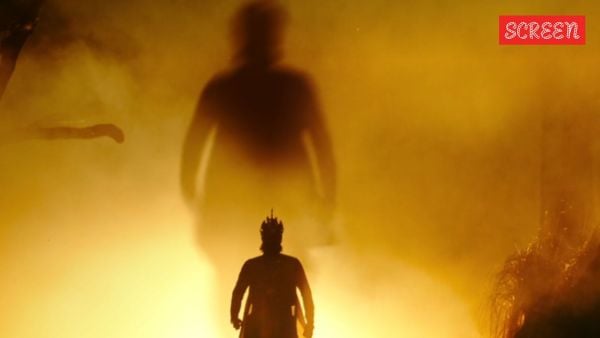 The silhouette of Rana Daggubati in the famous scene was improvised on the spot.
Improvisation while shooting the Kattappa killing Baahubali scene
One striking example of this organic improvisation can be found in Baahubali: The Conclusion, specifically in the now-iconic moment when Kattappa kills Baahubali. The haunting visual of Bhallaladeva’s (Rana Daggubati) looming silhouette has since become part of popular culture. Kumar recalls how that image was born entirely on set: “When I was doing a backlit for that scene, suddenly there was a lot of wind blowing and a lot of dust in the air. When Rana was walking in, even before he could enter the frame, I could see a huge shadow of him appearing on the screen. The smoke and dust were almost acting like a screen, and you could clearly see his silhouette. So I told Rajamouli that this was actually looking very good and that we should improvise around it. Then we started lighting it accordingly to enhance that effect.”
Another recurring visual motif in Rajamouli’s cinema is the confrontation between opposing forces, a face-off staged with mythic intensity. In Baahubali, it manifests in the clash between Prabhas and Rana Daggubati; in RRR, between Jr NTR and Ram Charan. Often, the camera captures them advancing towards each other. “I think that is one of Rajamouli’s favourite things, the idea of confrontation between two opposite forces. Even if you look at RRR, there also we did that. Here the idea was simple was that we wanted to show how strong Rana Daggubati is, and then suddenly how Prabhas comes in and overpowers him. It was about establishing those opposite yet equal forces in a powerful, visual way.”
Story continues below this ad
With Varanasi, Rajamouli has gone to the next level
In the same chat, he also reveals that he may not be working with Rajamouli on Varanasi, but that hasn’t changed their equation. “We’ve worked together for almost 20 years now. It’s like a family equation. It’s not like we’ve continuously done films together; there have been breaks in between, and I think breaks are actually a very healthy thing. But we’ve always stayed in touch. Every Sankranti, we go to the farm, stay there, celebrate the festival and all of that. So whether we do films together or not, he’s always family for us.”
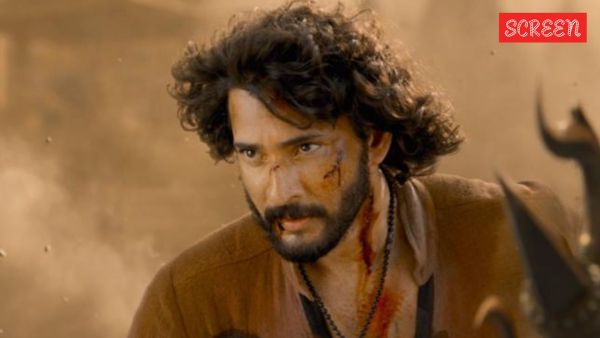 KK Senthil Kumar praised the visualisation of Varanasi.
Speaking about the Varanasi glimpse that was launched late last year, Kumar expresses admiration for Rajamouli’s ever-evolving vision. “I thought it was a great visualisation. There’s no doubt about that, his visualisation has always been strong. He always wants to clearly tell the story to the audience, what he’s trying to convey through the film. In that sense, with this, he has taken it to the next level.”
As for Kumar’s next project, Swayambhu, another period actioner, slated to release soon, he viewed it not as an attempt to surpass past achievements, but rather a termed it as a fresh creative challenge. “For me, every film is unique in its own way, Rajamouli has his own style of telling stories. But when you come to this film, Swayambhu, it’s a completely different space. Yes, it may be set in a particular time period, but you can’t group all period films into one box. Just like present-day films, there are so many of them, and each one is unique in its own way. For me, the biggest challenge is never about outdoing myself. It’s about presenting the director’s vision in the best possible way.”






 English (US) ·