.png)
.png) 21 hours ago
37
21 hours ago
37
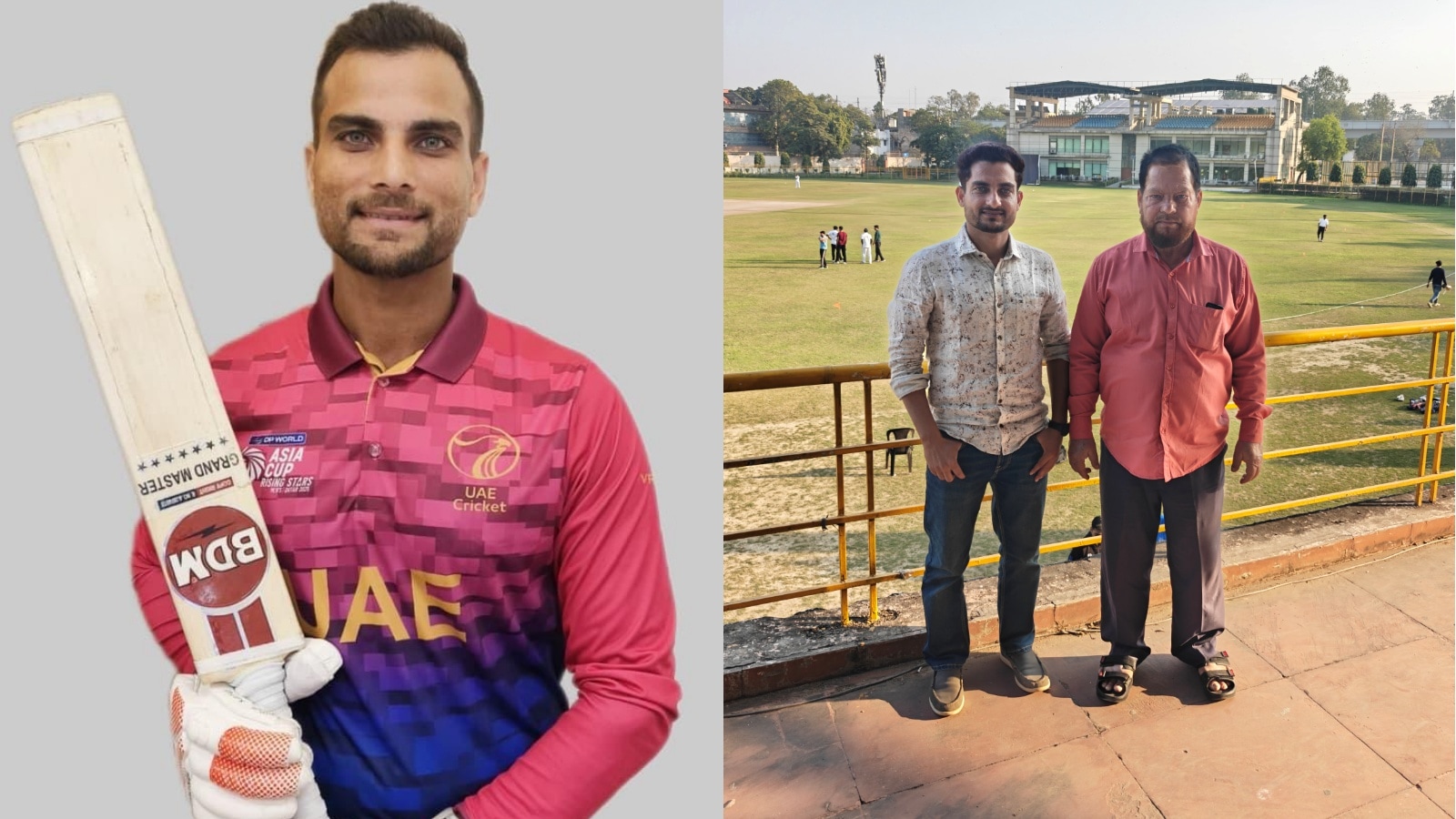
When Sohaib Khan’s blistering 29-ball 51 against Canada handed the UAE their second win ever in a T20 World Cup match in Delhi last week, a village in Bihar rose to the spotlight.
For Kothi, a village in Gaya district near the Jharkhand border that was earlier a Maoist-affected area, Sohaib’s burst to international success became its defining moment.
The 27-year-old pulled off an encore three days later. His family and friends were all in the capital when he was promoted to No. 4 in just his fifth T20I. Batting at the Arun Jaitley Stadium, 12 kilometres away from his first leather-ball experience while studying at the Jamia Millia Islamia University, Sohaib blunted an Afghanistan attack with a career-best 68. A sturdy right-hander, he reached his second successive fifty by lofting Afghanistan captain Rashid Khan for a six, bang onto the sightscreen.
But, it is not just about his personal success. In his gruelling bid to lap the stifling competition in India’s domestic cricket circuit, Sohaib hasn’t forgotten the weight of his journey and what it means for Kothi. For aspiring cricketers waiting on the fringes back home, he has opened an option, one that can fuel livelihoods and passions alike.
About a year before he left for Dubai, uncertainty looming over his playing career, Sohaib and his older brother, Altamash, established the Kothi Kings Cricket Club during the Covid pandemic in 2020. Three young cricketers mentored by the brothers in the club, built from scratch on the family land, have now moved to the UAE for jobs and playing opportunities. Currently, the club has 15 trainees.
After spending years away in boarding schools in Gaya and Delhi, the club was also about reconnecting with his roots. “The lockdown was the first time I really enjoyed being home. We opened the club not only to bring people into the sport but also to promote them to think big while still living there,” Sohaib tells The Indian Express.
This is something that Sohaib’s father, Adeeb “Jugnu” Khan, followed. A law graduate, Adeeb, forsook employment in the city due to several constraints.
Story continues below this ad
“Moving to the city would have been better for my income. When the Maoist movement affected areas of Bihar in the ’90s, Kothi remained open. But seeing the situation of the people, I did not pursue a job. The farming situation was also bad… Hum ne chodha nahin. Na Sohaib ki umang ko todha, na humare ichcha khwaishein (I did not give up. Neither did I break Sohaib’s desire, nor did I give up on my aspirations),” says Adeeb.
Their father was a stickler for education, says Altamash, who now works with the United Nations Development Programme. “We began playing the sport when we were in boarding school in Gaya. Being the eldest, I knew it would be tough for me, but I urged my father to support Sohaib,” he recalls.
The nudge from Altamash to move to Delhi united Sohaib with his true calling. Five years of university cricket between 2014 and 2019 coincided with Bihar’s return to full-fledged cricket under the Lodha reforms. Sohaib attended the Ranji Trophy camps in 2018 and 2019, but couldn’t make the final cut. Time was ticking, and the Covid wave set in panic.
“In 2021, after marriage, I had to choose between cricket and providing for my family,” Sohaib recalls.
Story continues below this ad
For four years from 2021, Sohaib worked a full-time day job in Dubai, with cricket reserved for the evenings. For the first six months, he says, he had to borrow money from his father and friends. Stability arrived after months of unemployment and odd stints in the sales sector. He soon worked his way towards the role of a financial consultant in an investment firm.
Sohaib’s decision to hold on to what he now calls routine, between a day job and competitive cricket at night, was backed by a renowned coach in the UAE circles. Hailing from Gaya himself, Naushad Alam encouraged Sohaib to try his luck in Dubai.
Persistence paid off with an ODI call-up in October 2025, followed by a T20 debut against India A in the Rising Stars Asia Cup.
“The last six months have been nothing short of a blessing. I was able to show my intent early on in the ODIs. The management has really prepared me for the international stage ever since,” he says.
Story continues below this ad
Hazel-eyed, Sohaib still receives curious questions about his ancestry. The family traces its lineage to Afghanistan, but has remained rooted in Kothi. “Be it Delhi or Dubai, people don’t believe me when I say that I am from Bihar. They say I look like an Afghan,” he says.
The big dream for the brothers now is to have a cricket ground somewhere in the panchayat area and sustain support for players who wish to chase a UAE cap.
“It wouldn’t be easy to formalise such an initiative. In the meantime, we will continue to send players to the UAE whenever an opportunity arises. Two bowlers from our club are already there,” says Altamash.
As his sons prepare for more possibilities from Kothi, Adeeb observes the evolving outlook of people in his village. “Many of them used to go to the city. To earn, to live, to study. They don’t talk much about going to the towns these days,” he says.
With Sohaib, Kothi has already gone international.






 English (US) ·