.png)
QUICK FACTS
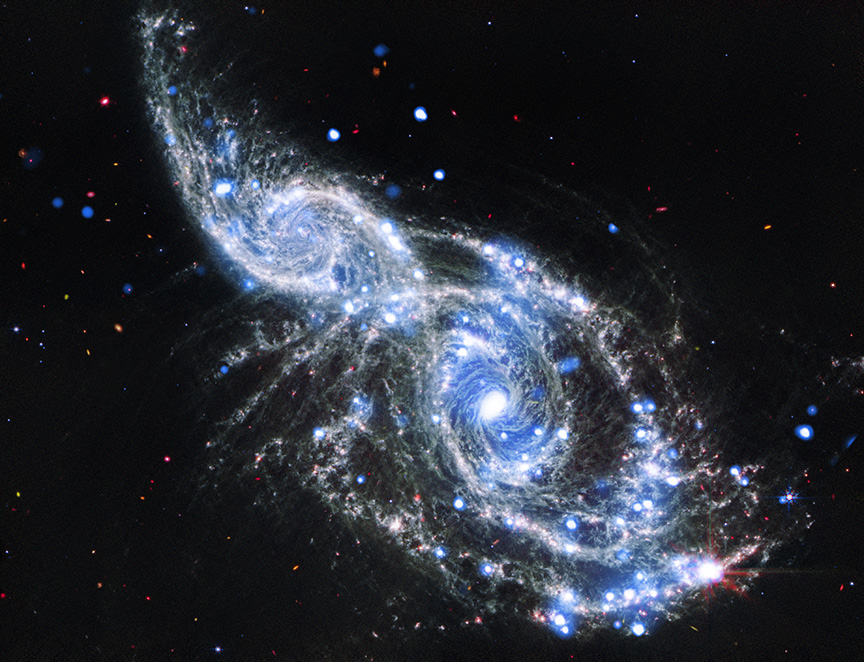
What it is: The spiral galaxies NGC 2207 and IC 2163
Where it is: 120 million light-years away, in the constellation Canis Major
When it was shared: Dec. 1, 2025
One of JWST's core tasks, according to NASA, is to provide scientists with a clear view of the centers of merging galaxies and thereby inform a new generation of models that will describe how galaxies interact and merge. NGC 2207 and IC 2163 are the perfect targets.
In the image, JWST's midinfrared data appear in white, gray and red, primarily showing the dust and cooler material within the galaxies' cores and spiral arms. Chandra's X-ray data are shown in blue, highlighting high-energy regions of the two galaxies — binary stars, the remnants of dead stars, and regions where supernovas have occurred.
The spectacular layered image of NGC 2207 and IC 2163 is one of four Chandra-based composites that were published at the same time. The other three include NGC 6334, a star-forming region known for its arcs of glowing gas and dust; supernova remnant G272.2-0.3, where hot X-ray-emitting gas fills an expanding shell; and a star system called R Aquarii, where a white dwarf star sucks material from a red giant star.
Each image merges Chandra's view of the high-energy universe with data from JWST (launched in 2021), the Hubble Space Telescope (launched in 1990) and the Spitzer Space Telescope (active between 2003 and 2020), as well as from ground-based telescopes.
For more sublime space images, check out our Space Photo of the Week archives.






 English (US) ·