.png)
 2 hours ago
23
2 hours ago
23
3 min readNew DelhiFeb 24, 2026 05:30 AM IST
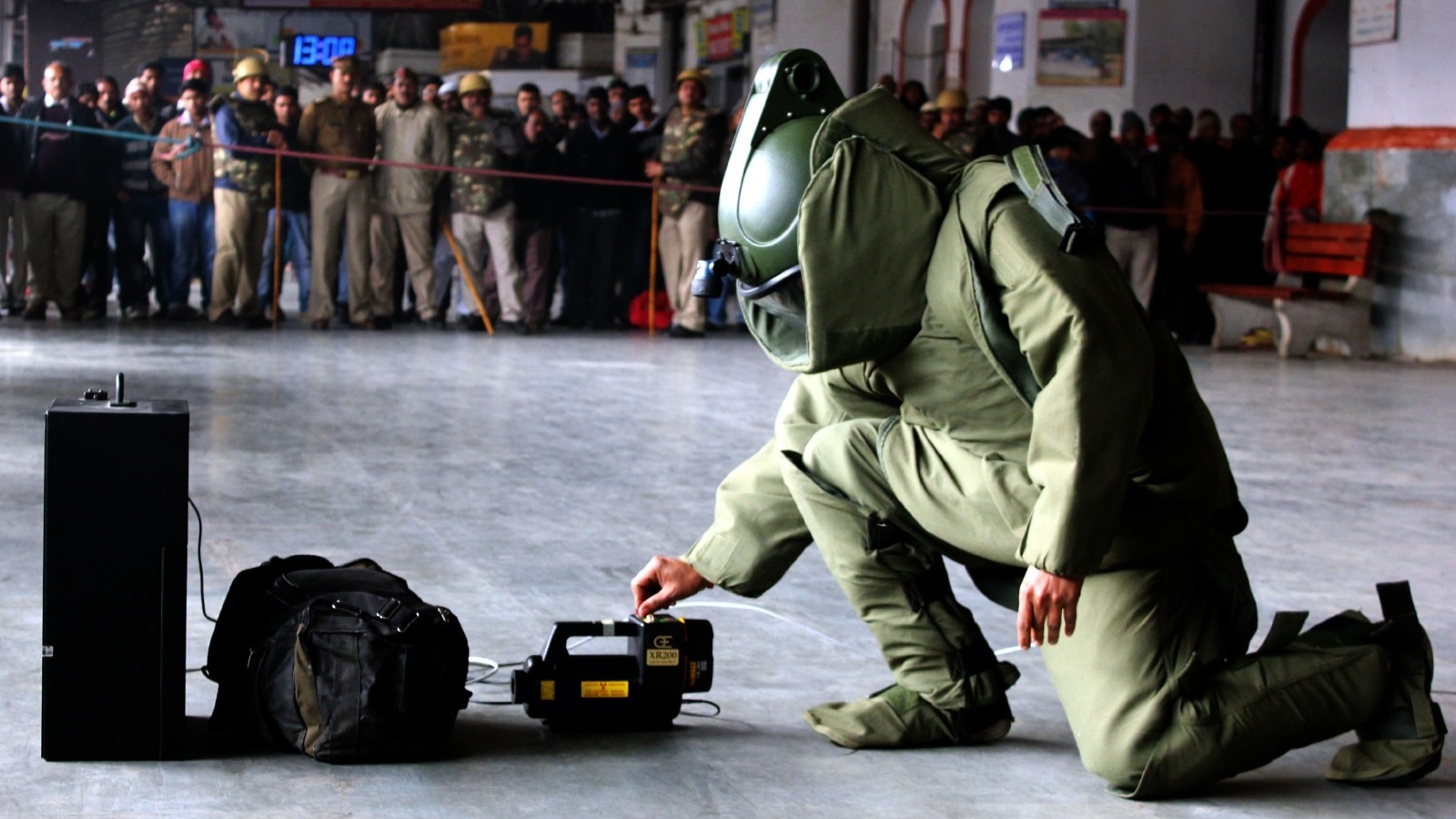 Aims to deny terrorists, their supporters access to funds, weapons.
THE CENTRE on Monday unveiled India’s first counter-terrorism policy, ‘Prahaar’, a comprehensive framework built on zero tolerance, intelligence-led prevention and coordinated response to extremist violence. The policy seeks to deny terrorists, their financiers and supporters access to funds, weapons and safe havens – both within the country and abroad.
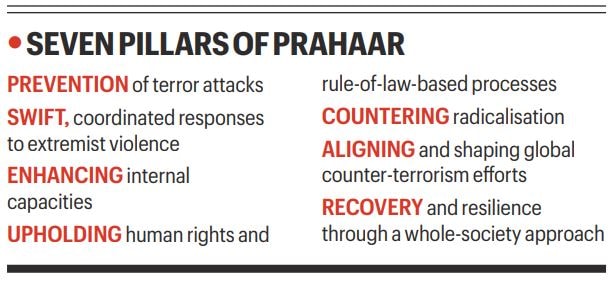
Announced by the Ministry of Home Affairs (MHA), Prahaar lays out a multi-layered strategy structured on seven key pillars — prevention, responses, aggregating internal capacities, human rights and rule-of-law based processes, countering conditions that enable terrorism including radicalisation, alignment with global efforts and shaping the international efforts to counter terrorism and recovery and resilience through a whole-of-society approach.
Without naming any country, it observed that “a few countries in the region have sometimes used terrorism as an instrument of state policy”, while reaffirming that India does not associate terrorism with any religion, ethnicity or civilisation, the document said.
Stating that India has consistently stood by the victims of terrorism and has been steadfast in its belief that there can be no justification whatsoever for violence in the world, the document said it is this principled approach that informs New Delhi’s policy of zero tolerance against terrorism.
“India has since long been affected by sponsored terrorism from across the border, with Jihadi terror outfits as well as their frontal organisations continuing to plan, coordinate, facilitate and execute terror attacks in India. India has been on the target of global terrorist groups such as Al Qaeda and the Islamic State of Iraq and Syria (ISIS), which have been trying to incite violence in the country through sleeper cells,” it said.
Operating from foreign soil, terrorists have hatched conspiracies to promote violence in India, with handlers using latest technologies, including drones, to facilitate terror-related activities and attacks in Punjab and Jammu and Kashmir, the policy said.
“Increasingly, terrorist groups are engaging organised criminal networks for logistics and recruitment to execute and facilitate terror strikes in India. For propaganda, communication, funding and guiding terror attacks, these terror groups use social media platforms as well as instant messaging applications,” it said.
Story continues below this ad
The policy lists out technological evolution, which offers terrorists a cloak of invisibility, making it difficult to track their funds. “Technological advancements like encryption, dark web, crypto wallets, etc. have allowed these groups to operate anonymously. Disrupting/intercepting terrorist efforts to access and use CBRNED (chemical, biological, radiological, nuclear, explosive, digital) material remains a challenge for counter terrorism (CT) agencies. The threat of state and non-state actors misusing drones and robotics for lethal purposes remains another area of concern, even as criminal hackers and nation states continue to target India through cyberattacks,” the document read.
The document highlighted the misuse of the internet for communication, recruitment, glorification of jihad and other terror-related activities, which are countered through proactive disruption of such cyber activities, online networks of terrorist groups and their propaganda and recruitment by intelligence and counter-terror agencies.
“The government engages a team of doctors, psychologists, lawyers and other members of civil society, including NGOs, religious and community leaders, to sensitise and reintegrate the affected community,” the policy said.







 English (US) ·