.png)
 2 hours ago
24
2 hours ago
24
NEW DELHI: Government on Monday unveiled the country's first-ever anti-terror policy elevating its "pro-active and intelligence-guided" approach to the level of a doctrine, which focuses, apart from the persisting threat of "hostile neighbours" deploying terror, on the new challenges of terrorists using modern communication devices and criminal networks.'Prahaar', an acronym for India's comprehensive counter-terrorism policy and strategy, aims at criminalising all terrorist acts and starving terrorists, their financiers and supporters of funding, weapons, safe havens and cyber resources.The policy rests on seven key pillars, represented by each letter of the acronym. It focuses on 'prevention' of terror attacks; 'responses' that are swift and proportionate; 'aggregating' of internal capacities for a whole-of-govt approach; 'human rights' and rule of law-based processes for mitigation of threats; 'attenuating' the conditions enabling terrorism, including radicalisation; 'aligning' international efforts to counter-terrorism; and 'recovery' through a whole-of-society approach.
.
Stating that India has been at the forefront of the fight against terrorism, the policy refers to 'neighbours' which use terrorism as an instrument of the state, highlighting threats from jihadi outfits as well as global terrorist groups such as ISIS and Al-Qaeda.
Prahaar aims at graded police response to radicalisation
Describing the way forward, the policy hints at the scope for further collaboration among various agencies on intelligence collection and investigation.
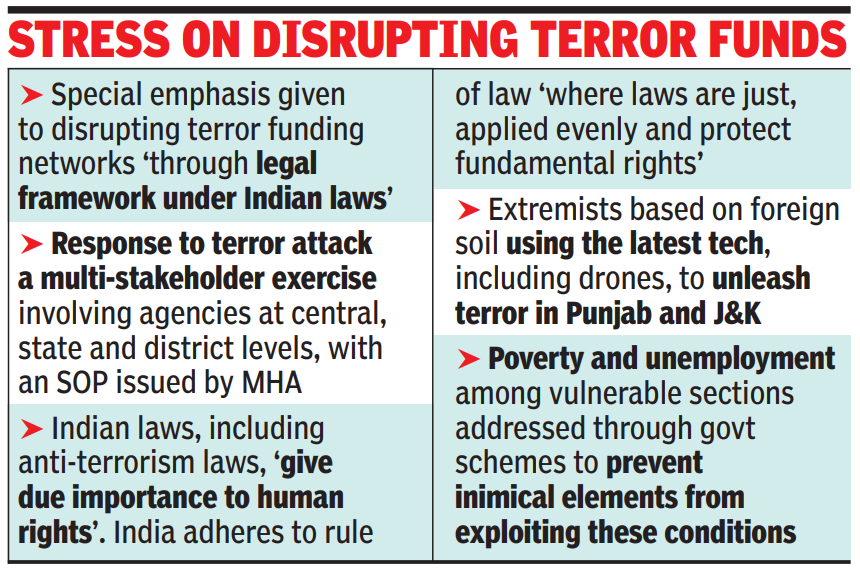
While seeking amendments in the counter-terror legal framework "from time to time", it underlines the continual need for building capacity of state-level counter-terror mechanisms and unity in their structure, resources, training and investigation methods.Stating that violent extremists based on foreign soil are using the latest technologies, including drones, to unleash terror in Punjab and J&K, the policy flags the use of organised criminal networks for logistics and recruitment, for executing terror strikes in India. Prahaar calls for global cooperation to tackle terror
As regards “aggregating” capacities, LEAs and security agencies must be modernised with the latest tools, technology and weaponry. Prahaar also seeks to safeguard human rights with legal processes that allow multiple levels of redressal and appeal to terror accused.The policy aims at graded police response to radicalisation with legal action dependent on the level of radicalisation. At the same time, socio-economic conditions of vulnerable youths and groups must be addressed with education and constructive engagement, in addition to de-radicalisation programmes.The need to align and shape international efforts against terrorism with treaties and processes like extradition, deportation as per UN norms are also outlined.







 English (US) ·