.png)
 10 hours ago
45
10 hours ago
45
Last Updated:March 25, 2026, 15:12 IST
Israel Iran war, Ukraine Russia strikes and Port Arthur blast disrupt global oil, drive Brent Crude above 100 and threaten Indian energy security and economy.


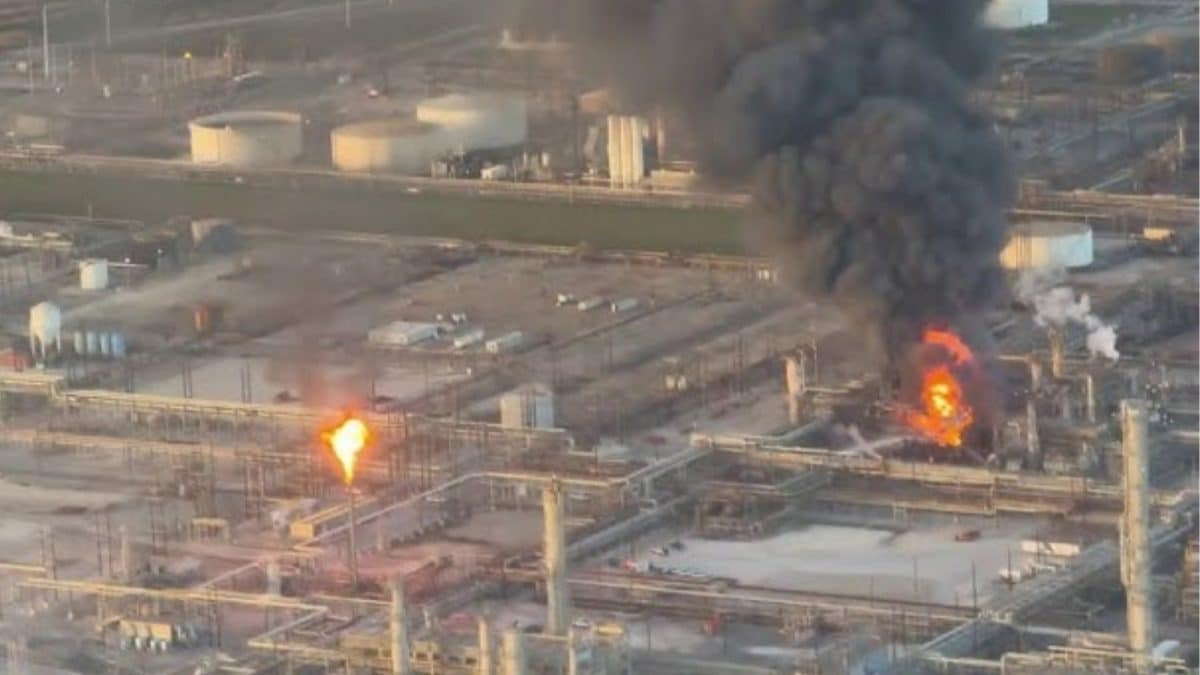
Aerial Video Snapshot - Pilot captures fire at Port Arthur Valero plant in Texas. (Image Courtesy: YouTube/Fox26 Houston)
Within a span of six days, between March 18 and 24, 2026, energy infrastructure came under attack or caught fire on three continents. Israel struck Iran’s South Pars gas field, the world’s largest. Ukraine hit two Russian oil refineries and a key export terminal on the Baltic Sea. And an industrial explosion tore through one of America’s biggest refineries in Port Arthur, Texas. Brent Crude, which was trading at $70 to $73 a barrel before the Iran-Israel war began on February 28, has since crossed $100. The International Energy Agency has called this the largest supply disruption in the history of the global oil market. For India, which imports 88 per cent of its crude oil and was buying energy from all three of these regions, it is no longer a foreign story.
The Gulf: Where It All Started
On March 18, Israel struck the Asaluyeh processing hub of Iran’s South Pars gas field in Bushehr Province. South Pars holds the world’s largest known natural gas reserve and, on the Iranian side alone, produces 730 million cubic meters per day, supplying roughly 70 per cent of Iran’s domestic energy. The strike took approximately 100 million cubic meters per day of processing capacity offline, about 14 per cent of total output.
Iran retaliated across the Gulf within 24 hours. Iranian missiles hit Qatar’s Ras Laffan Industrial City on March 19, the world’s largest LNG export facility, causing what QatarEnergy confirmed as “extensive damage" to two LNG trains. QatarEnergy CEO Saad al-Kaabi said the damage would cost approximately $20 billion annually to address and would take three to five years to repair, cutting Qatar’s LNG export capacity by 17 per cent. Saudi Arabia’s SAMREF refinery in Yanbu was struck the same day. Kuwait’s Mina al-Ahmadi and Mina Abdullah refineries caught fire after drone attacks. Iran also hit the UAE’s Habshan gas facility.
Brent Crude briefly touched $119 per barrel after those Gulf strikes before settling between $108 and $116. It dipped 11 per cent when Donald Trump claimed contact with Iranian intermediaries, then climbed back to roughly $102 by March 24. Iran has also effectively shut the Strait of Hormuz, through which about 20 per cent of global oil and LNG supply normally passes. The IEA estimates a shortfall of 8 million barrels per day in March from these disruptions combined.
Ukraine Turns Up The Heat On The Russians
Separately, Ukraine has been running a sustained campaign against Russian energy infrastructure to disrupt military fuel supplies, and it accelerated sharply this week.
On March 21, Ukrainian forces struck Rosneft’s Saratov refinery, damaging a secondary processing unit and a storage tank. Bloomberg reported the facility produces fuel for Russia’s military. Two days later, strikes hit the Baltic Sea oil export terminal at Primorsk and a refinery in Ufa, igniting storage tanks and disrupting exports. Al Jazeera reported that some barrages in the campaign involved nearly 300 drones and hit targets as far as 1,400 kilometres from the Ukrainian border.
This matters directly to India. India had become Russia’s largest crude oil buyer after European demand collapsed following the 2022 invasion of Ukraine. Russian crude accounted for around 34 per cent of India’s total crude imports, with roughly 70 per cent of Baltic Sea cargo loadings heading to Indian refiners in the months before this escalation. Simultaneously, Bloomberg reports that India has purchased 60 million barrels of Russian oil for April, after the unanimous lifting of sanctions against purchasing Russian oil.
With Gulf supplies disrupted and Russian export terminals also under attack, India’s two largest alternative sources are under pressure simultaneously.
The Texas Story
On March 23, explosions tore through the Valero-operated refinery in Port Arthur, Texas, one of the largest in the United States. Authorities described it as an industrial accident involving a diesel hydrotreater unit. No injuries were reported. Reuters confirmed the entire facility was taken offline.
The Port Arthur refinery processes roughly 435,000 barrels per day and converts heavy crude into petrol, diesel and jet fuel. It is one of the very few US refineries equipped to process Venezuelan crude. The shutdown came at a particularly bad moment. The US had been exporting approximately 357,000 barrels per day of crude to India in February 2026, up from around 221,000 barrels per day in the same period last year. India had indicated its total US energy purchases could rise to $25 billion, from $15 billion last year. Port Arthur’s shutdown tightens an already tight American supply picture.
What This Means for India
Prime Minister Narendra Modi told the Rajya Sabha on March 24 that the economic impact of the Middle East conflict would be felt for a prolonged period, specifically citing disruptions in India’s supply of crude oil, natural gas and petrochemicals.
India imports 88 per cent of its crude oil. Qatar supplies 41.4 per cent of India’s LNG, nearly all of it from the now-damaged Ras Laffan complex. Petronet LNG holds a 7.5 million tonne per annum long-term contract with QatarEnergy, which is under force majeure. India imports 60 per cent of its LPG consumption, and roughly 90 per cent of those imports transit the Strait of Hormuz.
The disruption has already hit factories. Around 100 ceramic manufacturing units in Morbi, Gujarat, shut after propane supplies were cut. Adani Total Gas nearly tripled gas prices for large industrial customers. GAIL has signalled possible supply curtailments to downstream users.
India’s remittances add a second layer of exposure. The country received $137 billion in remittances in 2024-25, the largest of any country in the world, with a substantial share coming from Gulf states whose economies are now under direct stress.
It’s not as bleak as it sounds, and India is not entirely without options. Crude sourcing outside the Gulf now stands at roughly 70 per cent of total imports. A 30-day US Treasury waiver allows Indian refiners to continue buying Russian oil and gas. LNG spot purchases from US terminals and Australian producers are being negotiated, though both involve significantly longer shipping routes and higher costs. Domestic LPG output has been ramped up by 36 to 38 per cent. India’s current fuel inventories cover roughly six to eight weeks of domestic demand.
That cushion is real. But six to eight weeks is not a long runway. The three fires burning simultaneously across the Gulf, Eastern Europe, and the Gulf of Mexico are not going out quickly. The nation must secure its energy futures before time overtakes us.
Handpicked stories, in your inbox
A newsletter with the best of our journalism
First Published:
March 25, 2026, 15:12 IST
News india Iran, Russia, Texas: Three Energy Crises Hit The World In One Week, With India Caught In The Middle
Disclaimer: Comments reflect users’ views, not News18’s. Please keep discussions respectful and constructive. Abusive, defamatory, or illegal comments will be removed. News18 may disable any comment at its discretion. By posting, you agree to our Terms of Use and Privacy Policy.
Read More







 English (US) ·