.png)
 2 hours ago
17
2 hours ago
17
On the banks of the River Clyde, half an hour to the south-east of Glasgow, Bothwell is one of the city’s prettiest and most prosperous commuter towns, famous for its medieval castle and annual scarecrow festival. Bothwell’s Victorian villas and secluded enclaves of luxury modern mansions sell into the millions to the TV personalities, professional footballers and entrepreneurs who favour its environs.
Bothwell Main Street, a designated conservation area, showcases glorious floral displays in summertime and year round an array of independent boutiques, jewellers and beauticians buck the trend for high street degeneration.
But walking along Main Street, the eye is also drawn to a succession of gap sites and burned-out buildings, jarring as rotten teeth in an otherwise perfect smile. These are the latest evidence of what police believe are targeted arson attacks that have plagued this closely knit community for at least a decade. What is going on in Bothwell?
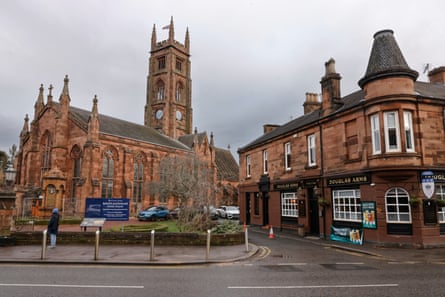
Data secured from Police Scotland by the Daily Record at the end of 2025 revealed there had been 27 incidents of fire raising in the town since 2021, affecting restaurants, vehicles and occasionally private residences, leading Bothwell to be nicknamed the firebomb capital of the UK.
More troubling still is that only one suspect has been tracked down, for one of the fires, and there have been no prosecutions, while at least two businesses have been driven out of the area by what some neighbours speculate could be targeted gangland attacks.
The first fires of 2026 happened in early January when two cars were torched in a residential area of the town. The scorch marks are still visible on the tarmac.
Last autumn, two premises on Main Street were set on fire only a month apart. When the Guardian visited, workers were replacing the charred door and window frames of the unit that previously housed Nel & Co, a popular dog-friendly bistro.
And as the road dips to meet the turning for the motorway, The Cut steakhouse, a large rosy sandstone building set back from the thoroughfare, sits empty behind fire service cordon tape, its elegant portico boarded up.
Between these two premises is another prime site, overgrown with drooping buddleia. Da Luciano restaurant stood here until its demolition in 2023 after two devastating firebomb attacks.
As Range Rovers and Jaguars purr along Main Street, the unwillingness among residents to talk openly about the fires speaks for itself. Some are willing – on condition of anonymity – to speculate about why this friendly, affluent community of about 6,000 people should be a target of such specific criminality, but there’s no masking the unease and, for some, genuine dread about the potential for reprisals.
“It’s dangerous and only luck that nobody has been hurt or killed yet,” says one person.
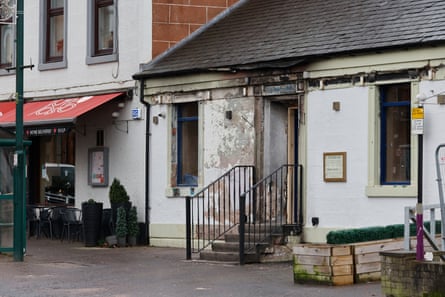
Another longtime resident points out that all three eating places were owned or run by Hugh O’Donnell or a member of his family. O’Donnell was jailed for six months in 2006 for running a brothel in Kelvingrove, Glasgow, having pleaded guilty to living off immoral earnings.
Speaking to the Daily Record immediately after the most recent fires, O’Donnell, 67, stressed he was a pensioner and “very interested in the quiet life”. “I can categorically tell you that I don’t know who is behind this and I cannot think of any grudge that would have led to such damage being inflicted,” he said.
O’Donnell, who did not respond to interview requests from the Guardian, added: “It is fair to say that I may have had certain associations 20 years ago but my life is very different now.” The Record has since reported that he and his family were leaving the area.
But O’Donnell is not the only victim. Vincent Marini’s popular Main Street restaurant, San Vincenzo, was a finalist in three categories at the 2019 Scottish Italian awards before a late-night blaze gutted the premises, the third attack in as many months.
Metal railings now sag around the rubbish-strewn site, next to Nel & Co, and Marini claimed at the time he had been targeted because he defied “a major Scottish crime family”. In a cryptic social media post, he wrote: “Sadly they won … To say we are devastated is an understatement … We failed. The beast was greater than us.”
Marini, who has similarly not responded to interview requests, moved out of the area and set up another restaurant in Glasgow. He sold the Bothwell site, which locals described as an “eyesore”, and South Lanarkshire council is now understood to be considering an application by its new owners to have it demolished.
The Guardian has approached as many other fire victims as possible – many of them extremely successful businessmen whose expensive cars were torched – but none were willing to speak about their ordeals.
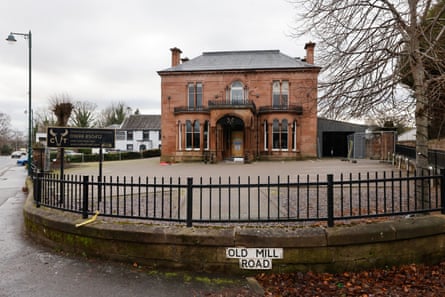
On Main Street, there is some sympathy for O’Donnell. “He’s not allowed to get on with his life,” says one resident who was born in the town. But most ire is focused on the council and what residents perceive as a failure to deal with the environmental consequences of these crimes.
“I’d like to hear less about the fires and more about how the council can help local businesses move through this,” says one boutique owner. “With all this negativity we have to work much harder to attract people from outside Bothwell. Visitors think we’re in the middle of a gang war when it’s really quite safe.”
There is a weary resignation at the prospect of the culprits being apprehended: “The problem for the police is that the person who has set the fire is unlikely to be the main offender.”
The final community council meeting of 2025 had a far higher turnout than usual. “There were at least 70 people there and the mood was heated,” says the Conservative councillor Kenny McCreary, a Bothwell resident of 21 years. “People are mad and they want something done.”
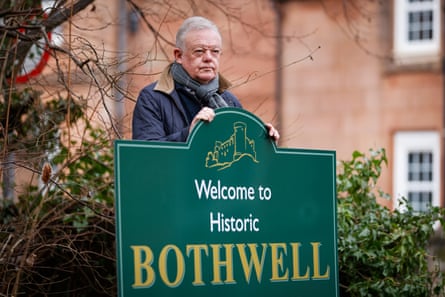
In early November last year, Marjory Robertson wrote to councillors, including McCreary, calling for “urgent action” from South Lanarkshire council to address the “battered” Main Street.
Robertson is the chair of Brighter Bothwell, a volunteer-led group set up 25 years ago to deal with litter and dog-fouling and now a hub for environmental action, renovating neglected parts of the town to create a nature trail along the former railway line, a fruit and veg garden and a play area inspired by the area’s coalmining heritage, with several Beautiful Scotland gold awards under its belt.
“The local feeling is frustration, not fear,” says Robertson. “Some people do come here for the postcode but there are many more who become part of the community and get involved as volunteers. It’s a small town but with a village feel.”
Dennis Walker, another active member of Brighter Bothwell, says: “Bothwell is the kind of place where you’re always bumping into people you know and stopping for a blether. There is a general feeling that the council is not stepping up and that this is a conservation area in name only. How can we bring Beautiful Scotland judges to look at our floral displays on the main street, only to turn around and see those eyesores?”
Walker, who has lived in Bothwell since 1979, explains how Bothwell’s historic affluence is set against its working-class industrial past: “The mansions were built for Glasgow merchants escaping the smoky city but there was always another side to Bothwell with the mines.”
Sandra Longmuir, who runs the community larder at Bellshill and Bothwell parish church, comes from a mining family and has concerns about Bothwell’s gentrification. “I’m born and bred and the town is not what it used to be,” she says. “We’ve lost all the village shops and now we have these restaurants that are getting burned down. All those memories and look at it now, it’s all rubble.”
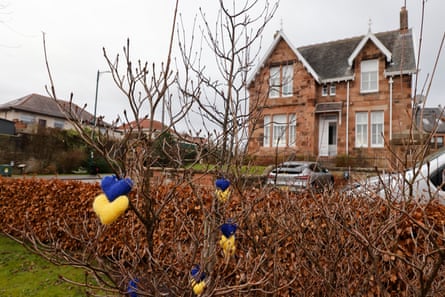
Police Scotland declined repeated requests for comment about the stark figures on unsolved arson attacks in the town, directing the Guardian to a public appeal for information about the most recent fires from the local area commander.
Ch Insp Sarah McArthur said: “We understand these incidents in Bothwell may be worrying for the local community, but I want to offer reassurance that we believe these fires were targeted and there is no wider risk to the public. The investigation into the circumstances surrounding these wilful fires is ongoing. Detectives are carrying out extensive inquiries to identify and trace those involved.”
Police Scotland also said there was nothing to link the January car fires to the autumn attacks.
The use of fire-raising as a criminal tactic to intimidate has grown in the past 10 years, says Graeme Pearson, a former director general of the Scottish Crime and Drug Enforcement Agency.
He describes the anonymous nature of the crime, and the scenario where someone addicted to drugs or alcohol may be offered a sum of money to pour accelerant outside a house or business and “is likely to consider it worth the risk given they are two or three stages away from the person who ordered the attack and the chances of being caught are fairly low”.
Pearson, who also served as Scottish Labour’s justice spokesperson before stepping down as an MSP in 2016, says the evacuation of criminals from big cities such as Glasgow and Edinburgh to surrounding suburbs, towns and villages is likewise a relatively new phenomenon and prompted by the significant wealth generated by drugs and organised crime.
“If you’ve been brought up in a tough environment surrounded by violent people and you accumulate some wealth, you start to feel vulnerable and want to move away,” he says.
Back on Main Street, there are green shoots of optimism visible along with the spring bulbs. “People have been feeling a bit down but I’m hopeful things will improve this year,” says one shopkeeper. “Bothwell is still the safest place in Scotland.”
McCreary says the council is taking a more active interest in Main Street – “I’m hopeful that by the summer things will look very different” – and holds a modest ambition. “We are exploring the possibility of having CCTV installed at either end of the Main Street. It’s a deterrent,” he says. “I just want the community to go back to normal like everybody else does.”


 English (US) ·