.png)
.png) 6 hours ago
13
6 hours ago
13
Rodri and America. It was always meant to be; a unique relationship forged by chance and moulded by destiny. Sixteen years before he kissed the World Cup trophy, confetti showering on him and fireworks wiggling into East Rutherford skies, he was in Connecticut, almost 100 miles from the scene of his conquest, as part of an exchange programme.
His father wanted him to pursue academics in the United States, but he was firm on his ultimate desire to be a footballer. But his father had other plans, and imagining that the American life would alter his son’s ambitions, he packed him off to a student programme in Connecticut. Rodri. Suddenly, the quiet teenager from the Madrid suburb of Villanueva de la Cañada found himself in the middle of a forest in Conn-et-ee-cut, as they call it. “It was like I was stepping into a Hollywood movie,” he wrote in Player’s Tribune. “You know the movies where the kids go to the camp on a big lake and there’s wooden canoes and you’re climbing trees and sleeping in tents and starting fires with sticks?” Everything felt strange for the true blue Madrid boy.
ALSO READ | Spain didn’t just win the World Cup. They made an argument for greatness
One day, he called his friends to play football. They thought it was American football. “No, no that’s not what I meant, soccer,” he told them. “Oh, saw-ker. No buddy, no way,” they said. He had a football with him and played all alone. Days, nights, in the peak of summer, in the dead of winter. He didn’t mind football’s improvised version, but he remained, at heart, a dissident loyal to the footie. “Genuine fun! I kind of liked it,” he wrote.
He didn’t miss home, swiftly learned English, with a typical Connecticut accent that endeared him to his friends. It would be the same quick grasping skills that made him indispensable in the teams of two antithetical managers, Diego Simeone and Pep Guardiola, the angel and the archangel. But he began to miss home when the World Cup began. “I couldn’t even check the internet, so I was in pain,” he said.
But the main office had a clunky computer. Every day, he asked the counselors for the score. One of them told him that Spain lost to Switzerland in the first round. His heart sank. “I thought they were pulling a prank.” By the knockouts, the counsellors would tell him without asking whether Spain won or not. He was on a canoeing trip when Spain beat Germany in the semifinal. “I never felt so far from home, but also close to home, if you understand what I mean,” he would say. He pleaded with the counsellor to let him watch the final on the computer. He did, but the internet was wobbly and he had to find an illegal stream. “When Iniesta scored, I literally started screaming and I ran outside and sprinted around the lake. The guys thought I was crazy.”
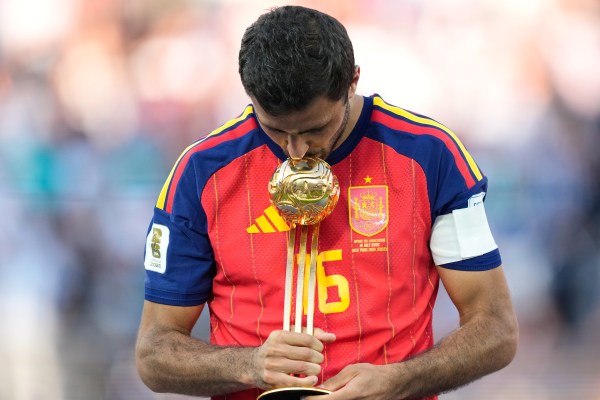 Rodri poses with the Golden Ball award at the end of the World Cup final. (AP Photo/Ashley Landis)
Sixteen years later, his friends would have realised the essence of his scream. He was holding the most precious trophy in the world aloft. A dream beyond for a Madrid boy.
***
Story continues below this ad
The route from Connecticut to New Jersey took years in the making. A year later, he returned home, and to his father’s anguish his son was still in love with the game. He let him be. “It was almost like a drug,” he once said. He journeyed from Atletico Madrid’s academy to Villarreal’s, before returning to Atletico as a senior player. The first big influence in his career was waiting for him, the manager Simeone. The Argentine sensed that he has marvellous technical finesse but not the nastiness his teams embodied.
“When I was at Villarreal, I was very good with the ball at my feet, but I was still a bit soft. With Diego Simeone, I learned what it means to be the bad guy – to be a bit of a b****** on the pitch. It was about making the other team a mess for 90 minutes. That was another important piece.” Simeone realised that he could be a bad guy without resorting to tactical fouls, without the opponents realising his meanness.
Rodri’s positional sense is so supreme that he is never out of his place to commit a nasty foul. A defensive fielder has the image of a tackle-happy, tough mean guy. But the finest of them are not, from the irrepressible Claude Makelele and Sergio Busquets to N’Golo Kante and Rodri. They have more time and space than all, a preternatural sense of the ball, the paths it would travel. This World Cup, he was ranked 97th in the list of offenders. That’s the paradox of Rodri, he won the golden ball without a single goal or assist, without topping any of the defensive or attacking metrics. Even in pass completion rate, he sits 44th on the table. So what made him the tournament’s most valuable player?
His second, and perhaps most influential, figure in life was Guardiola, who would say: “The way he sees the game, no one else sees, to its finest details, his vision is panoramic.”
Story continues below this ad
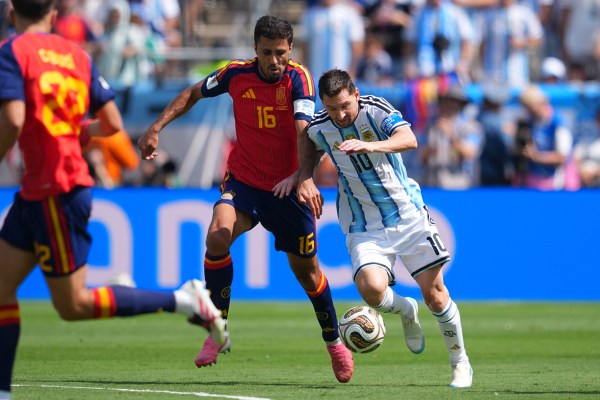 Rodri made Messi play increasingly with the right foot, lethal but not as much as his left peg. (AP Photo/Julio Cortez)
When he arrived in City, he was far from the midfield figurehead he is now. Guardiola advised: “Don’t move too much, a holding midfielder does not, move just enough and only when it is required.” Guardiola was surprised how fast he learned, and adapted. He enhanced his passing range, polished his positional awareness, and began his ascent to greatness.
ALSO READ | Sun sets on World Cup football’s greatest career as Messi tears drown out final
In a year, he became irreplaceable for City. Their fortunes have hinged directly on his availability and optimal fitness. “People always look at the players who score goals, but football is much more than that. Rodri controlled every match he played. He dictated the tempo, protected the defence, recovered possession, started attacks and gave every player around him the confidence to play their football,” Guardiola praised him.
In the final, he tied up Messi in knots, so much so that he began avoiding him like a thief would a policeman. Rodri made him play increasingly with the right foot, lethal but not as much as his left peg. Messi would have found traces of his old friend Sergio Busquets. Like the Barcelona cornerstone, he can’t be judged with stats, cannot be defined with his nomenclatural role. To label him as a defensive midfielder would be turning a blind eye to his attacking output, to call him a tempo-setter is an inaccurate compartmentalisation. He is, as Luis de la Fuente calls him, the traffic controller, whose role is not as glamorous as the secret agents or the sleuths, but controls the immediate world around him. He is the axis of the compass that lets Spain draw a perfect circle, a man whose occupancy of vital spaces sucks half the belief of his opponents. Argentina would readily vouch for the invisible man that made them anonymous.
Story continues below this ad
He perhaps exists in a state of paradox, a tempo-setter who is a holding midfielder, a disciple of both Simeone and Guardiola, a conductor who is also the lead vocals, and a true blue Madrid boy speaking “Conn-et-ee-cut” English. Also, the best midfielder in the world, a player whose numbers can’t capture him, and whose role defies definition.






 English (US) ·